
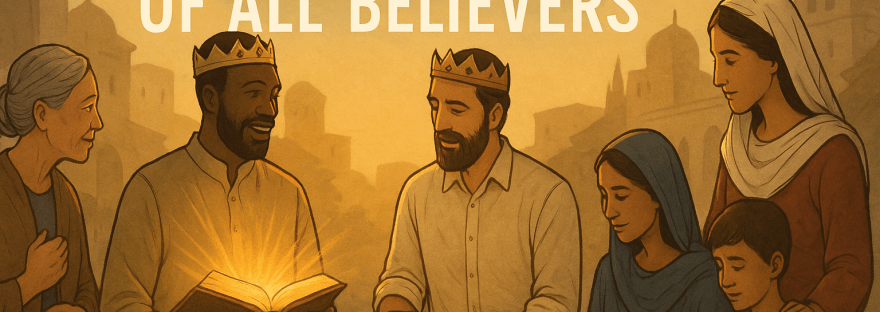
From the Series: Ordinary Saints: Lessons from the Ante-Nicene Church
Scripture quotations are from the New King James Version®.
Copyright © 1982 by Thomas Nelson. Used by permission. All rights reserved.
On any given Sunday morning, it’s easy to assume that ministry belongs to the people standing at the front of the church. Our attention naturally turns to the pastor preaching the sermon, the worship team leading in song, or the missionary sharing stories from abroad. Meanwhile, the woman quietly praying over a friend after the service, the father opening the Scriptures with his children around the dinner table, the retiree visiting someone in the hospital, or the young believer encouraging a coworker in Christ often goes unnoticed.
Yet if we were to ask the apostle Peter who was truly engaged in ministry, his answer might surprise us.
Writing to believers scattered throughout Asia Minor during a time of growing hardship, Peter reminded ordinary Christians of an extraordinary truth:
“You are a chosen generation, a royal priesthood, a holy nation, His own special people, that you may proclaim the praises of Him who called you out of darkness into His marvelous light” (1 Peter 2:9).
These believers were not religious elites. They were merchants, craftsmen, parents, laborers, widows, and servants—people living faithfully in ordinary places under difficult circumstances. Yet Peter did not define them by their occupations or their hardships. He reminded them of their new identity in Christ. Through Him, they had become part of God’s royal priesthood, a people set apart to worship Him, represent Him, and proclaim His greatness to the world.
That same truth remains just as powerful today. Before we identify ourselves by our careers, family roles, accomplishments, or even our place within a local congregation, Scripture reminds us that our deepest identity is found in Christ. Everything we do flows from who we have become through Him.
To appreciate the richness of Peter’s words, we must first understand what a priest represented under the Old Covenant. Priests did not volunteer for this ministry. God called them, cleansed them, and consecrated them for His service. They taught His Law, offered sacrifices, led worship, and interceded on behalf of the people. Their lives pointed beyond themselves to the holiness of God and humanity’s need for reconciliation with Him.
Everything changed with the coming of Jesus Christ and the establishment of the New Covenant.
As our Great High Priest, Christ fulfilled what the Old Covenant priesthood could only foreshadow. Through His once-for-all sacrifice, He opened the way for every believer to draw near to God with confidence. John celebrates this reality in Revelation, declaring that Christ “has made us kings and priests to our God” (Revelation 5:10). Believers do not replace Christ’s priesthood; rather, our ministry flows from His perfect and eternal priesthood.
Because of Him, the sacrifices we now bring are no longer animals laid upon an altar but lives willingly surrendered to God. Paul describes the Christian life as a living sacrifice, while the writer of Hebrews speaks of continual sacrifices of praise and acts of generosity. Under the New Covenant, the priestly work of God’s people is no longer performed with animals on an altar but with lives surrendered to Christ. We pray for others, proclaim the gospel, encourage fellow believers, extend mercy, and participate in Christ’s ministry of reconciliation. These are not separate callings reserved for pastors or missionaries. They are the natural expression of every believer’s new identity in Christ.
Imagine walking into a Christian gathering sometime during the middle of the second century. There is no cathedral, no stage, and no elaborate production. Families gather inside a modest home. Someone stands to read from a copy of one of the apostles’ letters or a Gospel that has been carefully passed from congregation to congregation. Psalms are sung together. Bread is broken in remembrance of Christ. An elder opens the Scriptures and encourages the congregation to remain faithful despite growing persecution.
Then the gathering ends.
The ministry, however, does not.
The widow continues caring for those in need. Merchants carry the gospel into the marketplace through honest work and gracious speech. Parents teach their children the Scriptures around the evening meal. Neighbors welcome strangers into their homes. Hospitality becomes an expression of Christ’s love, and ordinary occupations become opportunities to bear witness to His grace. Clement of Rome reflected this shared responsibility when he wrote, “Let each one serve as he has been gifted, for we are all part of one priesthood under the Lord.” While responsibilities differed, every believer understood that following Christ meant participating in His mission.
Perhaps you’ve quietly assumed that ministry isn’t really your calling because you’ve never preached a sermon, led a Bible study, or served in an official position. Maybe you’ve wondered whether your quiet acts of faithfulness matter because no one seems to notice them.
The New Testament offers wonderfully freeing news.
Christ never called most believers to stand behind a pulpit.
He called every believer to follow Him faithfully wherever He placed them.
Living as a royal priesthood is often expressed in the ordinary moments of life. It may look like patiently teaching a child to forgive, showing integrity when no one else is watching, praying faithfully for a struggling friend, welcoming a lonely neighbor into your home, or encouraging a weary believer with the promises of Scripture. The world may see simple acts of kindness, but God sees hearts faithfully reflecting His Son.
At times, we all feel inadequate for such a calling. Yet our priesthood is not something we earn through spiritual achievement. It is received through our union with Christ. As we abide in Him, the Holy Spirit continues to shape our character, strengthen our faith, and prepare us for every good work. Growth is often gradual. Like the believers who came before us, we learn faithfulness one act of obedience at a time, discovering that God’s strength is made perfect in our weakness.
This priesthood is also deeply communal. God never intended His people to serve Him in isolation. As members of one Body, we strengthen one another through prayer, encouragement, hospitality, discipleship, and bearing one another’s burdens. Whether offering a listening ear, extending practical help, opening our homes, or faithfully praying for another believer, we remind one another that no one walks alone. As each member faithfully embraces the opportunities God provides, the whole Church is strengthened, and Christ becomes more visible through His people.
The priesthood of all believers is not about elevating ourselves. It is about magnifying our Great High Priest. Every prayer whispered in faith, every meal shared in hospitality, every child taught the Scriptures, every quiet act of service offered in Christ’s name becomes an act of worship. That was the heartbeat of the early Church. It can become ours again—not by creating more programs or seeking greater recognition, but by recovering the beautiful truth that ordinary saints, walking closely with an extraordinary Savior, faithfully reflect His Kingdom wherever He leads them.
Prayer
Lord, thank You for calling me into Your royal priesthood through Christ. Help me remember that my identity is found in You before anything else. Teach me to serve faithfully in the ordinary moments of life, trusting that every act of obedience offered in love brings honor to Your name. May my life reflect the grace and truth of my Great High Priest, Jesus Christ. Amen.
Discover more from Rooted & Raised
Subscribe to get the latest posts sent to your email.

