
From the Series: Ordinary Saints: Lessons from the Ante-Nicene Church
Scripture quotations are from the New King James Version®.
Copyright © 1982 by Thomas Nelson. Used by permission. All rights reserved.
The prayer life of God’s Kingdom citizens goes beyond routine. Prayer is communion with the King, a time to speak, listen, surrender, intercede, battle, repent, and rest. It’s not a technique to master but a relationship to pursue.
For example, a day of relational prayer might begin in the morning with silent listening, inviting God to speak into any needs or anxieties for the day. Later, as needs or concerns for others arise, one might pause to intercede on behalf of a friend or coworker. During a lunch break, a believer could turn ordinary moments into prayer by expressing gratitude or asking for guidance. In quiet moments before bed, there might be an honest confession, a surrender of the day’s burdens, and a recognition of God’s presence. Relational prayer invites ongoing conversation with God in every part of life, not just at set times or in set places.
For the early Church, prayer was neither optional nor occasional but essential. Without abiding in Christ, they had no strength. Prayer became their daily atmosphere for life, worship, suffering, and service. And through prayer, God moved powerfully among them, setting the stage for remarkable change in every aspect of early Christian life.
Through prayer, God moved powerfully among them. Prisons shook. Fearful believers became courageous witnesses. Many were healed, while the discouraged grew stronger. Entire cities encountered the reality of Christ. This was not due to any special, inherent power, but because their prayers drew on Scripture, relied on the Holy Spirit, and focused on the Kingdom of God.
Jesus taught His followers:
“But you, when you pray, go into your room, and when you have shut your door, pray to your Father who is in the secret place…” (Matthew 6:6)
From this foundational truth, we see that prayer begins with intimacy. This is one of the most important truths believers must recover today. Jesus did not teach prayer merely as a religious obligation or public performance. He invited His people into fellowship with the Father. True prayer is relational. It flows from a heart that desires. Early believers prayed daily, not by force but longing for God’s presence. Their prayers were sincere and honest, seeking communion with the One who already knew them completely. the One who already knew them completely.
You may pause here and quietly think, “Sometimes my prayer life feels dry or inconsistent.” That struggle is deeply human. Prayer is not sustained by emotion alone. Like every relationship, intimacy with God grows through continual pursuit, even in seasons when feelings fluctuate. The Father does not turn away the believer who comes honestly before Him. If you find yourself in a dry season, consider setting aside just a few quiet minutes each day to sit in God’s presence or write a short, honest prayer in a journal. Even a small, intentional step can open the way for renewed intimacy with Him.
Building on this foundation, the early Church also understood that prayer was never meant to remain self-centered.
Paul wrote:
“Therefore I exhort first of all that supplications, prayers, intercessions, and giving of thanks be made for all men…” (1 Timothy 2:1).
Believers prayed for boldness, healing, the salvation of those in prison, the salvation of unbelievers, and strength for the Church. When one suffered, the whole body felt the burden. When one believer suffered, the entire body felt the burden together. This reflects the heart of Christ Himself. Prayer trains believers to look beyond their own needs and participate in God’s care for others.
You may recognize something here: “I spend much of my prayer time focused only on my own struggles.” While God certainly invites believers to bring personal needs before Him, Kingdom prayer expands the heart outward. As believers mature spiritually, intercession becomes an expression of love, compassion, and shared burden within the Body of Christ. For those seeking a way to begin, consider choosing one person, group, or situation each day to lift up in prayer. This simple practice can make intercession a natural part of your daily rhythm, helping you grow in love and concern for others.
Beyond intercession, the early Christians also viewed prayer as spiritual warfare.
Scripture reminds believers:
“For we do not wrestle against flesh and blood, but against principalities, against powers… against spiritual hosts of wickedness…” (Ephesians 6:12)
They understood that the Christian life was not merely a social or intellectual struggle. A spiritual battle was taking place beneath the surface. But importantly, they recognized that people themselves were not the enemy. The true conflict involved the spiritual. Prayer was never a last resort for them; it was always their first response. They prayed amid temptation and persecution, seeking protection, courage, discernment, and endurance, and used prayer to stand firm against the enemy. Prayer became part of how they stood firm against the enemy’s schemes.
You may feel overwhelmed by the reality of spiritual warfare. “How do I stand firm when life feels spiritually heavy?” Scripture continually points believers back to dependence upon God. The strength to endure does not come from human willpower alone, but from abiding in Christ through prayer, truth, righteousness, faith, and the Word of God. In such moments, believers can turn to specific Scriptures for encouragement and strength. For example, they might pray Ephesians 6:10-11: “Finally, be strong in the Lord and in the power of His might. Put on the whole armor of God, that you may be able to stand against the schemes of the devil.” A simple prayer could be: “Lord, help me to stand strong in Your truth and righteousness, and to trust in Your power when I feel weak. Clothe me with Your armor, and guide me by Your Spirit today.”
And there is deep assurance in this: believers do not fight for victory as though the outcome is uncertain. Christ has already overcome the world.
Prayer is not about manipulating God or forcing His hand. It is about aligning the believer’s heart with the will of God and participating in what He is already doing.
In addition to individual prayer, the early Church also prayed together. Corporate prayer unified believers, strengthened weary hearts, and reminded them they were not alone. In moments of fear and persecution, they gathered together and sought God with one mind and one heart. Their unity in prayer reflected their unity in Christ. This call to united prayer remains deeply important today.
Modern life easily fragments believers into isolation and distraction. Yet the Body of Christ was designed to pray together, carry burdens together, and seek God together. Prayer knits hearts together in humility and dependence upon the Lord.
If you do not already have a group to pray with, consider starting or joining a small prayer group. Invite a few friends, family members, or fellow believers to meet regularly for prayer, either in person or online. Praying together brings encouragement, accountability, and a stronger sense of unity. Even gathering with just one or two others can make a profound impact, helping you apply these truths and experience the power of shared prayer in your own life.
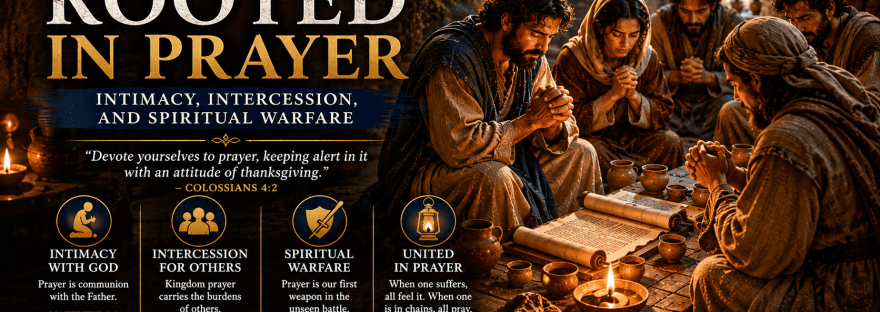
Taken together, what the early Church teaches us is both simple and profound. Prayer is intimacy with God. Prayer is intercession for others. Prayer is spiritual warfare.
The main takeaway is clear: Prayer is the vital connection for every believer who desires a close relationship with Christ, serving as a means of intimacy, intercession, and spiritual warfare.
The Kingdom of God is not advanced merely through activity, programs, or human effort. Ultimately, the Kingdom of God advances through those who stay rooted in prayer, showing that true effectiveness comes not from effort alone but from a heart aligned with God through devoted prayer.
Discover more from Rooted & Raised
Subscribe to get the latest posts sent to your email.

