
From the Series: Ordinary Saints: Lessons from the Ante-Nicene Church
Scripture quotations are from the New King James Version®.
Copyright © 1982 by Thomas Nelson. Used by permission. All rights reserved.
The central truth of Kingdom leadership is this: Jesus completely overturned the world’s definition of greatness.
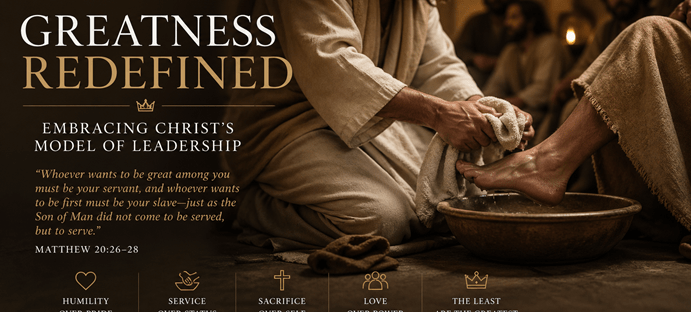
In a culture where power defined status and leadership meant authority over others, He took a towel, knelt down, and washed His disciples’ feet. Then he spoke words that still confront every human instinct toward self-exaltation:
“Whoever desires to become great among you, let him be your servant… just as the Son of Man did not come to be served, but to serve.” (Matthew 20:26–28)
This was not symbolic language meant to inspire. It formed the foundation of Kingdom leadership. Greatness, in Christ’s eyes, is measured by humility, sacrifice, and service.
The early Church understood this. They did not admire His words from a distance. They lived them. Their lives reflected a Kingdom where the highest place was found in lowering oneself for others.
They did not seek recognition or influence. Instead, they took up the work others avoided.
In those early generations, leadership was not defined by position but by character. Those who led were not known for visibility, but for willingness to serve. They shared meals with the poor. They visited prisoners and risked their lives to care for the sick, especially during plagues. They taught the truth without seeking payment or praise.
And often, they did not step into leadership quickly. Many resisted it, only accepting such roles when recognized by others for their faithfulness. There was no ambition to rise, only a desire to imitate Christ.
This raises a quiet but important question for the reader: What does leadership look like in my life? Is it something to attain, or something to embody? Consider: Where in my life am I drawn to lead by example rather than by position? When faced with a need, am I eager to serve, or do I wait for someone else to step in? In what areas do I seek recognition, and where can I choose to serve quietly instead? How would my approach to leadership change if I measured greatness by faithfulness and humility? These questions invite us to examine the shape of our influence and the heart with which we lead.
Jesus makes the answer clear:
“He who is greatest among you shall be your servant.” (Matthew 23:11)
To become great in the Kingdom is to take the position of a servant, not occasionally, but as a way of life.
For the early believers, authority was not expressed through control, but through example. Leaders were marked by endurance, humility, and sacrifice. They did not elevate themselves; they walked and often suffered alongside others.
But over time, something began to change. As recognition increased, so did the temptation to adopt the world’s patterns. Titles became more prominent. Distinctions grew. A distance formed between leaders and those they served. And slowly, the simplicity of Christ’s model began to fade.
Yet it is possible to resist this drift. We do so by choosing daily practices that keep our hearts anchored to Christ’s example: seeking accountability in community, regularly returning to Scripture’s vision of servant leadership, inviting honest feedback, and intentionally looking for opportunities to serve in hidden ways. Making time for prayer and self-examination helps us notice when pride or ambition begins to grow. We can also cultivate relationships with mentors who model humility and invite us to do the same. In these ways, we guard our hearts and leadership from moving toward worldly patterns, staying close to the original design Christ has given us.
This invites reflection: How easily do we drift from what Christ has clearly shown?
Because even now, the pull toward recognition remains strong.
Another striking reality in the early Church is who embodied this greatness. It was not always the visible or influential. It was the overlooked: women, children, servants, and unnamed faithful who lived in quiet obedience. The weak things of the world to put to shame the things which are mighty.” (Corinthians 1:27)
In the Kingdom of God, value is not assigned. In God’s Kingdom, value is not given by position, age, or visibility. It is shown through faithfulness. Quiet endurance, steadfast love, and unseen obedience carry eternal weight. For every leader who serves without applause, who labors behind the scenes, and who chooses faithfulness over acclaim, your work is seen and treasured by God. Even if your efforts go unnoticed by others, they matter deeply in the Kingdom. There is no wasted act of service, no unnoticed sacrifice, no overlooked obedience.
And there is assurance in this.
God does not measure greatness the way the world does. He does not require visibility to assign value. What he calls great is often hidden, humble, and costly. And what is done for Him, no matter how small it appears, is remembered.
This truth also reshapes how we view one another.
We are not called to honor only those who are visible or celebrated. We are to recognize quiet faithfulness in others. Those who serve without recognition, love without applause, and remain steadfast without acknowledgment are where true greatness is found.
Simple practices can help us foster a culture of encouragement. Take a moment to privately thank someone with a note or kind word, acknowledging their unseen efforts. Mention quiet acts of service in group settings or team meetings, highlighting the ways people invest in the community. Create space for testimonies that share stories of faithfulness and perseverance. Offer small gestures, like inviting someone for coffee or sharing a thoughtful gift, to affirm their value. Encourage others in your community to look for and celebrate the unnoticed contributions among you. In this way, we honor what God honors and build a culture where every act of faithful service matters.
The Body of Christ is meant to reflect this: a community where serving is normal, humility is honored, and no one seeks to rise above another. Here, Kingdom values become visible.
As I look at the present, I see how easily leadership can mirror the world. Influence, recognition, and growth often define success. Even inside the Church, numbers and visibility are common measures. But Kingdom success is measured differently. In the upside-down values of Jesus, faithfulness is greater than fame, and personal transformation outweighs outward achievement. Rather than asking how many follow us, we might ask how deeply we are following Christ. Are lives being changed, hearts made whole, forgiveness practiced, and humility nurtured? When the fruit of the Spirit is seen among us, when relationships are restored, and sacrificial love is common, we find true signs of success in ministry. “The last will be first, and the first last.” (Matthew 19:30)
The path forward in the Kingdom is not upward as the world defines it. It is downward into humility. It moves forward on our knees. It is expressed through service to a different kind of greatness.
One that does not fade.
One that is not self-made.
One that is recognized by God.
To follow Him is to embrace this path.
To become the least of all, and a servant of all.
Sources:
- The Holy Bible — Matthew 28:19–20; 2 Timothy 3:15–17; 1 Timothy 4:12–16; Colossians 1:28
- Didache, ch. 4
- Hermas, Mandate 12
- Ignatius of Antioch, Letter to the Ephesians
- Clement of Rome, 1 Clement 48
Discover more from Rooted & Raised
Subscribe to get the latest posts sent to your email.

