
From the Series: Ordinary Saints: Lessons from the Ante-Nicene Church
Scripture quotations are from the New King James Version®.
Copyright © 1982 by Thomas Nelson. Used by permission. All rights reserved.
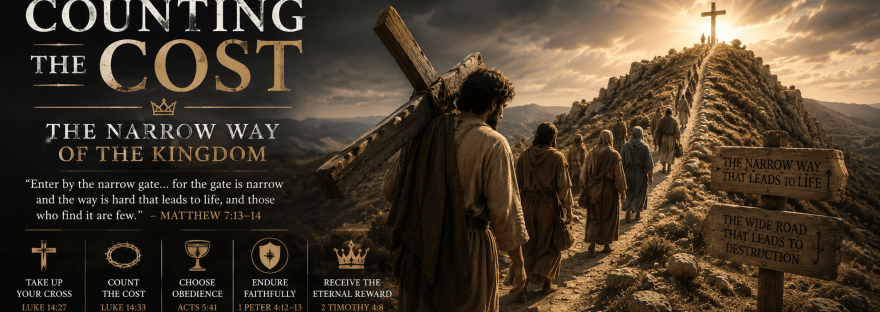
Jesus never hid the staggering cost of following Him. He did not promise comfort, popularity, or ease. Instead, He challenged every listener plainly:
“Enter by the narrow gate… Because narrow is the gate and difficult is the way which leads to life, and there are few who find it.” (Matthew 7:13–14)
The early Christians took Jesus’ words seriously. The path they walked was narrow, costly, and often marked by suffering. Yet they followed with joy, believing the One who called was worth more than anything lost. They understood that citizenship in the Kingdom of God came with sacrifice, but they also knew it came with eternal reward.
One of the clearest differences between the early Church and much of modern Christianity is that the former counted the cost before following Christ, whereas the latter often does not. They did not present discipleship as self-improvement or a temporary blessing. They understood that to follow Jesus meant dying to self. Jesus Himself warned:
“And whoever does not bear his cross and come after Me cannot be My disciple.” (Luke 14:27)
And again:
“So likewise, whoever of you does not forsake all that he has cannot be My disciple.” (Luke 14:33)
To the early believers, these warnings were no theory. Following Christ demanded everything: rejection, poverty, lost work, confiscation, prison, and even death. Still, they refused to turn back.
A reader may pause here and feel unsettled. “Would I truly follow Christ if it cost me everything?” That question is not meant to produce despair, but honesty. The narrow way forces us to confront where our treasure truly rests. It reveals whether Christ is simply part of our lives or Lord over them. Yet it is also in these moments of wrestling that Christ meets us with grace and compassion. Honest struggle is not failure; it is often the very place where faith grows. Take heart, His strength is made perfect in our weakness, and His love does not turn away from those who seek Him sincerely.
The early Christians also understood that the easy road was not the safe road. The world offered comfort and security, but the broad path led away from God. Early Christians chose obedience even when it meant embracing poverty, accepting imprisonment, and enduring rejection instead of compromise. And still, they rejoiced.
“So they departed from the presence of the council, rejoicing that they were counted worthy to suffer shame for His name.” (Acts 5:41)
This kind of joy seems strange to the natural mind. How can suffering and rejoicing exist together? The answer is found in what they believed about Christ. Their hope was not rooted in temporary ease, but in eternal life. They believed that no earthly loss could compare with what awaited them in the Kingdom of God.
You might think, “I struggle with surrender, even in smaller things.” That struggle is common. Discipleship challenges our desire for comfort and control, but Christ calls us to follow daily and trust Him step by step. One way to grow in surrender is to practice small, daily acts of trust: begin each morning with a short prayer of yielding to God’s will; offer help or encouragement to someone in need; set aside time to reflect honestly before God in confession; or choose to serve quietly where you might prefer comfort or recognition. These simple habits lay the groundwork for faithful living, helping our hearts say yes to God even in the ordinary details of life.
For the early Church, discipleship was not a single emotional moment. It was a lifelong surrender. Baptism marked the beginning of a completely new allegiance. Their faith reshaped how they lived, worked, suffered, and loved. They did not ask, “What is the least I can give and still belong to Christ?” Instead, their hearts asked, “How can I give Him everything?”
That spirit challenges modern assumptions about discipleship. Today, it is easy to reduce faith to attendance. That spirit shatters modern assumptions about discipleship. Today, faith can be reduced to attendance or surface agreement. But Jesus still commands: take up the cross, daily. The narrow road is now urgent. If I did not walk first. He carried the cross before He called us to carry ours. He understands rejection, suffering, betrayal, and loss. And He promises that those who follow Him will not lose their reward.
A reader may need to hear this clearly: the hardships of obedience are not signs that God has abandoned you. More often, they mark you as truly belonging to a kingdom the world cannot comprehend. The narrow path was personal, but it was never meant to be isolated. The Body of Christ exists to encourage weary believers, restore those who stumble, and remind one another that the road ahead leads to life. So let us walk together in this calling, praying for one another, offering support in seasons of difficulty, and carrying each other’s burdens. As a church, we are called to watch over one another in love, helping each other stay faithful as we journey along the narrow way. That is what sustained the early Church through persecution and hardship. They knew they were part of something eternal. And the same remains true today. What the early Church teaches us is both sobering and hopeful.
Look honestly at your own path: Will you count the cost and choose the narrow road of surrender, sacrifice, and perseverance that leads to life? As you reflect, consider: What are the areas of your life where following Christ may cost you something significant? Are there comforts or attachments you find difficult to release for His sake? What does wholehearted discipleship look like for you right now? Allow these questions to guide your honest conversation with God.
Whatever you surrender for Christ, do so with confidence; it is never in vain. Take the next step of trust and obedience today. Because beyond the narrow gate stands the King Himself, welcoming those who have counted the cost and finding in Him an everlasting reward.
Discover more from Rooted & Raised
Subscribe to get the latest posts sent to your email.

