
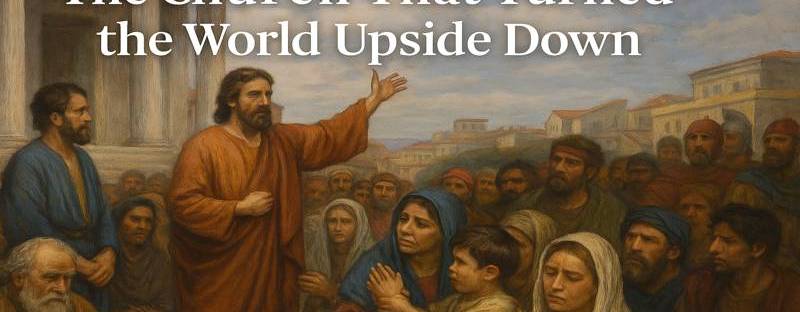
From the Series: Ordinary Saints: Lessons from the Ante-Nicene Church
Scripture quotations are from the New King James Version®.
Copyright © 1982 by Thomas Nelson. Used by permission. All rights reserved.
When the gospel began to spread across the Roman Empire, it did not come with force, influence, or institutional support. There were no platforms to amplify it, no systems to sustain it, and no recognition to legitimize it. It came through ordinary people, fishermen, slaves, mothers, merchants, and martyrs whose lives were so transformed that the world could not ignore what it was witnessing.
Scripture records the charge made against them: “These who have turned the world upside down have come here too.” (Acts 17:6). This shift, first seen in individual hearts before society at large, marked a new way forward. The Kingdom of God was not advancing through power, but through people who refused to live according to the values of the world. And nowhere was this more evident than in the early Church.
They did not wait for permission to speak. They did not rely on structures to reach others. They understood that they themselves were vessels of the gospel. Wherever they went, they carried Christ with them, not only in what they said, but in how they lived. Their generosity, their forgiveness, and their love bore witness to a reality beyond human reasoning.
Some may wonder about their own platform or influence, questioning their ability to make an impact. The early believers had neither. Their effectiveness was not rooted in visibility; it was rooted in obedience. What God did through them was not dependent on their position, but on their willingness to live faithfully where they were. Obedience today can look just as ordinary and powerful: offering a listening ear to a coworker in distress, extending forgiveness to someone at home, serving quietly in the community, or reaching out with encouragement to a neighbor. Even small acts of choosing honesty at work, showing patience in family conflicts, or meeting a need you notice become ways to reflect Christ’s love and presence. Each step of faithfulness in daily life is an opportunity to make an impact, whether or not it feels significant in the moment.
Building on their boldness, another defining mark of the early Church was their love. Their love was neither measured nor reserved. It reached the abandoned, the sick, the stranger, and even the enemy. When others fled from danger, they remained. When persecuted, they forgave. When mistreated, they prayed. Their love did not align with the world’s expectations, and that is precisely what made it powerful.
This challenge may draw some in and unsettle them, leading to reflection on their own love. Such reflection is not meant to condemn, but to reveal. The love that marked the early Church is not beyond reach; it is the result of a life transformed by Christ. It is not produced through effort alone, but through surrender to Him. Even when loving in this way feels impossible, Christ Himself provides the strength and grace to love others as He calls us to. We are not left to strive in our own might; He enables and equips us to grow in love, one step at a time.
In addition to their unmatched love, their unwavering conviction set them apart. They did not reshape the gospel message to gain acceptance. They did not soften the truth to avoid rejection. They lived lives that were set apart, even when that separation came at great cost. Some lost their livelihoods, others their possessions, and many, their lives. And yet, they endured with a confidence that did not come from this world.
“You had compassion on me in my chains, and joyfully accepted the plundering of your goods, knowing that you have a better and an enduring possession for yourselves in heaven.” (Hebrews 10:34)
This kind of endurance reveals where their hope was placed. It was not anchored in comfort or security, but in what God had promised.
This issue may prompt you to quietly wrestle with faithfulness in the face of great cost. Such a struggle reveals not weakness, but dependence. A young nurse, for example, working amidst a healthcare crisis, chooses to serve in understaffed wards rather than take a higher-paying, less demanding job elsewhere. Though she faces exhaustion and sometimes criticism for her faith, she continues to care for patients with quiet compassion, trusting that her obedience matters, even when unnoticed. The same God who sustained the early believers is the One who sustains His people now. He does not call us to stand alone, but to trust Him fully.
The early Church also understood that its mission was not simply to gather followers, but to make disciples. They invested in lives. They walked alongside one another. They taught, corrected, encouraged, and endured together. Discipleship was not confined to gatherings; it happened in homes, prison cells, moments of suffering, and daily life. It was personal, intentional, and sacrificial. They were not raising people who admired Christ; they were forming people who would live and die for Him. And through that, the world was changed.
Reflecting on the present through this lens, the contrast becomes clear. It is easy to rely on systems, programs, and visibility. It is easy to believe that influence is measured by reach or recognition. But the early Church reminds us that transformation does not begin with structure; it begins with surrender.
You may reflect on how to live as someone who belongs to another Kingdom. This question moves the message from observation to application. When believers begin to live in alignment with Christ, not partially, but fully, the impact cannot remain hidden.
To take a step this week, consider reaching out in love to someone in need, practicing forgiveness when it is difficult, or offering encouragement to someone who might need it most. Choose one practical way to put these truths into action, trusting that even small acts of faithfulness can have a greater impact than you realize.
As we grapple with these ideas, there is also assurance. We are not called to recreate their circumstances; we are called to walk in the same obedience. The same Spirit who empowered them dwells within every believer. The same truth they proclaimed remains unchanged. What God did through ordinary people then, He can still do now. And this is not something we are meant to carry alone. The Body of Christ is designed to reflect this together. As we encourage and strengthen one another and walk in unity, the witness becomes clearer. The light becomes brighter. The testimony becomes unmistakable.
Consider taking a moment together as a Church, small group, or gathering to reflect on what it means to be unified and encouraging in our own community. You might pause in prayer to ask God to deepen unity among you, or invite open discussion about practical ways to support and strengthen each other. When we intentionally seek God together and share honestly, He meets us and builds a community that bears witness to His love.
What we see in the early Church is not a distant ideal; it is a living example. They relied on presence, not power. They chose obedience over influence and remained transformed rather than conforming. And through ordinary lives surrendered to Christ, the world was turned upside down.
This remains possible today. Not by striving, but by surrender to Christ.
Discover more from Rooted & Raised
Subscribe to get the latest posts sent to your email.

