📖 “Providing honorable things, not only in the sight of the Lord, but also in the sight of men.” —2 Corinthians 8:21 (NKJV)
Being honest means doing what is right and telling the truth, even when no one is watching. It means choosing what is good in God’s eyes and also in how others see your actions.
Sometimes it can be tempting to hide the truth or do something wrong when you think no one will notice. But Jesus sees everything, and He cares about your heart. He wants you to live in a way that is honest and good.
When you choose honesty, you show that you love God and want to follow Him. You also build trust with others because they know they can believe what you say and trust what you do.
If you ever feel tempted to be dishonest, you can ask Jesus for help. He will give you the strength to choose what is right.
Prayer: Jesus, help me be honest in everything I do. Teach me to choose what is right, even when no one is watching. Thank You for helping me live in a way that honors You. Amen.
True discipleship is more than transferring information. It means teaching how Jesus lived and inviting others to follow His example in word, action, and love. The Kingdom of God is not only taught but formed through lives that reflect the King.
Jesus Himself gave this command:
“Go therefore and make disciples of all the nations… teaching them to observe all things that I have commanded you…” (Matthew 28:19–20)
Teaching others to observe means guiding them to obedience, so they see daily what following Christ looks like.
This focus on action and obedience finds its starting point in Scripture.
The early Church did not treat the Word of God as optional or secondary. They rooted both children and new believers in it from the beginning. They trusted that the Scriptures were sufficient, clear, authoritative, and breathed out by God to equip His people.
“From childhood you have known the Holy Scriptures, which are able to make you wise for salvation through faith which is in Christ Jesus.” (2 Timothy 3:15)
The Word is not simply informative; it is transformative. It shapes the mind, convicts the heart, and directs the life. Without it, discipleship becomes shallow, easily swayed by opinion rather than anchored in truth.
If you feel unequipped to teach Scripture, remember teaching starts with submission, not expertise. As the Word shapes you, you can share what you learn. Faithfulness in understanding leads to clarity over time.
If you are just beginning, try starting small. You might share a brief passage that is meaningful to you, along with a simple reflection on why it matters to you. Leading a short devotional or inviting discussion with a question such as, “What does this verse say to us today?” can help everyone grow together. Begin with what you know, trust God to use your efforts, and allow your confidence to build as you take each step.
Teaching goes beyond words alone.
Yet, teaching must be lived out, not spoken alone.
Paul writes:
“Let no one despise your youth, but be an example to the believers in word, in conduct, in love, in spirit, in faith, in purity.” (1 Timothy 4:12)
This is where discipleship becomes personal. Children, new believers, and those walking alongside us are not only listening but also watching. They are learning what forgiveness looks like when it is put into practice. They are seeing humility in action. They are observing whether our lives align with the truth we speak.
If you worry your life doesn’t fully match your teaching, let that refine, not discourage you. Discipleship is about real obedience, not perfection. Even our repentance teaches what is genuine and necessary.
But even instruction and example, on their own, are not enough. There is another essential element—spiritual discipline.
Early believers cultivated faith through practiced disciplines such as prayer, fasting, reading Scripture, worship, and obedience. These are not empty routines but ways to grow in Christ and depend on Him. As leaders, we can encourage these disciplines within our groups by fostering habits of shared prayer, inviting accountability through trusted partners, or committing together to regular times in the Word. Encouraging group members to set simple, shared goals, like praying for one another each week or partnering up for Scripture memorization, can make spiritual practices more accessible and help everyone persevere together.
These practices guard against a shallow faith that knows truth but does not live it.
If you struggle with spiritual discipline, remember the goal is not perfection but persistence. Growth comes through repeated pursuit of God.
With these foundations in place, everything converges on a single goal.
Discipleship is not about making followers of ourselves or building influence, but about forming Christlikeness in others.
This is the benchmark.
Teaching the Way of the Kingdom points others to Christ, His words, example, sacrifice, and authority, not to ourselves.
As I consider this, it becomes clear that this calling cannot be carried out in isolation. The Body of Christ is meant to function together in this work. We strengthen one another, correct one another, and walk alongside one another. Discipleship is both personal and communal, lived out in relationships that reflect the love and truth of Christ.
One practical way to foster this community is by forming small discipleship pairs or groups, where each person is supported and held accountable as they grow. Leaders might encourage participants to meet regularly with one or two others to share insights, pray together, and discuss how Scripture applies to daily life. Such intentional relationships help build trust and create a space for honest growth.
Consider: are we sharing information, or forming lives?
Because there is a difference
Here are some reflection questions to help you examine your approach:
– In what ways are my teaching and leadership practices leading to real transformation, not just increasing knowledge?
– How am I modeling the disciplines and Christlike behaviors I want to see in others?
– Where do I see growth in myself and those I disciple, and where do we need to press deeper into obedience and community?
You can use these questions personally or discuss them with your team to encourage intentional evaluation and growth.
The lesson is clear but challenging: instruction gives foundation, example gives credibility, discipline sustains, and the goal is Christlike transformation.
To teach the Way of the Kingdom is to live it ourselves and call others to genuine transformation in Christ.
Sources:
The Holy Bible — Matthew 28:19–20; 2 Timothy 3:15–17; 1 Timothy 4:12–16; Colossians 1:28
📖 “Trust in the Lord with all your heart, and lean not on your own understanding.” —Proverbs 3:5 (NKJV)
Trust is something every family learns over time, and God calls each member to place that trust in Him. There will be moments when life does not make sense—when plans change, challenges arise, or answers are not clear. In those times, God’s Word reminds you to trust Him completely.
Trusting God as a family means believing that He knows what is best, even when you do not understand everything. It means choosing to rely on His wisdom instead of trying to figure everything out on your own. This kind of trust brings peace and confidence into the home.
Families can grow in trust by turning to God together. Praying about concerns, reading Scripture, and talking about His promises help everyone remember that He is faithful. These habits build a strong foundation of trust that carries through every situation.
Parents can lead by showing trust in God during uncertain times. When children see that trust lived out, they learn that God can be depended on no matter what happens.
There may be moments when trusting God feels difficult. In those times, encouraging one another and remembering His past faithfulness can strengthen the whole family.
Knowing Christ as a family means choosing to trust Him daily. As you rely on Him together, your home becomes a place of peace, unity, and confidence in His care.
Prayer: Jesus, help our family trust You with all our hearts. When we do not understand, remind us that You know what is best. Teach us to rely on Your wisdom and walk in faith together each day. Amen.
📖 “Trust in the Lord with all your heart, and lean not on your own understanding.” —Proverbs 3:5 (NKJV)
This command calls for a complete reliance on God that goes beyond what you can reason or explain. Trusting “with all your heart” means placing full confidence in God’s character and Word, rather than dividing that trust between Him and your own perspective.
As a teenager, you are developing understanding, forming opinions, and learning to interpret the world around you. While growth in understanding is important, Scripture warns against leaning on it as your foundation. Human understanding is limited—it sees only part of the picture. God sees fully and completely.
There will be moments when what God says does not immediately align with what seems logical or expected. In those moments, trust becomes a decision. You are choosing to rely on God’s wisdom over your own, even when the outcome is not yet visible.
Through the Holy Spirit, Christ strengthens your ability to trust in this way. He brings clarity through Scripture and steadiness through His presence. Trust grows as you act on what God has said, even when you do not fully understand it.
Trust also reshapes how you respond to uncertainty. Instead of trying to control every outcome or find immediate answers, you learn to rest in God’s guidance. This does not remove questions, but it places them within the context of His faithfulness.
Knowing Christ transforms trust from a concept into a daily practice. It is seen in decisions, responses, and the posture of your heart.
Trusting God fully means placing confidence in who He is, not in what you can see.
Prayer: Jesus, help me trust You with all my heart. When I am tempted to rely on my own understanding, remind me that Your wisdom is greater than mine. Teach me to follow You with confidence, even when I do not see the full picture. Amen.
📖 “Trust in the Lord with all your heart, and lean not on your own understanding.” —Proverbs 3:5 (NKJV)
Sometimes things happen that you do not understand. You might wonder why something is difficult or why things are not going the way you expected. In those moments, God teaches you to trust Him.
Trusting Jesus means believing that He knows what is best, even when you do not understand everything. It means choosing to believe that He is good, that He loves you, and that He is taking care of you.
You do not have to figure everything out on your own. When you pray and talk to Jesus, you can give Him your worries and trust Him to guide you.
Each time you choose to trust Him, your faith grows stronger. You learn that He is always faithful and never fails.
Prayer: Jesus, help me trust You with all my heart. When I do not understand, remind me that You know what is best. Teach me to rely on You and follow You every day. Amen.
📖 “Trust in the Lord with all your heart, and lean not on your own understanding.” —Proverbs 3:5 (NKJV)
This command calls you to a wholehearted trust that reaches beyond what you can see or reason through. To trust the Lord with all your heart is to place full confidence in His character—His wisdom, His faithfulness, and His care—rather than dividing that trust between Him and your own understanding.
As a woman navigating the complexities of life, there are moments when understanding feels essential. You may want clarity, direction, and assurance before taking the next step. Yet Scripture gently redirects that desire. While understanding may be limited, God’s wisdom is complete. He sees what you cannot and knows what you do not.
Leaning on your own understanding can lead to anxiety, overthinking, or the need to control outcomes. Trusting God, however, invites you into a different posture—resting in His sovereignty while walking forward in obedience. It does not mean you will have every answer, but it means you are anchored in the One who does.
Through the Holy Spirit, Christ strengthens your ability to trust. As you spend time in His Word, your confidence in His character grows. You begin to recognize His faithfulness in past moments, which gives assurance for what lies ahead.
Trust is often lived out in quiet decisions—choosing to follow His Word when it conflicts with your instincts, releasing concerns you cannot resolve, and moving forward in faith when the path is not fully clear. These moments shape a life that depends on Him.
Knowing Christ transforms trust from something you try to maintain into something that grows naturally as you walk with Him. It becomes the steady foundation beneath every circumstance.
Trusting Him fully means resting in His wisdom, even when your understanding is incomplete.
Prayer: Jesus, help me trust You with all my heart. When I am tempted to rely on my own understanding, remind me that Your wisdom is perfect. Teach me to rest in Your care and follow Your direction with confidence each day. Amen.r-
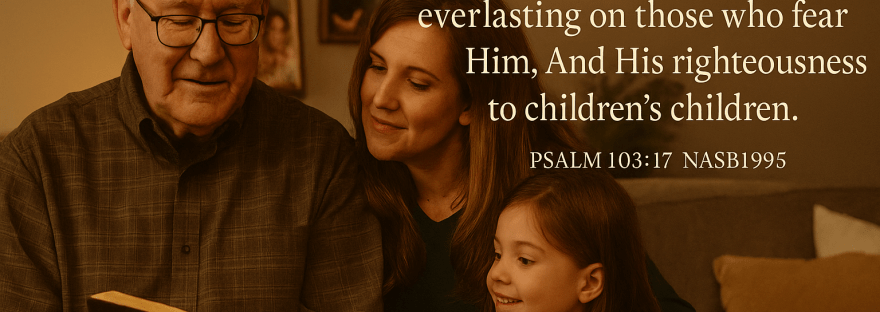
In a world that values speed and results, God’s Kingdom works differently. What is celebrated here is often not honored there. In His Kingdom, fruitfulness means enduring faithfulness and passing His truth to the next generation.
Scripture reminds me:
“For the Lord is good; His mercy is everlasting, and His truth endures to all generations.” (Psalms 100:5)
That truth alone changes everything. God does not work on a short timeline. He builds across generations. He calls His people to join this not by seeking quick results, but through steady obedience.
Generational faithfulness is slow and often unseen. Like a farmer tending a field, work begins long before anything appears. Seeds are planted quietly through things like bedtime prayers with children, sharing stories of God’s faithfulness, caring for aging parents, or helping a younger friend walk through a hard season. It might mean setting aside time each day to read Scripture together at home, offering forgiveness, sharing a personal testimony with the next generation, or simply modeling humility during everyday frustrations. These small acts, conversations, prayers, corrections, encouragement, and examples are all ways seeds are planted. They are watered over time, often without any sign of growth.
Yet God gives this promise:
“Let us not grow weary while doing good, for in due season we shall reap if we do not lose heart.” (Galatians 6:9)
This requires trust. It means working without a visible harvest, believing obedience now may bear fruit beyond us. This faithfulness is not about results, but God’s character.
A reader may feel tension: “What if I don’t see fruit? What if my effort seems wasted?” That question matters. But Scripture does not ask us to measure by sight. It calls us to remain faithful. The harvest is God’s. Our job is to sow.
There’s a temptation to measure legacy by the number of people reached, influence, or outcomes. But God’s Kingdom values depth over breadth.
The apostle Paul writes:
“But you must continue in the things which you have learned and been assured of, knowing from whom you have learned them.” (2 Timothy 3:14)
There’s deep meaning in that command. Emphasis is not on how many were taught, but on what was faithfully passed on. One life shaped in truth, grounded in love, and anchored in Christ is great in God’s eyes. That is eternal work.
This may bring relief to some. “Then my small sphere matters.” It does. Faithfulness is not limited by influence. It is defined by obedience. Whether teaching many or discipling one, the calling remains the same to pass on the truth without compromise.
Let us encourage and support each other in this journey. Pray for those beside you, speak words of encouragement, and offer help when the path feels hard. Our faithfulness is strengthened as we walk together, lifting one another up and reminding each other that God is at work in every act of obedience.
And none of us begins this work alone.
Every believer stands on those who came before: parents, teachers, pastors, friends who prayed, spoke truth, and endured often without recognition. Their obedience is our foundation.
Scripture says:
“Therefore we also, since we are surrounded by so great a cloud of witnesses, let us lay aside every weight… and let us run with endurance the race that is set before us.” (Hebrews 12:1)
This shifts my perspective. I am not starting something new; I am continuing what has been carried through generations. As I received, so I must give.
This realization brings weight and encouragement. The weight: my actions matter beyond my life. The encouragement: I am part of something greater than myself.
And the fruit of this kind of faithfulness does not disappear.
The fruit of faithfulness may not be recognized or remembered. But God sees. God remembers.
“The righteous will be in everlasting remembrance.” (Psalms 112:6)
Faithfulness leaves a mark. It shapes families, strengthens the Church, and influences lives in ways we cannot always see. It carries a quiet impact that outlasts those who live it.
A reader may wonder, “Will what I do last?” Scripture says yes, faithful work endures in God. What is rooted in Him remains.
I remember hearing the story of a grandmother who prayed daily for her family, often feeling unseen and wondering if her quiet devotion made any difference. Many years later, her grandson shared how those prayers shaped his own faith, even leading him to encourage others in difficult times. Though she never saw all the results, her faithfulness bore fruit in ways she could not have imagined. Stories like this remind us that the seeds we plant in faith often grow far beyond what we see. Even when our efforts seem small or unnoticed, God is at work, bringing lasting impact through our obedience.
There is a communal aspect to this calling. We are not to carry the baton alone. The Body of Christ labors together, encourages one another, and strengthens each other. Through this, the next generation sees living faithfulness.
As a congregation, we can intentionally cultivate generational faithfulness through shared initiatives. This might look like forming mentorship groups where older members walk alongside younger ones, or establishing prayer partners across age groups. Organizing intergenerational gatherings and events creates opportunities to share stories of faith and wisdom. Small group studies that blend different generations can deepen these connections, helping everyone see God’s work across every stage of life. By taking part in these practices together, we create a church culture where faith is planted, watered, and grown in community.
Bringing these themes together, what do we learn?
In God’s Kingdom, legacy is built on faithfulness, not achievement. It values depth over visibility. We receive truth and carry it forward with care.
And in all of it, God is the One who brings the increase.
Our calling is unwavering: remain faithful no matter what.
📖 “You shall love your neighbor as yourself.” —Mark 12:31b (NKJV)
Jesus teaches you to love others. Loving someone means caring about them, being kind, and treating them the way you would want to be treated.
Sometimes it is easy to love people who are kind to you. But Jesus teaches you to love everyone—even when it is hard. This means being kind, sharing, helping, and speaking gently.
Jesus showed perfect love in everything He did. He cared for people, helped them, and treated them with kindness. When you follow Him, He helps you love others the same way.
When you choose to love others, you are showing what Jesus is like. Your actions can help others see His love through you.
Prayer: Jesus, help me love others the way You love me. Teach me to be kind, patient, and caring. Help me show Your love in everything I do. Amen.
📖 “You shall love your neighbor as yourself.” —Mark 12:31b (NKJV)
When Jesus gives this command, He summarizes how believers are to relate to others. Loving your neighbor is not defined by emotion alone, but by action—treating others with the same care and consideration you naturally extend to yourself. This command reflects the character of God and reveals the heart of the law.
As a teenager, relationships are central to daily life—friends, classmates, family, and even those you may struggle to get along with. Loving others in these contexts is not always easy. Differences, misunderstandings, and personal conflicts can create barriers that make love feel difficult or undeserved.
Yet Jesus’ command does not depend on how others behave. It calls you to act according to truth rather than reaction. Loving your neighbor means choosing kindness, patience, and respect even when those qualities are not returned. It means seeking the good of others rather than acting out of self-interest.
This kind of love is not natural—it is formed through Christ. Through the Holy Spirit, He shapes your heart to reflect His love. As you grow in your understanding of how He has loved you, your ability to extend that love to others increases.
Loving your neighbor also requires intentionality. It is seen in everyday choices—how you speak, how you respond in conflict, and how you treat those who may be overlooked or difficult. These moments become opportunities to reflect Christ’s character.
Knowing Christ transforms how you approach relationships. You are no longer guided solely by how others treat you, but by how He has treated you.
Love that reflects Christ is not based on feeling—it is based on truth.
Prayer: Jesus, help me love others the way You have loved me. Teach me to show kindness and patience, even when it is difficult. Shape my heart so that my actions reflect Your love in every relationship. Amen.
📖 “You shall love your neighbor as yourself.” —Mark 12:31b (NKJV)
Jesus teaches that loving others is one of the most important ways to live. In a family, this love is shown every day through how each person treats the others. It is seen in kindness, patience, forgiveness, and care.
Loving your neighbor begins at home. It means speaking kindly, helping one another, and choosing to be patient even when it is difficult. These small actions build a strong and peaceful home.
Sometimes love is easy, especially when everyone is getting along. But there are also times when love takes effort—when someone is upset, when mistakes happen, or when feelings are hurt. In those moments, choosing love reflects the heart of Christ.
Families can grow in love by remembering how much Jesus has loved them. His love is patient, kind, and full of grace. When each person looks to Him, they learn how to love others in the same way.
Parents can guide children by showing love in their actions and words. Children learn what love looks like by watching how it is lived out at home.
Knowing Christ as a family means choosing to love one another daily. As love grows, the home becomes a place of peace, unity, and encouragement.
Prayer: Jesus, help our family love one another the way You love us. Teach us to be kind, patient, and forgiving. Let our home reflect Your love in everything we do each day. Amen.