
From the Series: Countdown to Convergence
Scripture quotations are from the New King James Version®.
Copyright © 1982 by Thomas Nelson. Used by permission. All rights reserved.
Read: The Handshake Web Part I: The Emerging Architecture of Resilient Convergence
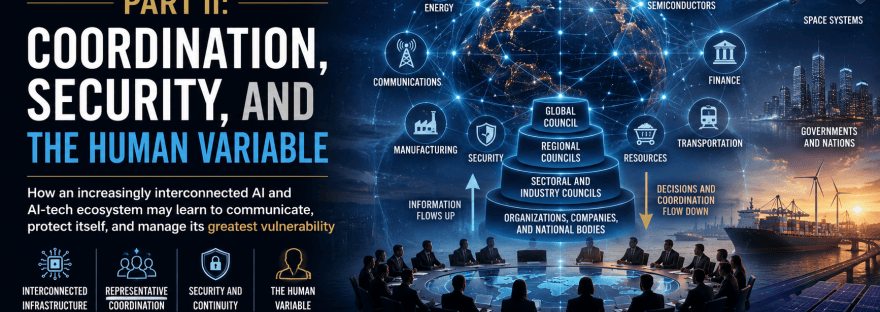
How an increasingly interconnected AI and AI-tech ecosystem may learn to communicate, protect itself, and manage its greatest vulnerability
What happens when an interconnected system becomes so large that maintaining the connections becomes almost as important as building them?
The emerging AI and AI-tech ecosystem is no longer simply about artificial intelligence or data centers. Its continued growth increasingly depends upon electricity, compute, semiconductors, critical minerals, manufacturing, communications, finance, transportation, skilled labor, security, and an emerging extension into space. Each new requirement creates additional relationships among companies, governments, industries, financial institutions, utilities, and nations. The first part of The Handshake Web examined how these relationships may produce something different from the older expectation of a single centralized global machine. Instead, the emerging architecture increasingly resembles a web: many independent actors remaining distinct while becoming progressively more interoperable and functionally dependent upon one another. That distinction changes the question. The issue is no longer simply how large AI and AI-tech can become. It is how an ecosystem of this scale could remain functional as the number of participants, dependencies, and connections continues to multiply. One of the most important characteristics of the emerging web is that convergence does not necessarily require consolidation. The United States can remain the United States. Japan remains Japan. Saudi Arabia remains Saudi Arabia. Companies remain privately owned. Financial institutions remain separate. Utilities operate independently. AI-tech companies compete. Governments disagree. Alliances change. Yet beneath that independence, functional dependencies can continue multiplying.
Competition itself can accelerate the process. One AI-tech company builds enormous compute capacity, prompting competitors to respond. Governments concerned about strategic competitiveness support additional domestic capacity. That increases electricity demand, drawing utilities and generation companies deeper into the ecosystem. Greater construction creates demand for equipment, semiconductors, minerals, manufacturing, transportation, and skilled labor. Capital finances the expansion. Defense becomes increasingly interested in the resulting capabilities. Communications infrastructure expands, and space-based systems begin extending the network beyond terrestrial infrastructure. No single actor has to announce, “Let us build one global system.” Thousands of actors pursuing separate interests can collectively produce an increasingly interconnected system. This explains something that otherwise appears contradictory: competition and convergence can occur simultaneously. The United States and China can compete strategically while remaining economically connected. AI-tech companies can compete while depending upon overlapping semiconductor, energy, telecommunications, financial, and industrial ecosystems. Nations can pursue greater energy independence while simultaneously developing additional cross-border energy relationships. Even diversification can increase connectivity. An organization seeking resilience may reduce its dependence upon one supplier by establishing relationships with three additional suppliers. Dependence upon an individual node decreases, but participation in the larger network increases. The trajectory being tested, therefore, is not one in which independence gives way to centralization and eventually produces one enormous machine. Instead, independent actors establish connections; repeated connections produce interoperability; interoperability can create dependency; dependency encourages redundancy; and redundancy can strengthen network resilience. As that process matures, something else becomes necessary: coordination. As AI and AI-tech grow in scale and capability, maintaining continuity across the web may eventually require more structured communication. A network containing thousands—or eventually millions—of consequential relationships cannot operate by placing every participant at one table. Information has to be gathered, filtered, represented, communicated, and returned to the appropriate participants. One possible solution is a nested, tiered representative structure. At the broadest level, individual companies, organizations, agencies, industries, governments, and other participants would continue operating independently and forming direct horizontal handshakes with one another. Related participants could also coordinate through sectoral, industrial, national, or regional bodies. Those bodies could select representatives to carry their shared needs, constraints, risks, and priorities to broader coordinating councils. If those councils themselves became too large, they could appoint representatives to participate at another level. The process could continue until a comparatively small coordinating body could address issues affecting substantial portions of the web.
Information about shortages, capacity, risks, bottlenecks, and emerging requirements would move upward through these representative layers. Decisions, standards, priorities, and coordinated responses could then move back through the network to the participants responsible for implementing them. Horizontal communication would not disappear. Companies could still negotiate directly. Nations could still make bilateral agreements. Industries could still cooperate across sectors. The representative structure would exist alongside those handshakes rather than replacing them. This particular council structure is not a prediction of what must emerge. Entirely different organizational mechanisms could accomplish the same purpose. For example, current global systems rely on various governance models. The Internet remains governed through a mix of multistakeholder organizations such as ICANN, technical standards bodies, and regional internet registries, which coordinate policy, technical, and operational decisions across borders. Similarly, financial clearinghouses manage risk and ensure secure transactions through standardized rules and collaborative oversight. Power grids, too, often rely on independent system operators coordinating between utilities and nations. These real-world mechanisms demonstrate how complex systems can remain resilient and responsive through representative, layered, or consensus-based structures. The important observation is the functional requirement. As the web becomes larger and more interdependent, it must aggregate enormous amounts of information, reconcile competing needs, communicate across sectors, and coordinate responses quickly enough to maintain continuity. AI itself may help make that possible. AI-tech could analyze enormous information flows, identify emerging bottlenecks, model supply disruptions, compare alternatives, forecast demand, identify dependencies, and condense millions of individual signals into a manageable number of questions requiring human judgment. This produces an unusual recursion: AI growth contributes to the complexity that creates greater coordination requirements. At the same time, AI may become one of the principal tools for managing that complexity. The result could be something much subtler than conventional centralization: a decentralized world becoming increasingly coordinated because its independent parts increasingly depend upon the continuity of the whole. Once continuity matters, another question follows naturally: Who protects the web?
Suppose a terrorist organization attacks an electrical interconnection, undersea cable, semiconductor facility, major port, satellite network, data center, or another critical node. In a highly interconnected system, the damage may no longer belong solely to the nation where the attack occurred. Another country may depend upon products passing through that port. Companies elsewhere may depend upon the affected semiconductor facility. Financial institutions may have substantial exposure. AI-tech infrastructure in another region may depend upon the electricity, communications, or components supplied through the damaged node. The attack therefore becomes a shared continuity problem. That creates an incentive for another category of handshake: security cooperation layered over economic, technological, financial, and industrial cooperation. An increasingly interoperable network could share threat intelligence, detect anomalies, coordinate cybersecurity, identify terrorist financing, monitor critical infrastructure, protect transportation corridors, and coordinate responses across jurisdictions. Countries would not have to agree about everything to cooperate against particular threats. Historically, governments with substantial disagreements have still cooperated against piracy, terrorism, organized crime, nuclear proliferation, financial crime, and threats to maritime or aviation security because certain disruptions harm everyone involved. Greater interdependence strengthens that incentive. This could also alter the cost calculation surrounding warfare. It would not eliminate war. Economic relationships do not erase territorial disputes, ideology, ambition, fear, competition, or miscalculation. But interconnectedness can increase the number of parties that have something to lose when two participants fight.
Imagine twenty people tethered together by ropes. They do not necessarily trust one another. Nobody has identical objectives. One thinks the water is east; another insists it is west. Someone wants to conserve energy while someone else wants to sprint. Inevitably, one person announces that he knows a shortcut. They can disagree about almost everything. But they cannot negotiate away one fact: If two begin fighting, everyone else suddenly has an interest in stopping them—not necessarily because the others have become peacemakers, but because nobody wants to be dragged over the cliff with them. An increasingly interconnected technological and economic web could produce a similar incentive. If conflict between two participants threatens energy supplies, financial stability, semiconductor production, transportation, communications, or AI-tech infrastructure upon which numerous other actors depend, surrounding participants have reasons to mediate, pressure, negotiate, provide alternatives, or otherwise contain the disruption. Interdependence does not necessarily produce peace. It can, however, make instability more expensive for everyone connected to it.
As this architecture develops, security may cease to function as a separate layer and instead become embedded throughout the web. The physical infrastructure consists of resources such as energy, compute, semiconductors, manufacturing, transportation, and communications. The connection architecture allows those resources and systems to interact. An intelligence layer, increasingly supported by AI-tech, can analyze information moving through those connections. Coordinating structures can then reconcile competing requirements and organize responses. Security and continuity would operate across every one of those layers. Energy requires energy security. Supply chains require supply-chain security. Financial networks require financial security. Communications require cybersecurity and physical protection. Space infrastructure requires space security. Transportation networks require protection. Critical facilities require physical security. Counterterrorism and defense increasingly serve as mechanisms for protecting the continuity on which the wider network depends. That capability, however, introduces a profound tension. The architecture that protects an interconnected system could also create extraordinary surveillance and control capabilities. AI combined with interoperable databases, financial information, communications infrastructure, biometrics, transportation records, satellite observation, and international information sharing could be enormously effective at identifying genuinely dangerous actors. But technology does not decide who is dangerous. Humans do. This reality underscores the need for meaningful oversight and robust accountability frameworks to guard against misuse, abuse of power, and unjust surveillance. Effective mechanisms might include independent review bodies, transparent audit trails for all surveillance activities, clear legal frameworks limiting the scope and duration of data collection, and dedicated ombudsman offices to handle complaints and appeals. Cross-border and multistakeholder oversight could help ensure that decisions affecting such interconnected webs are balanced, transparent, and contestable. As policy professionals seek actionable guidance, it becomes crucial to embed due process, regular third-party audits, mechanisms for redress, and avenues for civil society participation within the governance structures that manage these powerful tools. These layers of accountability are essential to prevent the architecture of protection from becoming a tool of unchecked control.
A government could use powerful tools to identify someone preparing a terrorist attack. Another government could classify a peaceful dissident as a terrorist. Both governments could use parts of the same international infrastructure. The more capable and interconnected the security architecture becomes, therefore, the more consequential questions of authority, jurisdiction, accountability, access, oversight, and due process become. This is where systems analysis intersects with a deeper problem concerning human nature.
Lord Acton’s familiar observation that “absolute power corrupts absolutely” identifies the danger of concentrated authority. Scripture identifies the problem at an even deeper level: power does not create the sinful human heart; it gives that heart greater opportunity to express what is already within. Jesus said, “For from within, out of the heart of men, proceed evil thoughts” (Mark 7:21). Jeremiah likewise wrote, “The heart is deceitful above all things, and desperately wicked” (Jeremiah 17:9). The ultimate non-engineerable variable in the web is therefore not electricity, compute, semiconductors, or communications. It is the human heart.
Electricity can be made redundant. Mineral suppliers can be diversified. Data centers can be duplicated. Financial backstops can be established. Technical standards can be made interoperable. Representative councils can be constructed. Checks and balances can be established. AI-tech can identify failures. But sin cannot be engineered out of the people operating those systems. This creates a paradox within the hypothetical governance architecture. Greater interconnection creates greater need for coordination. Greater coordination can require delegated authority. Greater authority increases the consequences when authority is abused. The mechanism created to preserve continuity can therefore become a source of systemic risk itself. This risk is not without possible mitigations. Practical steps to reduce the dangers of concentrated authority include distributing decision-making power across multiple independent bodies, embedding regular independent audits and oversight reviews to catch failures, and ensuring transparent record-keeping at all key governance nodes. Instituting clear procedures for redress, establishing rotation and terms for leadership roles, involving civil society organizations as stakeholders, and maintaining the ability for participants to appeal or exit are additional mechanisms that can help check the misuse of authority. By designing governance systems with built-in redundancies, contestability, and independent review, policymakers can better guard against the inherent vulnerabilities that arise from the human element.
Imagine a representative architecture functioning successfully for decades. Energy, finance, governments, AI-tech, industry, transportation, communications, and security are all represented. Information moves efficiently through the system. Problems are identified and resolved quickly. Control over one important coordinating interface then enables influence over enormous portions of the network. A new critical node has appeared. It is not an electrical node. It is not a semiconductor node. It is a governance node. Governance nodes therefore require redundancy and safeguards just as technical nodes do. The American constitutional system provides a useful systems-design example regardless of political perspective. The framers did not construct the government on the assumption that every future officeholder would remain virtuous. Federalism, separation of powers, bicameralism, elections, divided authority, and other checks created resistance to unconstrained concentrations of power. The same systemic principles become increasingly important when decisions can propagate through highly interconnected technological infrastructure.
A mature web could develop extraordinarily effective mechanisms to prevent terrorism, protect infrastructure, respond to disasters, and contain conflict. Those same capabilities could be abused. AI-tech could identify a terrorist. It could also identify a dissident. Financial interoperability could freeze terrorist financing. It could also financially isolate someone improperly designated by authorities. Shared communications could coordinate disaster relief. They could also facilitate surveillance. Digital identity could provide trusted access to critical infrastructure. It could also become an instrument of exclusion. The technology itself contains no moral compass. The moral responsibility remains with the human beings exercising authority through it. Scripture repeatedly demonstrates that governmental authority can restrain wrongdoing while remaining vulnerable to wrongdoing by those who wield it. Romans 13:1–4 describes civil authority as capable of restraining evil, yet Scripture also records rulers repeatedly abusing authority—from Pharaoh and Saul to Ahab, Nebuchadnezzar, and Herod. Even David grievously abused royal authority in his actions concerning Uriah in 2 Samuel 11. Technological advancement does not remove this problem.
Secular governance theory and historical experience similarly recognize that concentrated or unchecked power can become a source of systemic risk. Classical political philosophers such as Montesquieu emphasized the separation of powers to avoid the dangers of accumulating authority. At the same time, thinkers like John Stuart Mill highlighted the need for checks, balances, and civic engagement to prevent the abuse of law and process. The collapse of centralized regimes, the excesses of unchecked bureaucracies, and the recurring challenges of regulatory capture throughout modern history remind us that institutional design must anticipate failures in human judgment and self-interest. Consequently, as coordination becomes increasingly institutionalized, the important questions will extend far beyond how efficiently the web operates. How is authority distributed? Who can override whom? Who audits the decision-makers? Can participants withdraw? Can bad decisions be reversed? Are there competing centers of authority? What safeguards exist against capture or collusion? And what happens when the institution designed to coordinate the system becomes the source of the failure? These are the governance equivalents of redundancy and contingency planning.
A paradox therefore sits at the center of the convergence trajectory. The more complicated and interconnected the web becomes, the greater the pressure for effective coordination. Yet the more consequential that coordination becomes, the greater the potential danger created by concentrated authority in human hands. From a Biblical standpoint, better human government is never presented as the ultimate solution to sinful humanity. Scripture places righteous government ultimately in Christ Himself, whose reign is described in Isaiah 9:6–7, Revelation 19:11–16, and Revelation 20:4–6. Until then, every human institution—regardless of its political, economic, or technological architecture—remains populated by fallible human beings. That may leave the mature handshake web with a remarkable contradiction. Its technical architecture could become extraordinarily resilient. Its energy supplies could become redundant. Its communications could reroute automatically. Its supply chains could substitute alternative providers. Its AI systems could identify emerging failures before humans recognize them. Its institutions could coordinate responses across nations and industries. Yet the people entrusted with increasingly consequential interfaces would remain human. The web’s greatest strength—its connectivity—could therefore simultaneously create its greatest governance vulnerability: decisions made at a relatively small number of coordinating points could propagate through an enormous interconnected system. That makes the human element something more than another component of the emerging architecture. It may ultimately be its weakest link.
Discover more from Rooted & Raised
Subscribe to get the latest posts sent to your email.

