
Why the Headlines Matter More Together Than They Do Apart
From the Series: Countdown to Convergence
Open your favorite news app today, and within minutes you’ll likely encounter stories that seem completely unrelated.
Artificial intelligence continues advancing at a breathtaking pace. Nations meet to discuss global AI governance. Economic uncertainty dominates financial headlines. Wars and regional conflicts reshape alliances. Governments debate digital identity, cybersecurity, and critical infrastructure. International organizations call for greater cooperation to address increasingly global challenges.
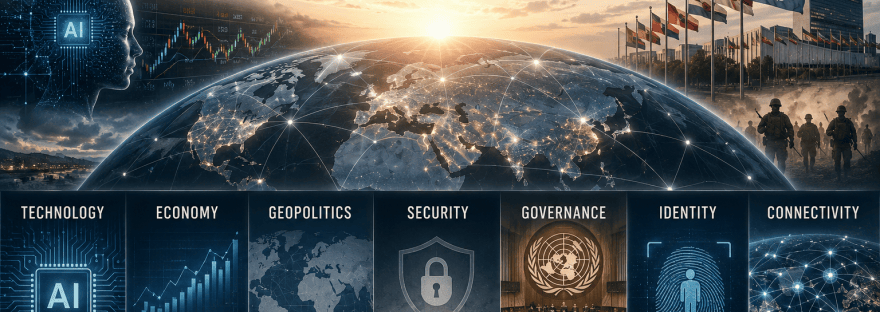
Most of us read these headlines one at a time before moving on with our day. But what if the most important question isn’t what each headline means individually? What if it’s where they all appear to be heading together? That question lies at the heart of the Convergence Framework. Rather than viewing technological, economic, political, military, and cultural developments as isolated events, the framework asks whether these independent systems are becoming increasingly interconnected. Like streams flowing toward the same river, each trend may have its own origin, yet together they can reveal a broader trajectory.
Over the past year, that pattern has become increasingly difficult to ignore. Artificial intelligence is no longer simply a technological story. It has become an economic, national security, educational, and international governance issue. Earlier this month, the United Nations convened its inaugural Global Dialogue on AI Governance in Geneva, bringing governments, industry leaders, scientists, and civil society together to discuss international cooperation on artificial intelligence. At nearly the same time, the Independent International Scientific Panel on AI released its first global assessment, emphasizing both AI’s opportunities and the growing need for coordinated oversight. Meanwhile, the United Nations High-Level Political Forum on Sustainable Development met to review progress toward the 2030 Agenda. With only four years remaining until the Sustainable Development Goals’ target date, international leaders again emphasized partnerships, innovation, infrastructure, and coordinated action as essential to achieving those objectives. These developments do not, by themselves, fulfill biblical prophecy. Neither do they prove that any particular prophetic event is imminent. They are, however, observable examples of increasing international coordination across multiple independent sectors. That distinction matters.
For many years, discussions about Bible prophecy often focused on a single event—a peace treaty, a war, a financial crisis, or a new technology. The Convergence Framework suggests something different. Rather than watching for a single dramatic headline, it observes how separate developments gradually become interconnected over time. Technology influences economics. Economics influences geopolitics. Geopolitics influences security. Security influences governance. Governance increasingly depends upon technology. Each system reinforces the others. Whether one agrees with every policy or not, the observable reality is that today’s challenges are increasingly addressed through international cooperation, shared digital infrastructure, and interconnected systems. That trend deserves careful observation without requiring sensational conclusions. Scripture encourages exactly this kind of careful discernment.
When the sons of Issachar are described as men “who understood the times, with knowledge of what Israel should do” (1 Chronicles 12:32, NASB 1995), they are commended not for speculation but for wisdom. Likewise, Jesus repeatedly instructed His disciples to remain watchful—not fearful, but spiritually awake (Matthew 24:42–44). Being watchful does not require assuming that every headline fulfills prophecy. Nor does it require dismissing observable changes because previous generations have also experienced turbulent times. Biblical discernment lives between those extremes. It recognizes that history unfolds according to God’s sovereign purposes while acknowledging that believers are called to observe the times with humility and wisdom. That is why this series continues to distinguish between established facts, reasoned analysis, and biblical interpretation. The facts are observable. The analysis remains open to revision as events unfold. Scripture alone remains unchanging.
As followers of Christ, our confidence is never placed in analytical models, political systems, or technological forecasts. Those things will continue to evolve. Our confidence rests in the Lord who declares “the end from the beginning” (Isaiah 46:10) and whose purposes cannot be thwarted. The convergence of global systems may continue, or it may slow, shift, or take unexpected turns. Either way, our calling remains unchanged. We are to watch carefully, think biblically, test everything against God’s Word, and live faithfully in whatever season He has placed us. The headlines will continue to change. Christ will not.
Discover more from Rooted & Raised
Subscribe to get the latest posts sent to your email.

