
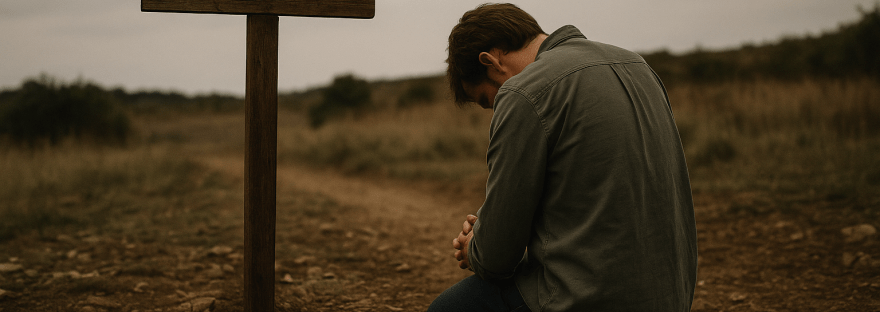
Confidence in Yourself Will Fail—Christ Will Not
📖 “These things I have spoken to you, that in Me you may have peace. In the world you will have tribulation; but be of good cheer, I have overcome the world.“
—John 16:33 (NKJV)
The disciples believed they were finally beginning to understand Jesus clearly.
They told Him, “Now we are sure that You know all things… By this we believe that You came forth from God” (John 16:30, NKJV). Their words sounded strong and confident.
Jesus answered with a searching question:
“Do you now believe?” (John 16:31, NKJV).
He then told them that the hour was coming when they would scatter, return to their own homes, and leave Him alone. They sincerely believed they were ready to stand with Jesus, but they did not yet understand how quickly fear would expose their weakness.
Within hours, soldiers would arrest Him.
The disciples would flee.
Peter, who had insisted that he was prepared to die with Jesus, would deny three times that he even knew Him.
Their confidence in themselves would collapse.
Jesus would remain faithful.
This context makes His next words especially meaningful: “These things I have spoken to you, that in Me you may have peace” (John 16:33, NKJV).
Jesus did not say, “You will have peace because you are stronger than you realize.”
He said peace would be found in Him.
There is an important difference between confidence in Christ and confidence in yourself.
Self-confidence says, “I know I would never do that.”
Confidence in Christ says, “Apart from Him, I am capable of falling; therefore, I must watch, pray, and depend upon Him.”
Self-confidence assumes that strong emotions will produce lasting obedience.
Confidence in Christ understands that faithfulness requires more than a sincere moment or an impressive declaration.
You may feel spiritually strong during a worship service, Bible study, retreat, or meaningful conversation. In that moment, obedience seems easy. You cannot imagine denying Jesus, compromising your convictions, or returning to a sin you have promised to leave.
Then the pressure arrives.
Friends laugh at what you believe. Someone you want to impress invites you into something wrong. You are alone with your phone and believe no one will discover what you view. Anger rises before you stop to consider your words. Fear makes silence seem safer than honesty.
Suddenly, what appeared easy in an emotional moment becomes costly in ordinary life.
Peter’s failure warns you not to trust your own determination.
But it does not teach that failure must be final.
After His resurrection, Jesus restored Peter and entrusted him with responsibility among His people. Peter’s confidence had been broken, but Christ’s purpose for him had not been destroyed.
That does not make Peter’s denial unimportant. His sin was serious, and he wept bitterly after recognizing what he had done. Yet Jesus already knew Peter would fail, and He prayed that Peter’s faith would not fail completely. Jesus told him, “When you have returned to Me, strengthen your brethren” (Luke 22:32, NKJV).
Christ knew both the failure and the restoration before Peter experienced either.
This gives hope when you have failed after speaking confidently about what you would never do.
Perhaps you compromised to gain acceptance. You returned to a habit you thought you had defeated. You remained silent when you should have spoken. You lied to protect yourself. You behaved one way around Christians and another way elsewhere.
Do not excuse the sin.
Do not redefine it.
Do not hide behind the fact that everyone fails.
Confess it honestly and return to Christ.
John wrote, “If we confess our sins, He is faithful and just to forgive us our sins” (1 John 1:9, NKJV). The answer to failure is not greater confidence in your ability to perform better next time. It is repentance joined to deeper dependence upon Jesus.
Christ then told His disciples, “In the world you will have tribulation” (John 16:33, NKJV).
He did not promise them that faithfulness would remove trouble. They would face opposition because they belonged to Him. The world that rejected Christ would also resist His followers.
Tribulation includes severe trouble and pressure. For the apostles, this would include persecution as they proclaimed the risen Christ. Their suffering would not mean Jesus had lost control or failed to keep His promises.
He had warned them in advance.
Christians should therefore be careful not to interpret every hardship as persecution. If people oppose you because you were arrogant, dishonest, cruel, or irresponsible, that is not suffering for Christ. Peter warned believers not to suffer because of their own wrongdoing (1 Peter 4:15).
But there will be times when obedience costs you something.
You may lose approval because you will not join in sin. A friendship may change because you refuse to affirm what Scripture condemns. You may be mocked for believing the gospel. Someone may call you hateful simply because you will not change what God has said.
Jesus does not promise that faithfulness will always be applauded.
He promises something greater:
“Be of good cheer, I have overcome the world.“
Jesus spoke before the cross, yet He described His victory as certain. He would die for our sins, rise from the grave, and defeat the power of death. The world’s rebellion could not prevent Him from accomplishing the Father’s will.
This is the foundation of Christian courage.
Courage is not pretending that opposition cannot hurt.
It is knowing that opposition cannot overturn Christ’s victory.
The earliest Christian teenagers needed this truth. Some lived in households where other family members worshiped Roman gods. Refusing religious ceremonies could cause tension. Faithfulness might affect friendships, apprenticeships, social opportunities, or standing within the community.
They could not assume they would always feel brave.
They needed to know where to find peace when their courage weakened.
Not in themselves.
In Christ.
The same is true for you. Your emotions will change. Your determination may weaken. Your understanding of your own strength may prove inaccurate. But Jesus Christ does not change.
When you recognize your weakness, do not surrender to hopelessness. Let that knowledge move you toward watchfulness, prayer, Scripture, fellowship with other believers, and dependence upon the Holy Spirit.
Knowing Christ means I do not have to pretend that I am strong enough for every trial.
I know that I am weak.
I also know that He is faithful.
My peace is not secured by confidence that I will never stumble. It is secured by the Savior who has already overcome the world and who receives those who honestly repent and return to Him.
Prayer:
Lord Jesus, forgive me for the times I have trusted my determination more than I have depended upon You. Keep me from confidently declaring what I would never do while ignoring my need to watch and pray. When pressure reveals my weakness, help me confess my sin honestly rather than excuse, hide, or redefine it. Give me courage to obey when faithfulness costs approval, friendship, comfort, or opportunity. Teach me to distinguish suffering for Your name from consequences caused by my own wrongdoing. When trouble comes, remind me that my peace is found in You. You have overcome the world, and You will remain faithful even when I discover how weak I am. Amen.
Discover more from Rooted & Raised
Subscribe to get the latest posts sent to your email.

