📖 “Peace I leave with you, My peace I give to you; not as the world gives do I give to you.” —John 14:27a (NKJV)
Every family goes through busy days, stressful moments, and emotional challenges. But Jesus offers something that no routine, rule, or resolution can bring—His peace.
The world’s version of peace comes when everything feels just right. But Jesus gives peace that stays—even when the house is loud, plans change, or trials come.
His peace isn’t earned. It’s a gift He left with His people—and that includes your home.
When Jesus is welcome in your daily life, His peace settles into your conversations, your decisions, and your hearts. His Spirit reminds you that He is with you—and that is enough.
Family Reflection:
When is it hardest for our family to feel peace?
How can we invite Jesus into those moments?
Prayer: Lord Jesus, thank You for leaving us Your peace. Fill our home with it—not just when things are easy, but even when they’re hard. Help us live in Your presence, trusting You together. Amen.
📖 “Peace I leave with you, My peace I give to you; not as the world gives do I give to you.” —John 14:27a (NKJV)
There’s peace that comes from getting good news, finishing all your assignments, or having a quiet moment. But then there’s God’s peace—and it’s different.
The world’s peace depends on everything going right. God’s peace comes even when things go wrong.
Jesus didn’t say, “I’ll give you peace when your life is perfect.” He said, “I give you My peace.” It’s His peace—calm in the middle of chaos, confidence in the middle of fear, quiet in the middle of noise.
The world can’t give that kind of peace. And it can’t take it away either.
Challenge: Write this verse down somewhere you’ll see it this week: “My peace I give to you.” Let it remind you that Jesus has already given you what you need.
Prayer: Jesus, I need Your peace—not the kind the world gives. Help me trust You even when things feel out of control. Remind me that You’re still here, and still in charge. Amen.
📖 “Peace I leave with you, My peace I give to you; not as the world gives do I give to you.” —John 14:27a (NKJV)
There’s a kind of peace the world offers—a quiet home, a paid bill, a clean medical report—but it’s always temporary. One unexpected phone call or headline can steal it away.
But the peace Jesus gives? It’s different. It’s not based on circumstances—it’s rooted in Him.
This peace isn’t passive or distant. It’s the presence of the Holy Spirit calming your heart when everything around you feels unsteady. It’s the stillness that comes when your soul is anchored in Christ, even if your world isn’t.
And this peace isn’t something you earn or manufacture. It’s a gift. Jesus left it with you—intentionally, eternally, and personally.
You don’t have to search for it. Just receive it.
Reflection Questions:
Am I looking for peace in the world’s comforts—or Christ’s presence?
What might it look like to rest in His peace today?
Prayer: Lord Jesus, thank You for leaving me Your peace. Teach me to rest in it—not just when things go right, but especially when they don’t. Help me trust in You over what I see. Amen.
📖 “…and bring to your remembrance all things that I said to you.” —John 14:26b (NKJV)
One of the sweetest works of the Holy Spirit is how He reminds us of the truth—right when we need it most.
A child struggling with fear may suddenly recall, “God has not given us a spirit of fear…” A mother battling doubt may remember, “The Lord is my Shepherd, I shall not want.” In a family disagreement, a quiet verse might rise up: “Be kind to one another…”
These moments aren’t random—they’re the Holy Spirit, lovingly reminding us of God’s truth.
But for Him to remind us, we must first fill our hearts with the Word. As we read Scripture together, memorize verses, and talk about the Lord’s promises, we give the Spirit something to bring back in the days ahead.
Family Reflection:
What’s one verse or truth God reminded you of recently?
How can we help each other remember His Word more often?
Prayer: Holy Spirit, thank You for reminding us of Jesus’ words. Help us hide them in our hearts so that we may live by them and walk in truth as a family. Amen.
📖 “…and bring to your remembrance all things that I said to you.” —John 14:26b (NKJV)
Ever had a verse come to mind at the exact moment you needed it? That’s not coincidence. That’s the Holy Spirit.
Jesus said the Spirit would remind you of His words—when you’re tempted, confused, hurt, or needing direction. But here’s the key: the Spirit brings back what you’ve already stored up.
So if your heart is empty of truth, there’s nothing to bring back. But if you’re filling up on the Word, the Spirit will pull truth out at the right time, like a perfectly timed reminder from Heaven.
It’s how God keeps you anchored in a storm and grounded in the chaos of life.
Challenge: Write one verse on a sticky note or set it as your lock screen today. Ask the Holy Spirit to remind you of it when you need it most.
Prayer: Holy Spirit, bring Jesus’ words back to my mind when I need them. Help me to take Your Word seriously and store it deep in my heart. Amen.
📖 “…and bring to your remembrance all things that I said to you.” —John 14:26b (NKJV)
Have you ever forgotten something important, like your homework or your shoes? It happens to all of us!
But guess what? When it comes to God’s Word, the Holy Spirit helps us remember the things Jesus said.
That means if you’ve read a Bible verse or heard something true about God, the Holy Spirit can bring it back to your mind right when you need it—especially when you’re scared, sad, or unsure what to do.
He reminds us that God loves us, that we can trust Him, and that we’re never alone.
Think About It:
What’s one Bible verse you remember when you’re afraid or sad?
Could that be the Holy Spirit helping you?
Prayer: Holy Spirit, thank You for helping me remember what Jesus said. I want to know His words and follow them every day. Amen.
📖 “…and bring to your remembrance all things that I said to you.” —John 14:26b (NKJV)
Do you ever forget what God has spoken over your life? In the middle of everyday stress, distractions, and disappointments, it’s easy to lose sight of His promises.
But Jesus promised that the Holy Spirit would bring His words back to your mind—not only in quiet moments, but right in the thick of daily life.
When you’re afraid, He reminds you: “Fear not, for I am with you.” When you’re weary, He whispers: “Come to Me, and I will give you rest.” When you’re discouraged, He speaks: “Be of good cheer; I have overcome the world.”
You don’t have to carry the burden of spiritual memory alone. The Spirit is faithful to recall truth at just the right time. Your job is to stay in the Word—He will do the reminding.
Reflection Questions:
Can I recall a moment when the Holy Spirit reminded me of a verse I needed?
Am I filling my heart with God’s Word so He has something to draw from?
Prayer: Holy Spirit, thank You for bringing to remembrance the words of Jesus. Help me to store up His Word in my heart so I may walk in truth, even when I feel weak or forgetful. Amen.
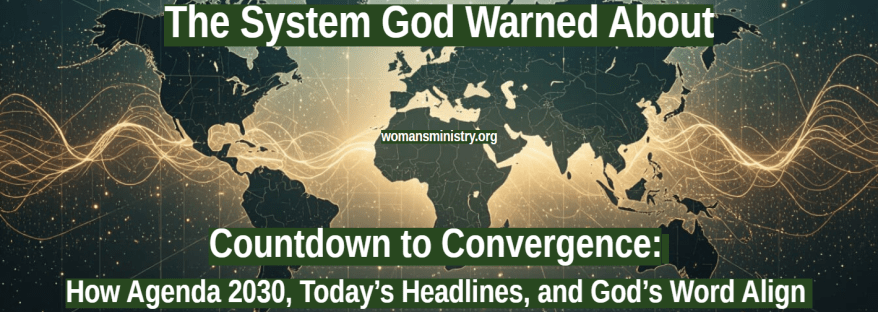
Countdown to Convergence traces the alignment of Agenda 2030’s goals, today’s headlines, and God’s prophetic Word. This series reveals how the world’s plans are converging into the very system the Bible warned us about — the last global order before Christ’s return. Our purpose is not fear, but watchfulness, so that the Church stands ready, holding fast to the Blessed Hope, and calling others out of the system that will soon demand total allegiance.
The System God Warned About
In September 2015, world leaders gathered at the United Nations and adopted what they called a “plan of action for people, planet and prosperity” — better known as the 2030 Agenda for Sustainable Development. Among their goals: the end of poverty, hunger, and inequality, along with the building of “peaceful, just and inclusive societies.”
On the surface, it all sounds noble. But when we hold their vision up to Scripture, we see something deeper: a system that mirrors exactly what the Bible warned about nearly two to four thousand years ago — a final world order built on human unity apart from God, demanding total control over life, commerce, and even belief.
Scoffers in the Last Days
The moment we begin to speak of prophecy, scoffers rise up. Peter told us this would happen:
“Knowing this first: that scoffers will come in the last days, walking according to their own lusts, and saying, ‘Where is the promise of His coming? For since the fathers fell asleep, all things continue as they were from the beginning of creation.’” (2 Peter 3:3–4, c. AD 65, NKJV)
Their very denial is itself a fulfillment of prophecy. Scoffing does not disprove God’s Word — it proves it. And Jesus told us not to be lulled into complacency but to watch (Matthew 24:42).
Apostasy Comes First
The Bible also makes clear that before the Antichrist is revealed, a great falling away must take place:
“Let no one deceive you by any means; for that Day will not come unless the falling away comes first, and the man of sin is revealed, the son of perdition.” (2 Thessalonians 2:3, c. AD 51, NKJV)
This apostasy — a visible Church departing from the truth, softening itself for deception — is already underway. I have written in depth on this in another series, but here we will simply note: apostasy clears the ground for everything else. It is the precursor to the convergence we now see.
Three Timelines Converging
Their Timeline – Agenda 2030
The UN’s 2030 Agenda lays out 17 Sustainable Development Goals with 169 targets to be achieved by the year 2030. Words like “universal,” “inclusive,” and “global” echo throughout the text. These reveal not just programs, but a vision for centralized, worldwide governance.
Current Events Timeline
Headlines today show the groundwork being laid:
Nations piloting digital IDs tied to access.
Central banks testing CBDCs (central bank digital currencies).
Governments drafting AI regulations to control information and speech.
These aren’t isolated innovations; they are puzzle pieces being fitted into one global system.
God’s Timeline – Prophecy
Scripture told us long ago where this would lead:
“…and the fourth beast shall be a fourth kingdom on earth, which shall be different from all other kingdoms, and shall devour the whole earth, trample it and break it in pieces.” (Daniel 7:23, c. 530 BC, NKJV)
“…and that no one may buy or sell except one who has the mark or the name of the beast, or the number of his name.” (Revelation 13:17, c. AD 95, NKJV)
“For when they say, ‘Peace and safety!’ then sudden destruction comes upon them, as labor pains upon a pregnant woman. And they shall not escape.” (1 Thessalonians 5:3, c. AD 51, NKJV)
Across 2,500 years of prophecy, the same reality is revealed: a global system of control arising just before the Lord’s return.
Why This Is the Last Economic System
History has seen many empires — Babylon, Rome, and countless others. But none had digital enforcement or global reach. What is being built now is unprecedented. Once established, it will not be surrendered, because it fulfills exactly what Revelation describes: a system continuing until Christ Himself destroys it at His coming (Revelation 19:11–21).
This is not just another cycle of history. It is the final man-made system, the Beast system.
God’s Pattern of Deliverance
Yet in all of this, we see God’s character and pattern. He delivers His people at the brink, just before wrath falls:
Noah and his family were lifted above the flood before judgment came (Genesis 7, c. 1445 BC).
Lot was led out of Sodom before fire fell (Genesis 19, c. 1445 BC).
Israel walked through the Red Sea just as Pharaoh’s army closed in (Exodus 14, c. 1445 BC).
Esther stood at the king’s side as Haman’s plot collapsed (Esther 7, c. 450 BC).
Each moment of deliverance came when the enemy’s pride was at its peak — and God was glorified. The Rapture of the Church will be no different.
Watchfulness and Hope
Jesus said, “Watch therefore, for you do not know what hour your Lord is coming” (Matthew 24:42, c. AD 60, NKJV). Paul reminded us that Christ will appear “to those who eagerly wait for Him” (Hebrews 9:28, c. AD 65, NKJV).
We do not watch with fear, but with expectancy. We are not appointed to wrath (1 Thessalonians 5:9). We are called to endure faithfully, to shine as lights in a dark world, and to fix our eyes on the Blessed Hope — the soon return of Jesus Christ.
“Britain to introduce compulsory digital ID for workers” — Reuters
“New digital ID scheme to be rolled out across UK” — GOV.UK(UK government announcement)
“Digital identity leaders and privacy experts sound the alarm on invasive ID systems (‘Phone Home’)” — ACLU press release
“Apple’s digital ID program expanding nationwide in 2025 amid privacy debates” — Mobile ID World
“Mandatory digital ID card plan blasted as ‘ludicrous’ …” — The Sun
“The global rise of digital ID technology in 2025” — ZignSec blog
CBDC (Central Bank Digital Currency) Pilots & Developments
India: Retail Sandbox for CBDC / Deposit Tokenization Pilot
The Reserve Bank of India (RBI) launched a “retail sandbox” to let fintech firms build and test solutions around the digital rupee.Reuters+1
India will also pilot deposit tokenization (turning deposits into tokenized digital instruments) as part of its digital currency strategy. Reuters
Uganda: CBDC Pilot with Tokenized Economy
Uganda launched its CBDC (digital shilling) pilot in a $5.5 billion tokenised economy model, building an infrastructure that goes beyond money to tokenizing real assets and systems. Techpoint Africa+2CoinCentral+2
The pilot is anchored in Uganda’s Green Industrial & Special Economic Zone (GISEZ), embedding the CBDC into industrial and trade flows. Techpoint Africa
China has conducted multi-year trials for its digital yuan (e-CNY) across cities and sectors. Digital Watch Observatory
There is growing interest globally in “programmable money” (money with built-in rules / smart contracts). Digital Watch Observatory+1
Representative Articles & Links
“India’s central bank launches digital currency retail sandbox” — Reuters Reuters
“RBI launches digital currency retail sandbox” — Economic Times The Economic Times
“Uganda launches CBDC pilot in $5.5B tokenised economy” — Techpoint Africa Techpoint Africa
“Indian central bank to launch pilot for deposit tokenisation” — Reuters Reuters
“Cryptocurrencies and digital money in 2025” — Dig.watch (background / trends) Digital Watch Observatory
“Blockchain and Digital Assets News and Trends – February 2025” — DLA Piper DLA Piper
AI Regulation / AI Legislation & Policy
U.S. Regulatory Changes & Strategy
The U.S. under the 2025 administration has prioritized regulatory clarity for digital assets and AI. State Street
A new Executive Order called “Strengthening American Leadership in Digital Financial Technology” set the tone for digital asset + AI policy. State Street
The administration formed a “President’s Working Group on Digital Assets,” including an AI/Crypto Special Advisor. State Street
It also rescinded SAB 121 (which had required custodial crypto assets to be recognized on balance sheets), replacing it with SAB 122, aligning accounting treatment more cleanly.State Street
The U.S. government expects to release a high-level AI policy (for oversight and risks) around mid-2025. State Street
State / National AI-focused Legislation
The National Conference of State Legislatures tracks 2025 AI bills in U.S. states (covering issues like transparency, bias, oversight). NCSL
Across the globe, jurisdictions are pushing or drafting AI regulation (e.g. EU’s AI Act, national AI laws). State Street+1
Regulatory Outlook & Trends
Many commentators expect U.S. regulation to be more innovation-friendly than restrictive, at least initially. State Street
The intersection of AI and digital assets (e.g. algorithmic stablecoins, programmable finance) is a major regulatory frontier. State Street+1
In Europe, regulations on digital “dark patterns,” algorithmic decisioning, and fairness (like the proposed Digital Fairness Act) are in motion. Wikipedia
Legislative Activity in U.S. States (2025)
Various state bills have been introduced on AI, covering disclosure, bias mitigation, algorithmic audits, etc. NCSL
Representative Articles & Links
“2025 regulatory preview: Understanding the new US … digital assets & AI” — State Street’s Digital Digest / regulatory outlook State Street
“2025 Digital ID Predictions: What’s Next for the Industry?” — Trinsic (with mention of AI-enabled identity) Trinsic
“Global Crypto-Asset Regulation Outlook (May 2025)” — Substack insight piece Insights for VC
“Artificial Intelligence 2025 Legislation” — NCSL overview of state AI bills NCSL
“Blockchain and Digital Assets News and Trends – February 2025” — DLA Piper, covering overlap with AI & digital assets DLA Piper
“Digital Fairness Act” — Wikipedia summary of proposed EU legislation (relates to algorithmic fairness and digital regulation) Wikipedia
📖 “But the Helper, the Holy Spirit, whom the Father will send in My name, He will teach you all things…” —John 14:26a (NKJV)
As a mother, you wear many hats: planner, comforter, cook, peacemaker—and teacher. But there’s one role you don’t carry alone: spiritual teacher.
Jesus promised the Holy Spirit would teach you all things—and that includes the wisdom to raise your children, navigate family struggles, and open God’s Word together.
This promise also means your children are never too young to learn from the Spirit. He teaches in quiet moments, through Scripture, and even through correction. He shapes hearts while you plant seeds.
You are not the final voice in your children’s lives—the Holy Spirit is. And He is faithful to speak.
Family Reflection:
How can we make room for the Holy Spirit to teach us as a family?
What’s something we’ve learned from God this week?
Prayer: Holy Spirit, be our Teacher. Lead our family into truth, help us understand the Word, and guide us in love and obedience. We want to follow You together. Amen.