
From the Series: Ordinary Saints: Lessons from the Ante-Nicene Church
Scripture quotations are from the New King James Version®.
Copyright © 1982 by Thomas Nelson. Used by permission. All rights reserved.
When the gospel began to spread across the Roman Empire, it did not arrive with force, influence, or institutional backing. There were no armies, no political leverage, and no platforms to amplify its message. Instead, it moved through ordinary people, fishermen, slaves, mothers, merchants, and martyrs, whose lives were so transformed that the world could not ignore them.
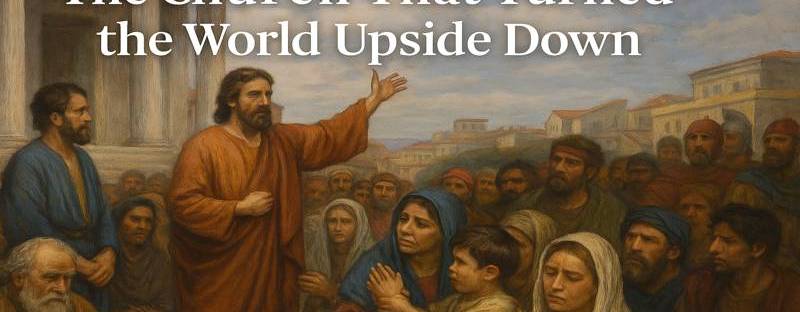
Scripture records the charge made against them: “These who have turned the world upside down have come here too.” (Acts 17:6). This was not an exaggeration. It was recognition. Something was happening that disrupted the very foundations of the world around them. But the transformation did not begin outwardly; it began in the hearts of those who refused to live by the world’s values. The Kingdom of God was not merely being proclaimed; it was being lived.
As I consider the early Church, one of the most striking realities is how it functioned without the structures we often rely on today. They had no buildings to gather in, no systems to organize large-scale movements, and no means to broadcast their message across regions. Yet the gospel spread rapidly and deeply. Why? Because every believer understood that they themselves were carriers of the message. Evangelism was not assigned to a few; it was lived by all. Wherever they went, they spoke of Christ, but not only with words. Their lives bore witness through love, generosity, forgiveness, and truth.
Now, a reader might pause here and think, “I don’t have a platform. I don’t feel equipped to reach others.” But the early Church had none of those things either. Their effectiveness was not rooted in visibility; it was rooted in obedience. The same remains true today.
If you are wondering what this looks like in daily life, consider taking one small step this week. You might invite a neighbor for a cup of coffee and simply listen to their story. You could offer to pray for someone going through a hard time. Perhaps you will share a word of encouragement or bring a meal to someone in need. Even a simple act of kindness or a conversation about hope can open doors. As you look for these opportunities, trust that God can work through your ordinary moments.
Flowing from this, another defining mark of the early believers was their love. Their love was not selective, conditional, or driven by recognition. It was costly, sacrificial, and often extended to those who opposed them. They cared for abandoned children, stayed behind to tend to the sick during plagues, welcomed strangers, served the poor, and forgave those who persecuted them. Their love did not make sense to the world, and that is precisely why it had power.
“They are attacked by Jews as aliens and are persecuted by Greeks, yet those who hate them are unable to give any reason for their hatred.”
— Epistle to Diognetus, ch. 5
“See how they love one another… and how they are ready to die for each other.”
— Tertullian, Apology 39
This kind of love cannot be manufactured. It flows from a life transformed by Christ. It reveals a Kingdom that operates differently than the world expects.
At this point, you may feel both drawn and challenged. “Do I love like that?” The answer may not always be comfortable. But the question itself is necessary. Because the love that marked the early Church is the same love Christ calls us to walk in today. But take heart: God does not ask us to love sacrificially by our own strength. He Himself provides the love we lack and empowers us to love others even when it feels impossible. If you feel inadequate, remember that God is always ready to help you love as He desires.
Alongside this extraordinary love, there was an unwavering refusal to compromise. The early Christians did not reshape the gospel message to gain acceptance. They did not soften the truth to avoid rejection. They lived lives that were distinctly set apart, holy, obedient, and anchored in Christ. This often came at great cost. They lost positions. They forfeited property. They endured suffering. Some faced death. And yet, their response was not resentment; it was joy rooted in something greater than what they had lost.
“You had compassion on me in my chains, and joyfully accepted the plundering of your goods, knowing that you have a better and an enduring possession for yourselves in heaven.” (Hebrews 10:34). That kind of perspective cannot be sustained by human strength. It is anchored in eternal hope.
A reader may quietly wrestle with this: “Would I stand like that if it cost me everything?” That question reveals where our trust truly rests. But it also opens the door to assurance, because the same God who sustained them is the One who sustains His people now. To bring this into today, consider the example of Pastor Andrew Brunson, who spent two years imprisoned in Turkey for his faith and refused to deny Christ despite immense pressure. Or recall the courage of Asia Bibi, who held firm to her Christian convictions through years of hardship and threats. Stories like these remind us that steadfast faith is not just a story of the early Church, but is lived out in our own times as well. God still gives His people strength and hope even in the hardest circumstances.
The early Church also understood that its mission was not simply to gain followers but to make disciples. They did not measure success by numbers. They invested in lives, walking alongside one another. Discipleship happened in homes, prison cells, and places of suffering. It was relational and sacrificial. They were not raising admirers; they were forming people who would live and, if necessary, die for Christ. And through that, the world was changed.
Bringing this forward to today highlights an important contrast. It is easy to rely on systems, programs, and visibility. It is easy to believe that influence comes through reach and recognition. But, what if we, as a Church community, set aside one day each month to serve our local neighborhood together, visiting the elderly, helping those in need, or hosting open meals for anyone seeking connection? Or imagine gathering as small groups to pray for and reach out to the people around us in personal, practical ways, just as the early believers did. Choosing to step beyond our routines and organize intentional acts of love and hospitality as an entire body can remind us that the Church’s influence grows most when we act as one. Consider challenging your congregation to identify a shared project or outreach that allows everyone to participate in living out the gospel beyond the Church walls. In doing so, we reflect the unity and purpose that marked the first followers of Christ. But the early Church shows something different. Transformation does not begin with programs; it begins with people fully surrendered to God.
A reader might reflect, “What would it look like if I truly lived as a citizen of another Kingdom?” That is the question that shifts everything. Because when believers begin to live in alignment with Christ, not partially, but fully, the impact cannot remain contained.
There is also encouragement here. We are not called to replicate their circumstances; we are called to walk in the same obedience. The same Spirit who empowered them dwells within every believer. The same truth they proclaimed is still alive. The same call remains, and we do not walk this alone. The Body of Christ is meant to reflect this together. As we encourage one another, sharpen one another, and walk in unity, the witness becomes stronger. The light becomes clearer.
What we learn from the early Church is not complicated, but it is costly.
- They did not rely on power; they carried presence.
- They did not argue their way forward; they loved sacrificially.
- They did not conform; they stood apart.
- And through ordinary lives marked by extraordinary obedience, the world was shaken.
The same kind of world-changing impact is still possible today. It won’t happen by personal effort alone or by striving for recognition. It happens through surrender to God; He accomplishes His work as we yield to Him. As you reflect on your own journey, consider taking a step of surrender this week. Pray and ask God to show you where He is inviting you to trust Him more fully, and commit to responding with an open heart. You might pray, “Lord, I surrender my plans, fears, and desires to You. Use my life for Your purposes.” Trust that as you take even one small step of obedience, God will meet you and accomplish His work through you.
Sources:
- The Holy Bible — Acts 17:6; Hebrews 10:34; Matthew 5:14–16
- Epistle to Diognetus, ch. 5
- Tertullian, Apology 39
- Eusebius, Church History
Discover more from Rooted & Raised
Subscribe to get the latest posts sent to your email.

