From the Series: Countdown to Convergence
Scripture quotations are from the New King James Version®.
Copyright © 1982 by Thomas Nelson. Used by permission. All rights reserved.
The Handshake Web, Part II: Coordination, Security, and the Human Variable
What appears to be developing is not one giant integrated machine where everybody gives up independence. It looks more like a network of semi-independent systems that increasingly require one another to keep functioning and growing. For example, recent challenges in global chip supply chains have shown how even tech giants rely on complex webs of manufacturing, logistics, and cross-border agreements to maintain production. The rapid adoption of cloud interoperability standards, such as those among major cloud providers to move workloads efficiently, is another illustration. In layman’s language, I would picture it this way: AI/AI-tech becomes an increasingly important engine. Around that engine grows an enormous support web supplying what it needs. The members of that web remain independent, but they increasingly build standardized ways to exchange resources, information, capacity, financing, and assistance. The basic scaffolding begins with AI tech and compute, which depend on electricity and energy infrastructure. That energy infrastructure is connected to chips, critical minerals, and manufacturing, which in turn depend upon communications networks, fiber, satellites, and emerging space infrastructure. These systems rely upon transportation, logistics, and supply chains, all of which require capital, banking, insurance, and government finance. Labor, engineering, construction, and other forms of human capital support the entire structure, while defense, cybersecurity, and physical security protect its operation. Governments, regulators, and international coordinating institutions increasingly interact with all of these layers.
None of these relationships is strictly linear; each layer increasingly depends upon and communicates with several others, creating the larger web. But those arrows aren’t really vertical. Eventually they’re everywhere. Energy needs capital. Capital needs information. Information needs communications. Communications need chips. Chips need minerals. Minerals need energy and transportation. Transportation needs energy. Defense needs AI-tech. AI-tech needs space and terrestrial communications. Governments need all of them. That’s the web. At the center of this web is what I call the “handshake” mechanism: a formal or informal agreement, standard, or interface that allows different systems to cooperate, share resources, and depend on each other without giving up independence. And then comes the handshake mechanism. A handshake basically says, “I don’t have to own you in order to depend upon something you provide.” That’s enormously important. The United States doesn’t have to own a foreign mine. A hyperscaler doesn’t have to own every power plant supplying its data centers. An AI-tech company doesn’t have to own every chip fab. Japan doesn’t have to own America’s financial system to benefit from a financial backstop. A government doesn’t have to own a private space company to contract for launch capability. They create interfaces. Contracts are handshakes. Technical standards are handshakes. Trade agreements are handshakes. Currency arrangements are handshakes. Defense agreements are handshakes. Power-purchase agreements are handshakes.
Cloud interoperability is a handshake. Emergency assistance is a handshake. Shared infrastructure can be a handshake. And eventually the really important transition is likely to be from individual handshakes to systems of handshakes. That’s where the scaffolding starts looking mature. At the present stage, a need arises, an appropriate partner is identified, terms are negotiated, and a connection is established. In a more mature version of the web, a need would arise within an already established network, a compatible provider or alternative would be identified, and capacity could be connected, rerouted, or substituted rapidly—potentially with much of that process already standardized or automated. That’s the difference between having a bunch of extension cords lying around and having an electrical grid. That’s where diversification becomes central.
Suppose Country A relies completely on Country B for something critical. That’s dependency, but it’s fragile. So Country A adds C and D. Now B fails, and C picks up some load while D supplies another portion. That’s redundancy. But for C and D to substitute effectively, they need compatible standards, logistics, financial arrangements, communications, contracts, infrastructure, etc. So strangely, attempts to reduce dependency on individual nodes can increase dependency on the larger network. That’s one of the most interesting things uncovered. Eventually the objective isn’t necessarily independence. It’s continuity. And once continuity becomes the objective, the system starts behaving differently. A node fails? Reroute. A country becomes unreliable? Substitute. A data center loses power? Shift workloads. A mineral source disappears? Activate another supplier. A financial system experiences stress? Liquidity/support mechanisms activate. A hurricane knocks something offline? Move capacity through another node while repairs occur. A geopolitical dispute breaks one handshake? Find another route through the web. That’s why a mature system can tolerate enormous amounts of disagreement without necessarily coming apart. Then humans have to manage the thing. This is the part I’ve spent so much time discovering.
Eventually, there are too many handshakes for everybody to coordinate everything independently. That’s where a tiered representative governance structure or a nested representative council system, where information and authority move both directions through it, becomes plausible. Not necessarily the architecture they’ll choose, but something functionally similar. Possible governance models to explore include intergovernmental organizations dedicated to infrastructure standards, public-private consortia for setting and enforcing cross-border protocols, federated oversight councils composed of sectoral and regional representatives, and adaptive policy levers such as incentive-based coordination frameworks or binding international agreements on interoperability and security. More speculative options include algorithmic coordination layers that supplement human councils, or dynamic regulatory sandboxes that allow experimentation across national and institutional boundaries. Briefly outlining these models can help analysts consider actionable frameworks for ensuring effective coordination in this complex environment. At the broadest level are the individual participants in the web. Related participants could coordinate through sectoral, industrial, national, or regional bodies, which would select or appoint representatives to carry their needs, constraints, and concerns to the next level. Those representatives could then participate in broader cross-sector coordinating bodies, where issues affecting multiple parts of the web are reconciled. Information, needs, and problems would move upward through these representative layers, while decisions, standards, priorities, and coordinated responses would move back down through the network. This would allow a very large decentralized system to coordinate without requiring every participant to have a seat at the highest decision-making table.
Energy says: “We’re approaching capacity.”
AI-tech says: “We need another 20 GW.”
Mining says: “We can’t supply those materials on that schedule.”
Finance says: “We can finance expansion, but at this cost.”
Government says: “We can accelerate permitting.”
Labor says: “You can permit whatever you want; we don’t have enough electricians.”
Now somebody has to reconcile those constraints. And increasingly, AI itself could become the information-processing layer helping those representatives understand the beast. That’s an interesting recursion: AI creates infrastructure complexity that requires greater coordination, while AI itself becomes one of the tools used to coordinate that complexity. It can model demand, identify bottlenecks, optimize transportation, forecast energy requirements, monitor inventories, identify supply disruptions, model alternatives, and present decision-makers with options. But as AI takes on a more central role in coordination, this introduces a new set of governance challenges. Issues such as transparency of decision processes, accountability for outcomes, and the potential for systemic bias must be actively managed as the system grows in complexity. Embedding ethical guardrails and robust oversight mechanisms will be essential to ensure AI systems used for coordination remain aligned with broader human values and policy objectives. However, humans still decide what tradeoffs they’re willing to make.
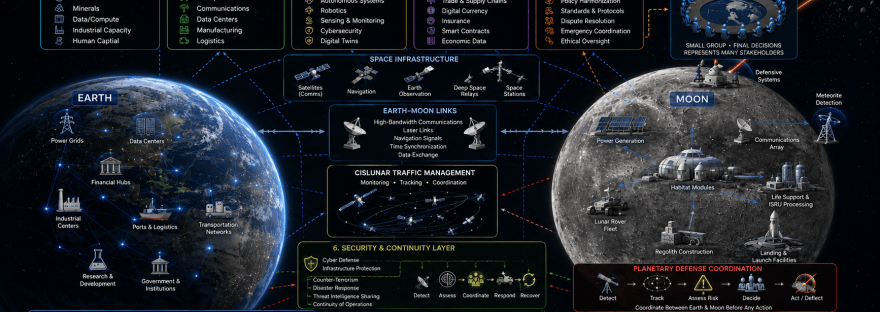
So in drawing the mature scaffolding I have been hypothesizing, I actually give it four layers:
- Physical layer: Energy, compute, chips, minerals, manufacturing, transportation, communications, space infrastructure.
- Connection layer: Standards, contracts, markets, networks, financial mechanisms, trade arrangements, interoperability.
- Intelligence layer: AI/AI-tech monitoring the enormous amounts of information flowing through the physical and connection layers, identifying problems and optimizing responses.
- Coordination layer: Governments, corporations, institutions, and potentially increasingly formal representative structures making decisions about priorities, conflicts, security, resources, and continuity.
And all four continuously feed one another. Not necessarily a single centralized machine. More like a living infrastructure network that continuously senses, communicates, substitutes, repairs, finances, negotiates, and expands. And that’s why stabilization wouldn’t mean the thing stops moving. A mature version is moving constantly. Its stability would come from its ability to keep functioning while moving.
The trajectory I am watching begins with connection. As connections multiply, they can produce interoperability, and repeated interoperability can create dependency. Dependency then encourages diversification as participants seek alternatives to individual suppliers or nodes. Diversification can produce redundancy, which makes substitution possible when a particular connection fails. Reliable substitution strengthens continuity, while the need to preserve continuity increases pressure for coordination. If those coordinating relationships become persistent and formalized, they begin to become institutionalized. Taken far enough, this progression could eventually produce what I call resilient convergence: a condition in which the larger system remains functional not because every individual connection is permanent, but because the web has developed enough interoperability, redundancy, substitution, and coordination to survive the loss or disruption of particular connections.
I am nowhere near being able to say that entire sequence has occurred. Much of what I am seeing remains considerably earlier. But that is the scaffolding I’m now looking for evidence of. Even so, early signals are visible. For example, the EU’s Gaia-X initiative and similar government-industry cloud projects are already piloting standardized interfaces across independent infrastructure, echoing the kind of ‘handshake’ mechanisms I described. In global supply chains, industry groups governing chip manufacturing and diversified mineral sources are experimenting with automatic substitution protocols and multi-provider contracts to maintain continuity when a single node fails. Likewise, the creation of regional grid coordination centers reflects a shift toward mature, rapid response for shifting energy loads. Though these implementations are partial and not yet fully integrated, they illustrate a tangible move along the path I’ve outlined. And the key change in my thinking is that I no longer expect mature convergence to look like everybody becoming one thing. It could look almost exactly opposite: lots of independent things that can no longer function efficiently without continually communicating with, substituting for, supporting, and coordinating with one another. That’s the web. And AI/AI-tech may simultaneously be one of its largest consumers, one of its strongest accelerators, and eventually one of the principal tools used to manage it. That’s why this thing got so much bigger than “they’re building a lot of data centers.”