I’m a follower of Christ, learning daily to walk the narrow path laid out in His Word. Through Rooted & Raised: Anchoring Women & Children in Christ, I simply seek to point others back to Scripture, tested by the Holy Spirit, lived out in faith, and anchored in truth.
● This space isn’t about lofty theology or grand platforms. It’s about humble obedience, Kingdom living, and helping others, especially women and families, rediscover the kind of faith that bears fruit, costs something, and reflects the love of Christ. My heart is to encourage others as I learn, grow, and surrender alongside them.
● This space isn’t built on lofty theology or big platforms, it’s grounded in humble obedience, Kingdom living, and encouraging women and families to rediscover a faith that bears fruit, costs something, and reflects the love of Christ.
● I don’t have a budget for an editor, publisher, or team behind the scenes. Everything you see here is created prayerfully and paid for out of pocket, using the tools I can afford to help present a clear, polished message of truth and hope.
● If you're blessed by what you read and would like to contribute toward this work, you’re welcome to support via:
📲 Cash App: $RootedRaised
📖 “Blessed are the peacemakers, for they shall be called sons of God.” —Matthew 5:9 (NKJV)
Being peaceful means helping bring calm and kindness instead of arguments and trouble. A peacemaker is someone who tries to make things right when there is a problem.
Sometimes people may argue or feel upset with each other. In those moments, you can choose to be peaceful. You can use kind words, listen carefully, and help others get along.
Jesus teaches you to be a peacemaker. He helps you choose peace instead of anger. When you follow Him, you learn how to bring calm into difficult situations.
Being peaceful shows others what Jesus is like. It helps people feel safe and cared for.
Prayer: Jesus, help me be peaceful and kind. Teach me to be a peacemaker in every situation. Help me use my words and actions to bring calm and love to others. Amen.
📖 “But the fruit of the Spirit is… self-control.” —Galatians 5:22–23 (NKJV)
Self-control means choosing what is right, even when you feel like doing something else. It means stopping and thinking before you act, speak, or react.
Sometimes you may feel angry, impatient, or tempted to do something wrong. In those moments, it can be hard to make the right choice. But Jesus helps you have self-control.
When you ask Jesus for help, He gives you the strength to pause and choose what is right. He helps you speak kindly, act wisely, and make good decisions.
Self-control helps you grow stronger in your faith. It shows that you are learning to follow Jesus in everything you do.
Prayer: Jesus, help me have self-control in my thoughts, words, and actions. Teach me to pause and choose what is right. Thank You for helping me grow and follow You every day. Amen.
📖 “But the fruit of the Spirit is… self-control.” —Galatians 5:22–23 (NKJV)
Self-control is often understood as discipline or restraint, but Scripture reveals its true source—it is a fruit of the Spirit. This means it is not produced by willpower alone, but formed through the work of the Holy Spirit within you. It reflects a life that is being shaped by Christ.
As a teenager, you experience a wide range of emotions, pressures, and influences. There are moments when reactions feel immediate—words spoken without thought, decisions made impulsively, or responses driven by emotion. In those moments, self-control becomes essential.
Self-control is the ability to pause before reacting, to choose truth over impulse, and to align your actions with God’s Word. It affects how you speak, how you respond to frustration, how you handle temptation, and how you make decisions.
Through the Holy Spirit, Christ strengthens this capacity within you. As you grow in your relationship with Him, your responses begin to change. What once felt automatic becomes intentional. You learn to pause, to think, and to act in alignment with His truth.
Self-control also protects you. It guards your words from causing harm, your actions from leading to regret, and your decisions from being shaped by momentary emotion. It creates stability in your life, allowing you to respond with wisdom rather than impulse.
This growth takes place over time. It is developed through daily choices—choosing to pause, choosing to listen, choosing to respond according to what God has said. Each moment becomes an opportunity to walk in step with the Spirit.
Knowing Christ transforms self-control from self-effort into Spirit-led living. It becomes evidence of His work within you.
Self-control is not suppression—it is strength directed by truth.
Prayer: Jesus, help me grow in self-control through Your Spirit. When I feel tempted to react quickly, remind me to pause and choose what is right. Shape my thoughts, words, and actions, so they reflect Your truth each day. Amen.
📖 “But the fruit of the Spirit is… self-control.” —Galatians 5:22–23 (NKJV)
Self-control, as Scripture presents it, is not simply discipline—it is evidence of the Holy Spirit at work within you. It is a strength brought under the direction of truth, shaped by a life that is yielded to Christ. This means it is not something you produce on your own, but something that grows as you walk in step with Him.
As a woman navigating responsibilities, emotions, and daily demands, there are many moments where self-control is tested. Words may rise quickly in frustration, decisions may be influenced by pressure, or reactions may be driven by emotion. In those moments, the need for restraint becomes clear.
Self-control allows you to pause before responding. It creates space between impulse and action, allowing God’s truth to guide your response. It affects how you speak, think, and act in both public and private moments.
Through the Holy Spirit, Christ strengthens your ability to exercise this control. As you remain in His Word and depend on His presence, your responses begin to reflect His character rather than your immediate emotions. Over time, what once required effort becomes a steady pattern of living.
Self-control also brings protection. It guards your words from causing harm, your decisions from being impulsive, and your actions from leading to regret. It creates stability, allowing you to respond with wisdom rather than reaction.
There will be moments when choosing self-control requires intentionality—holding back a response, choosing patience, or redirecting your thoughts. These moments are not interruptions; they are growth opportunities.
Knowing Christ transforms self-control from self-effort into Spirit-led strength. It becomes the outward expression of a life anchored in Him.
Self-control is strength guided by truth and sustained by His Spirit.
Prayer: Jesus, help me grow in self-control through Your Spirit. When I feel overwhelmed or tempted to react quickly, remind me to pause and seek Your guidance. Shape my words, thoughts, and actions, so they reflect Your truth each day. Amen.
📖 “But the fruit of the Spirit is… self-control.” —Galatians 5:22–23 (NKJV)
Self-control helps a family live in peace and unity. It means choosing how to respond instead of reacting quickly. God’s Word teaches that self-control comes from the Holy Spirit, helping each person make wise and thoughtful choices.
At home, self-control is shown in many ways—speaking calmly instead of shouting, being patient instead of getting upset, and thinking before acting. These choices help prevent conflict and create a peaceful environment.
There will be moments when emotions are strong. Someone may feel frustrated, tired, or upset. In those times, self-control helps each person pause and choose a better response. This brings understanding and helps restore peace more quickly.
Families can grow in self-control by encouraging one another and turning to God for help. Praying together and remembering His Word helps everyone slow down and make wise decisions.
Parents can model self-control by how they respond during stressful moments. Children learn by watching and practicing these same choices in their own actions.
Knowing Christ as a family means allowing His Spirit to guide your responses. As each person grows in self-control, the home becomes a place filled with peace, wisdom, and understanding.
Prayer: Jesus, help our family grow in self-control. Teach us to pause, think, and choose what is right in every situation. Guide our words and actions so our home reflects Your peace each day. Amen.
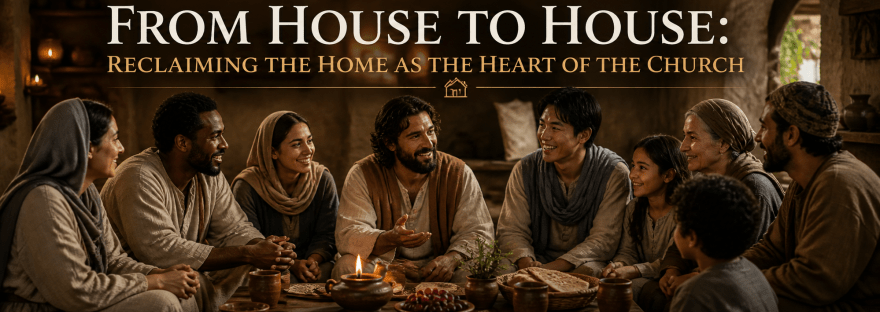
Before there were church buildings or institutions, the Kingdom of God moved quietly and powerfully through homes. The early Church was not sustained by structures. Instead, it thrived through lives surrendered to Christ within households. The home became both a sanctuary and a training ground. It was a place where faith was taught, seen, practiced, and passed on. Scripture gives us this picture:
“So continuing daily with one accord in the temple, and breaking bread from house to house…” (Acts 2:46)
This was daily life. Faith shaped the ordinary. Meals were shared with gladness, prayers lifted together. The Word was spoken in teaching, conversation, correction, and encouragement. What happened at home shaped the Church as it became.
When I consider this, I see that the household was not secondary; it was central. Christian homes were marked by a distinct way of living, intentional and devoted. Fathers led in spiritual care. Mothers nurtured and instructed with wisdom. Children were immersed in the life of faith, watching and learning from devoted lives. Paul’s words reflect this reality:
“Likewise greet the Church that is in their house.” (Romans 16:5)
With this in mind, the Church was not something people attended; it was something they embodied, beginning within their own homes.
You might feel the weight of that truth: “My home doesn’t feel like that. It feels busy, distracted… ordinary.” But this is where the story of the early Church meets our reality. They did not live in ideal conditions, but by daily rhythms we know: meals, responsibilities, relationships. The difference was intention, not perfection. A home becomes a place of Kingdom life when Christ is honored within it, even in small, consistent ways.
Simple daily practices make faith tangible at home: praying together before meals, reading a Bible verse at breakfast, or sharing one way you noticed God at work. Offering encouragement, singing a hymn, or blessing your children before bed are small actions with a meaningful impact. These steps, in the midst of ordinary days, help make Christ central in family life.
Hospitality was another defining mark of these households. This was a way of life, not just an event. Doors were open. Tables were shared. All were welcomed: the stranger, the poor, and the believer. In doing so, families demonstrated the heart of the Kingdom. They met needs beyond what was required.
“Do not forget to entertain strangers, for by so doing some have unwittingly entertained angels.” (Hebrews 13:2)
This kind of hospitality may feel unfamiliar today. You might think, “I don’t have the space, time, or resources for that.” But biblical hospitality is about willingness, not abundance, and it is not about impressing others, but about making room. Even simple acts of welcome are meaningful: inviting a neighbor for coffee, hosting a meal, or helping a single parent. A greeting, a homemade treat, or a listening ear can open the door to a deeper connection. Hospitality is possible for any household, even amid busy lives.
In addition to hospitality, discipleship was not confined to structured settings. It happened in the flow of daily life. As it is written:
“You shall teach them diligently to your children, and shall talk of them when you sit in your house, when you walk by the way, when you lie down, and when you rise up.” (Deuteronomy 6:7)
Faith was integrated into everything. Conversations at the table, prayers before bed, and guidance in decision-making passed on truth and reinforced daily life. Children can participate through simple activities that make faith real: leading a prayer before a meal, choosing a worship song, and sharing daily gratitude. Older children might read a Bible verse or help lead a discussion about faith in daily situations. Age-appropriate practices invite children to weave faith naturally into family life.
Reflecting on this, you may think, “I’ve relied on Church programs to teach what I should be modeling.” That realization is not meant to bring guilt, but clarity. The Church gathers to strengthen and equip, but the home is where faith is continually formed.
Before the Church grew outwardly, it grew inwardly, starting inside everyday homes.
“Every day… in every house, they did not cease teaching and preaching Jesus as the Christ.” (Acts 5:42)
Long before the Church became visible to the world, it was vibrant within homes. Families discipled families. Households became Kingdom outposts. Private beginnings shaped what was seen in public, bringing encouragement and responsibility.
Encouragement comes because Kingdom work does not require platforms or perfect conditions. It begins where we are with the people God places in our lives. Responsibility remains because what happens at home shapes the next generation. None of this is meant to be carried alone. The Body of Christ supports this work. As families walk together in faith and believers encourage one another, impact multiplies. Connecting with other families by joining or forming Church small groups can offer additional encouragement and support. These groups provide a space to share burdens and victories and grow together in faith. Homes connected in Christ become a network of living testimonies, quietly advancing the Kingdom.
So, as we draw these threads together, what do we learn? The home is not separate from ministry; it is the first place of it. Hospitality is not optional; it is an expression of Kingdom life. Faith is best passed on through daily rhythms, not isolated moments, lived in Christ.
The Church did not begin in buildings. It began in homes. And it still flourishes wherever homes are surrendered to Him.
📖 “Therefore, to him who knows to do good and does not do it, to him it is sin.” —James 4:17 (NKJV)
God’s Word teaches that knowing what is right is important, but choosing to do it is what truly matters. In a family, there are many moments each day where this choice appears—whether it is being honest, helping one another, showing kindness, or making a difficult but right decision.
Sometimes it is easy to know what is right, but harder to act on it. There may be fear, hesitation, or the desire to choose what feels easier. This verse reminds us that doing what is right is not something to delay—it is something to act on.
In a home, choosing what is right together builds strong character and trust. When each family member chooses obedience to God, it creates a place where truth is lived out, and relationships grow stronger.
Parents can guide children by helping them understand not only what is right, but why it matters. Encouraging one another to act on what God teaches helps build a family that is grounded in His truth.
There will be times when doing what is right is difficult. In those moments, families can pray together and ask Jesus for strength. He gives the courage needed to follow through with obedience.
Knowing Christ as a family means choosing to act on what He teaches. As each person responds faithfully, the home becomes a place where God’s truth is lived out daily.
Prayer: Jesus, help our family choose what is right. Give us the courage to act on what You teach, even when it is difficult. Teach us to encourage one another and follow You faithfully each day. Amen.
📖 “Therefore, to him who knows to do good and does not do it, to him it is sin.” —James 4:17 (NKJV)
Sometimes you know what is right, but it can still be hard to do it. You might feel tempted to choose something easier or follow what others are doing. But God teaches you to do what is right.
Doing what is right means obeying God and choosing what pleases Him. It means being honest, kind, and making good choices, even when it is difficult.
Jesus helps you do what is right. When you are unsure or tempted, you can ask Him for help. He gives you the strength to choose what is good.
Each time you choose to do what is right, you are growing in your faith. You are learning to follow Jesus more closely.
Prayer: Jesus, help me do what is right. When I feel tempted to choose the wrong thing, give me strength to follow You. Teach me to make choices that honor You every day. Amen.
📖 “Therefore, to him who knows to do good and does not do it, to him it is sin.” —James 4:17 (NKJV)
James presents a direct and sobering truth—sin is not only what you do wrong, but also what you fail to do when you know what is right. This expands the understanding of obedience beyond avoiding wrongdoing. It includes actively choosing what aligns with God’s will.
As a teenager, you are often aware of what is right. Whether through Scripture, instruction, or conviction, there are moments when the right choice is clear. Yet knowing what is right does not always make it easy to act on it. Pressure, fear, or convenience can influence decisions in ways that lead away from obedience.
This verse brings clarity to those moments. When you recognize what is good and choose not to act on it, that inaction becomes sin. This reveals that obedience is not passive—it requires intentional response.
Through the Holy Spirit, Christ brings conviction and guidance. He makes you aware of what is right and strengthens your ability to follow through. The presence of conviction is not meant to discourage you, but to direct you back into alignment with God.
Choosing what is right often requires courage. It may involve standing apart from others, speaking when it would be easier to remain silent, or acting when it would be more comfortable to do nothing. These moments shape your character and reflect your trust in God.
Knowing Christ transforms how you respond to conviction. Instead of resisting or ignoring it, you begin to act on it. Obedience becomes a deliberate choice to align with His truth.
Doing what is right is not always easy, but it is always the path of obedience.
Prayer: Jesus, help me not only know what is right, but to act on it. When I feel tempted to ignore what You are showing me, give me courage to obey. Shape my heart to respond quickly and faithfully to Your truth. Amen.
📖 “Therefore, to him who knows to do good and does not do it, to him it is sin.” —James 4:17 (NKJV)
This verse brings a clear and searching truth—obedience is not only about avoiding what is wrong, but also about actively doing what is right. When God makes something known, whether through His Word or conviction by the Holy Spirit, the response is not meant to remain passive. It calls for action.
As a woman navigating daily responsibilities and decisions, there are moments when the right path is clear. You may sense a prompting to speak, act, respond with kindness, or step forward in obedience. Yet even with clarity, hesitation can arise. Fear, uncertainty, or the desire for comfort can make it tempting to delay or avoid action.
Scripture reveals that in those moments, inaction carries weight. Choosing not to do what is right, when it is known, is itself sin. This truth is not meant to condemn, but to bring clarity. It highlights the importance of responding faithfully to what God has already revealed.
Through the Holy Spirit, Christ brings both conviction and strength. He does not leave you to act alone. He guides your understanding and enables your response. As you grow in sensitivity to His leading, your willingness to act increases.
There will be times when doing what is right requires courage—speaking truth with grace, extending forgiveness, or stepping into something that feels uncertain. In those moments, obedience becomes an act of trust.
Knowing Christ transforms how you respond to conviction. It is no longer something to ignore or delay, but something to act upon. Faith becomes visible through obedience.
Doing what is right is not about perfection—it is about faithful response to what God has shown.
Prayer: Jesus, help me be faithful to act on what You show me is right. When I am tempted to hesitate or avoid obedience, give me the courage to follow through. Strengthen my heart to respond quickly and trust Your leading in every situation. Amen.