I’m a follower of Christ, learning daily to walk the narrow path laid out in His Word. Through Rooted & Raised: Anchoring Women & Children in Christ, I simply seek to point others back to Scripture, tested by the Holy Spirit, lived out in faith, and anchored in truth.
● This space isn’t about lofty theology or grand platforms. It’s about humble obedience, Kingdom living, and helping others, especially women and families, rediscover the kind of faith that bears fruit, costs something, and reflects the love of Christ. My heart is to encourage others as I learn, grow, and surrender alongside them.
● This space isn’t built on lofty theology or big platforms, it’s grounded in humble obedience, Kingdom living, and encouraging women and families to rediscover a faith that bears fruit, costs something, and reflects the love of Christ.
● I don’t have a budget for an editor, publisher, or team behind the scenes. Everything you see here is created prayerfully and paid for out of pocket, using the tools I can afford to help present a clear, polished message of truth and hope.
● If you're blessed by what you read and would like to contribute toward this work, you’re welcome to support via:
📲 Cash App: $RootedRaised
📖 “Be strong and of good courage… do not be afraid… for the Lord your God is with you wherever you go.” —Joshua 1:9 (NKJV)
Sometimes it can be hard to do what is right, especially when others are doing something different. You might feel nervous or unsure. But God tells you to be strong and courageous because He is always with you.
Being brave does not mean you are never afraid. It means you trust God and choose to do what is right, even when it feels hard.
Jesus helps you be brave. When you pray and ask Him for help, He gives you the courage to stand for what is right and to follow Him.
Each time you choose to do what is right, you grow stronger in your faith and learn to trust God more.
Prayer: Jesus, help me be brave and do what is right. When I feel afraid, remind me that You are with me. Give me the courage to follow You in every situation. Amen.
📖 “Be strong and of good courage… do not be afraid… for the Lord your God is with you wherever you go.” —Joshua 1:9 (NKJV)
God’s command to Joshua was given in a moment of transition and responsibility. He was about to lead God’s people into unfamiliar territory, facing challenges that required both strength and trust. The foundation of that courage was not Joshua’s ability, but God’s presence—the Lord your God is with you wherever you go.
As a teenager, there are moments when standing for what is right requires courage. It may involve going against the crowd, choosing integrity when others do not, or remaining faithful to God’s Word in situations where it is not popular. These moments can bring pressure, uncertainty, or fear.
Scripture does not deny those feelings, but it redirects your focus. Courage is not the absence of fear—it is the decision to act in obedience despite it. The reason you can do so is the same reason given to Joshua: God is with you.
Through the Holy Spirit, Christ strengthens your heart to stand firm. He provides clarity when you are unsure, conviction when you are tempted to compromise, and strength when obedience feels costly. You are not standing alone—His presence sustains you.
There will be times when choosing what is right requires sacrifice. You may be misunderstood, left out, or challenged. In those moments, remembering who you are following brings perspective. Obedience to God is greater than approval from others.
Courage also grows over time. Each decision to stand for what is right strengthens your faith and deepens your trust in God. What once felt difficult becomes steadier as you learn to rely on Him.
Knowing Christ transforms courage from self-reliance into dependence on His presence. You are not drawing strength from yourself, but from the One who is with you.
Courage to stand for what is right is grounded in the certainty that God is with you.
Prayer: Jesus, help me have the courage to stand for what is right. When I feel pressure or fear, remind me that You are with me. Strengthen my heart to choose obedience and to trust You in every situation. Amen.
📖 “Be strong and of good courage… do not be afraid… for the Lord your God is with you wherever you go.” —Joshua 1:9 (NKJV)
God’s command to Joshua was not rooted in his own strength, but in God’s presence. The path ahead was uncertain, yet the foundation for courage was clear—the Lord your God is with you wherever you go. This same truth applies to your life. Courage is not drawn from within yourself, but from the assurance that God is present and active.
As a woman navigating life’s responsibilities and decisions, there are moments when courage is required. It may be standing firm in truth, making a difficult decision, or walking a path that is not widely understood. These moments can bring uncertainty and even fear.
Scripture does not call you to ignore fear, but to trust God in the midst of it. Courage is the decision to move forward in obedience, even when the outcome is not fully visible. It is choosing to rely on God’s presence rather than your own understanding.
Through the Holy Spirit, Christ strengthens your heart in these moments. He provides clarity when decisions feel uncertain, conviction when compromise is tempting, and strength when obedience requires sacrifice. You are not walking alone—He is with you.
There may be times when choosing truth means standing apart or facing misunderstanding. In those moments, remembering who you are following brings perspective. Your obedience is not for others’ approval, but for alignment with God.
Courage also grows as it is exercised. Each step of obedience strengthens your faith and deepens your trust in God’s faithfulness. What once felt difficult becomes steadier as you learn to rely on Him.
Knowing Christ transforms courage from self-effort into reliance on His presence. It becomes a steady confidence that no matter where you go, He is with you.
Courage to walk in truth is sustained by the presence of God.
Prayer: Jesus, help me walk in courage as I follow You. When I feel uncertain or afraid, remind me that You are with me. Strengthen my heart to stand in truth and trust You in every step I take. Amen.
📖 “Be strong and of good courage… do not be afraid… for the Lord your God is with you wherever you go.” —Joshua 1:9 (NKJV)
God calls families to be strong and courageous, not because life will always be easy, but because He is always with them. His presence is the reason a family can face challenges with confidence and peace.
In a home, courage can be seen in many ways—doing what is right when it is difficult, trusting God when things are uncertain, and encouraging one another when fear begins to rise. Each family member plays a role in helping the others remain strong.
There will be times when situations feel overwhelming or unclear. In those moments, remembering God’s promise brings comfort. He is present, guiding and strengthening each step.
Families can grow in courage by turning to God together. Praying, reading His Word, and speaking His promises aloud help remind everyone that they are not alone. These practices build faith and confidence over time.
Parents can lead by showing trust in God during difficult moments. Children learn that courage is not about being fearless, but about trusting God even when fear is present.
As a family walks in courage together, fear begins to lose its hold. Each person learns to rely on God’s presence rather than their own understanding.
Knowing Christ as a family means living with confidence in His promise. As you trust Him together, your home becomes a place of strength, peace, and steady faith.
Prayer: Jesus, help our family be strong and courageous. When we feel afraid or uncertain, remind us that You are with us. Teach us to trust You and encourage one another as we follow You each day. Amen.
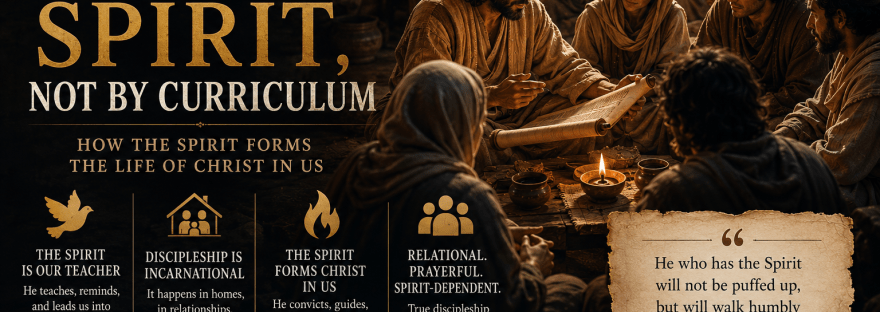
Discipleship is not just about workbooks, programs, or structured courses. While these tools have value, true discipleship is a deeper, lifelong process led by the Spirit. It involves being transformed into the image of Jesus Christ through surrender, obedience, and daily abiding in Him. But what does this look like in everyday life? Simple daily practices can help. You might begin your morning by inviting the Spirit to guide your words and actions. Pause regularly to pray or recall Scripture throughout your day. Choose to obey a gentle prompting to serve someone in need or forgive someone who has hurt you. End your day by reflecting in prayer, asking God to reveal where you need to grow and giving thanks for His presence. Practicing small acts of surrender, obedience, and trust creates space for the Spirit to shape you into Christ’s likeness. This distinction matters because it is possible to gather information about Christ through programs yet remain untransformed by Him, whereas Spirit-led discipleship leads to real change.
The early Church knew this truth well. They had no printed study guides or official discipleship systems. They did not depend on complex programs. Yet they raised courageous, holy, and faithful believers who were rooted in Christ. Why? Their discipleship was grounded in Scripture, shaped by the Spirit, and lived out through daily surrender and obedience.
Jesus promised His followers:
“But the Helper, the Holy Spirit, whom the Father will send in My name, He will teach you all things…” (John 14:26)
The Holy Spirit is essential, not optional, in discipleship. Without the Spirit, discipleship can become about information rather than transformation. Knowledge may grow, but the heart can stay the same. Someone might learn biblical words, memorize doctrine, and participate in church activities, yet remain spiritually immature. The Spirit brings conviction, humility, obedience, and real change.
You may pause here and recognize something deeply personal. “I’ve learned a lot about Christianity, but sometimes I still feel unchanged inside.” That realization can feel discouraging, but it is also important. Feeling this way is a normal part of the journey, and you are not alone. When you notice this gap between what you know and how you feel, take it to God in prayer and ask Him to keep shaping your heart. If needed, consider reaching out to a trusted friend or spiritual mentor to pray with you and offer support. Scripture never presents discipleship as mere intellectual growth. God’s goal is not simply informed minds, but transformed lives.
The Spirit shapes our hearts in ways the world never could. He does not just give information. He forms Christ within His people. He reminds them of Jesus’ words, convicts them of sin, strengthens them in their weakness, and leads them into the truth through God’s Word.
John writes:
“But the anointing which you have received from Him abides in you… and His anointing teaches you concerning all things…” (1 John 2:27)
This does not mean teachers are unnecessary. God sends pastors, elders, and teachers to help the Church. But good teaching always points people to trust Christ and depend on the Holy Spirit, not just human systems.
The early Christians understood this balance well. They valued instruction, but they recognized that the Spirit was the true Teacher behind every faithful word spoken. Their discipleship was also deeply relational.
Today, discipleship can become institutionalized. Classes, schedules, and programs often contain it. But in the early Church, discipleship happened during daily life. It took place in homes with meals and prayer. It happened during suffering and hardship. Mature believers walked with younger ones, showing faithfulness day by day. They learned Christ not only through sermons but through watching one another endure suffering, extend forgiveness, practice hospitality, and remain steadfast in prayer.
You may reflect, “I long for that kind of authentic discipleship.” Many believers feel that tension today. While programs can organize information, they cannot create the spiritual family, shared burdens, or Spirit-filled relationships that come from true discipleship. Discipleship is formed through proximity, humility, patience, and genuine care within the Body of Christ.
One way to foster this kind of community is to participate in small groups that meet regularly for prayer, sharing, and mutual encouragement. Opening your home for meals, joining accountability partnerships, or gathering a few people to study Scripture and pray together can help deepen relationships. Serving together on ministry teams, visiting those in need, or simply spending time with others outside of formal church events builds real connection. Creating space in church life for honest conversations and shared prayer helps nurture authentic spiritual friendships and provides practical support for the journey of faith. This is why the early Church emphasized character so strongly.
The Spirit does not produce prideful, self-exalting disciples. He forms humility, servanthood, and love within believers. As the Shepherd of Hermas observed:
“He who has the Spirit will not be puffed up, but will walk humbly and serve others.”
The evidence of spiritual maturity is not merely knowledge; it is Christlike character.
Paul expressed this beautifully when he wrote:
“My little children, for whom I labor in birth again until Christ is formed in you…” (Galatians 4:19)
That is the true goal of discipleship: Christ formed within His people.
The Holy Spirit works with patience in believers. He shapes the life of Jesus in them. He convicts sin, renews the mind, grows spiritual fruit, and gives power to obey. He teaches not only Christ’s words, but His ways.
No curriculum alone can produce love, joy, peace, patience, kindness, goodness, faithfulness, gentleness, or self-control. While programs may impart biblical concepts, only abiding in Christ produces spiritual fruit, contrasting external teaching with internal transformation. Only abiding in Christ through the Spirit can.
You may quietly wonder, “Why does spiritual growth sometimes feel slow?” Discipleship is not instant. Formation takes time. Slow growth is not a sign of failure but rather a normal and purposeful part of God’s process. The Spirit often works deeply and patiently. Even in seasons when change feels slow, God is still at work below the surface, shaping believers through ordinary obedience, hidden prayer, trials, correction, and perseverance. Remember how God formed Joseph in the darkness of prison before raising him into leadership, or how Moses spent years in the wilderness before stepping into his calling. Growth is seldom as dramatic as people expect, but just as in Scripture, God faithfully brings fruit in His timing. Over time, though, the evidence becomes visible. And importantly, believers are not meant to walk this process alone.
The Spirit forms disciples in the Body of Christ. The early Church prayed together, corrected and encouraged one another, and carried each other’s burdens. Spirit-led discipleship thrives in communities where believers truly pursue Christ and help each other stay faithful. If you are seeking to experience this kind of community, consider joining a prayer group at your church or starting a regular gathering with a few friends to pray, study Scripture, and encourage one another. You might also form an accountability partnership with someone you trust, meeting regularly to share honestly, pray, and support each other in your walk with Christ. Taking these steps can help make the communal aspect of discipleship more accessible and real in your own life.
Here is great comfort for the restless heart. Transformation does not depend on our strength or perfect systems. The same Spirit who empowered the early Church indwells believers today, faithfully completing His work in us.
What the early Church teaches us is deeply needed today. True discipleship is Spirit-led, not merely driven by schedules. The Holy Spirit is our Teacher, Comforter, and Transformer. Programs may inform, but only the Spirit forms Christ within us. And discipleship must remain relational, prayerful, humble, and dependent upon God. Because the goal has never simply been to educate Christians. The goal is for people who increasingly look like Jesus.
📖 “And whatever you do, do it heartily, as to the Lord and not to men.” —Colossians 3:23 (NKJV)
God calls families to do their best in everything, not for attention or praise, but for Him. When each person understands that their actions are done for the Lord, it changes how they approach daily tasks and responsibilities.
In a home, this can be seen in simple ways—helping with chores, completing responsibilities, and treating one another with care. Even the smallest tasks become meaningful when they are done with a willing heart.
Sometimes it can be hard to stay motivated, especially when work feels routine or when no one seems to notice. But God sees every effort. Doing your best is not about being perfect, but about giving your effort with the right attitude.
Families can encourage one another by reminding each other that their work matters. When everyone contributes with a willing heart, the home becomes a place of teamwork, respect, and care.
Parents can model this by showing dedication and a positive attitude in their own responsibilities. Children learn that doing their best is a way to honor God.
Knowing Christ as a family means choosing to do everything with a whole heart for Him. As each person gives their best, the home reflects His faithfulness and love.
Prayer: Jesus, help our family do our best in everything we do. Teach us to work with willing hearts and good attitudes. Remind us that we are serving You in all things, and help us honor You each day. Amen.
📖 “And whatever you do, do it heartily, as to the Lord and not to men.” —Colossians 3:23 (NKJV)
This instruction shifts the focus of your work from outward recognition to inward devotion. What you do is not ultimately for others to see or approve—it is done before the Lord. This transforms even the most ordinary tasks into something meaningful.
As a woman carrying many responsibilities, there are moments when what you do may feel unnoticed or routine. Effort can go unseen, and motivation can fade when recognition is absent. Yet Scripture reminds you that your work is not defined by who sees it, but by who it is for.
To do something “heartily” means to give your full attention and effort, not out of pressure, but out of devotion. It reflects a willingness to engage fully, even in tasks that may seem small or repetitive.
This perspective changes how you approach your day. What might feel ordinary becomes purposeful. Each responsibility, each act of service, becomes an opportunity to honor God.
Through the Holy Spirit, Christ reshapes your motivation. Instead of seeking external affirmation, you find steadiness in knowing that God sees every detail. This brings both freedom and consistency.
There will be times when working wholeheartedly requires intentionality—choosing to give your best when you feel tired, unrecognized, or distracted. In those moments, remembering who you are serving brings clarity and strength.
Knowing Christ transforms your work from obligation into worship. It becomes an expression of your relationship with Him.
Wholehearted work reflects a life directed toward God, not defined by others.
Prayer: Jesus, help me do everything with a whole heart for You. When I feel unseen or unmotivated, remind me that You see all things. Strengthen me to serve faithfully and to honor You in every task, both great and small. Amen.
📖 “And whatever you do, do it heartily, as to the Lord and not to men.” —Colossians 3:23 (NKJV)
Paul redirects the motivation behind every action. The focus is not on external recognition or approval, but on the Lord Himself. This means that every task—whether seen or unseen, significant or routine—is ultimately done before God.
As a teenager, much of what you do can feel tied to expectations—grades, performance, responsibilities, or how others perceive your effort. It can be easy to measure your work based on recognition or results. Yet Scripture calls you to a deeper motivation.
To work “heartily” means to engage fully, with sincerity and effort. It is not about perfection, but about wholeheartedness. This kind of work is not dependent on who is watching or whether the task feels important. It is rooted in the understanding that everything you do is done before the Lord.
This perspective transforms even ordinary responsibilities. Tasks that may seem routine or unnoticed become meaningful when they are done as an offering to God. Your effort reflects your devotion, not your circumstances.
Through the Holy Spirit, Christ shapes this mindset within you. He redirects your focus from external validation to internal faithfulness. Over time, your work becomes consistent, not because of pressure, but because of purpose.
There will be moments when it is tempting to do less—when the task feels unimportant or when no one is paying attention. In those moments, remembering who you are ultimately serving brings clarity. Your work is not for temporary approval, but for the One who sees fully.
Knowing Christ transforms your motivation. You are no longer working to be seen by others, but to honor Him.
Working with a whole heart reflects a life directed toward God.
Prayer: Jesus, help me do everything with a whole heart for You. When I feel unmotivated or focused on what others think, remind me that I am serving You. Strengthen me to work faithfully in every task and to honor You in all I do. Amen.
📖 “And whatever you do, do it heartily, as to the Lord and not to men.” —Colossians 3:23 (NKJV)
God wants you to do your best in everything you do. Whether you are learning, helping at home, or playing, you can do it with a good attitude and a willing heart.
Sometimes it may feel easier to rush or not try very hard. But Jesus teaches you to give your best effort, because you are doing it for Him.
When you do your best, you show that you care and that you want to honor God. It is not about being perfect—it is about trying your best with a joyful heart.
Jesus helps you have the strength and attitude to do your best each day.
Prayer: Jesus, help me do my best in everything I do. Teach me to work with a good attitude and a willing heart. Thank You for helping me honor You in all I do. Amen.
📖 “A soft answer turns away wrath, but a harsh word stirs up anger.” —Proverbs 15:1 (NKJV)
Gentleness plays an important role in creating a peaceful home. God’s Word teaches that how we respond to one another can either calm a situation or make it worse. A gentle answer brings peace, while harsh words can lead to more conflict.
In a family, there are many moments when emotions can rise—misunderstandings, frustration, or tiredness. In those moments, each person has a choice. Instead of reacting quickly with strong words, choosing a gentle response can change the direction of the situation.
A gentle answer does not ignore what is wrong. It means speaking truth in a calm and kind way. This helps others feel heard and understood, making it easier to resolve problems.
Parents can model gentleness by responding calmly, even during difficult moments. Children learn that strength is shown through self-control and kindness, not through harsh reactions.
When a family practices gentleness, it creates a home where people feel safe, respected, and cared for. Conflicts are handled with wisdom, and peace becomes a natural part of daily life.
Knowing Christ as a family means allowing His gentleness to shape your words and actions. As each person chooses to respond with care, the home becomes a place where peace grows and relationships are strengthened.
Prayer: Jesus, help our family respond with gentleness. Teach us to speak calmly and choose words that bring peace. Guide our hearts so that our home reflects Your love in every conversation. Amen.