“But each one must examine his own work, and then he will have reason for boasting, but to himself alone, and not to another.” — Galatians 6:4 (NASB 1995)
In a world obsessed with comparing achievements, Paul calls believers to examine their own work. Not to prove themselves to others, but to walk in Spirit-led integrity.
The Spirit invites you to measure your growth—not by others’ successes—but by your own obedience. That quiet, faithful service God sees? That matters.
Don’t compare your ministry. Steward your assignment.
Reflection: Am I looking to others for validation—or asking the Spirit to examine my own heart?
Prayer: Holy Spirit, teach me to live faithfully before You. Let me examine my life by Your Word, not someone else’s success. Amen.
From the series: Understanding the End Times — A Biblical Framework
“And I saw thrones, and they sat on them, and judgment was committed to them… And they lived and reigned with Christ for a thousand years.” — Revelation 20:4 (NKJV)
When John describes Christ’s thousand-year reign in Revelation 20, believers often pause and ask: What exactly is the millennium? How we answer that question shapes our entire view of eschatology.
For two thousand years, Christians have wrestled with how to interpret this passage. Three main views have emerged: Premillennialism, Amillennialism, and Postmillennialism. Each carries implications not only for how we read Scripture, but also for how we live out our faith.
What Is the Millennium?
The word “millennium” comes from the Latin mille (thousand) and annus (year). Revelation 20:1–6 mentions “a thousand years” six times, describing a period when Satan is bound, the saints reign with Christ, and the first resurrection takes place.
The question isn’t whether the text speaks of a thousand years — it clearly does. The question is whether this is to be taken literally or symbolically, and how it fits into the broader storyline of Scripture.
The Three Major Views
1. Premillennialism
Christ returns before the millennium.
Revelation 19 (Christ’s return) flows naturally into Revelation 20 (the thousand-year reign).
Christ reigns on earth, fulfilling Old Testament promises of peace, justice, and restoration.
Strengths: Takes the text literally, aligns with Old Testament prophecies, reflects the expectation of the early church.
2. Amillennialism
The millennium is symbolic of Christ’s current reign from heaven.
The binding of Satan is seen as Christ’s victory at the cross, limiting his power over the nations.
There is no literal thousand-year reign; Christ returns once at the end for judgment and new creation.
Strengths: Simplicity. But it risks spiritualizing promises made to Israel and reinterpreting prophecy apart from its plain meaning.
3. Postmillennialism
The millennium is a golden age of gospel triumph.
Through preaching, missions, and cultural transformation, the world becomes increasingly Christianized.
Christ returns after this period of worldwide renewal.
Strengths: Optimism for the power of the gospel. Yet history — world wars, apostasy, increasing hostility — challenges this view.
The Early Church and the Shift
The early church was overwhelmingly Premillennial (often called Chiliasm). Writers like Justin Martyr (AD 100–165) and Irenaeus (AD 130–200) expected a literal reign of Christ on earth.
But over time, especially under the influence of Greek philosophy that despised material and earthly realities, allegorical interpretation grew.
Origen (AD 185–254) spiritualized many prophecies, and Augustine (AD 354–430) eventually shifted from a Premillennial to an Amillennial position. In his City of God, he argued the millennium represented the present church age.
This view gained dominance in the Roman Catholic Church and for centuries branded Chiliasm as heresy.
Testing by Fruit
Jesus said: “You will know them by their fruits.” (Matthew 7:16)
The Chiliast expectation of the early church produced urgency, holiness, and watchfulness.
The allegorical shift produced complacency, political compromise, and hostility toward Israel.
The Postmillennial dream produced missionary zeal, but faltered under the reality of human sin.
By their fruit, we see which view best aligns with the consistent, literal promises of God’s Word.
Why It Matters
Eschatology isn’t just about charts or arguments. It’s about whether we take God at His Word. Do we believe Christ will return to reign, just as He said? Do we trust that His promises to Israel and the nations will be fulfilled?
The millennium question forces us to confront whether our hermeneutic — our method of interpretation — is consistent.
Reflection
The three millennial views show us more than academic differences. They reveal the importance of reading Scripture faithfully. The early church expected a literal kingdom. Over time, allegory blurred those promises. Today, we are called back to simple trust: God says Christ will reign for a thousand years — and He will.
Reflection Questions
Which millennial view were you most familiar with before reading this?
Why do you think the early church’s expectation of a literal kingdom is significant?
How does Jesus’ warning to test by fruit (Matt. 7:16) apply when evaluating different eschatological systems?
Closing Prayer
Lord, thank You that Your Word is clear and true. Guard us from twisting it to fit human philosophies or traditions. Help us to trust in Your promises, as written, and to wait eagerly for the day when Christ will reign on the earth. Keep us watchful, holy, and ready. In Jesus’ name, Amen
“For if anyone thinks that he is something when he is nothing, he deceives himself.” — Galatians 6:3 (NASB 1995)
Humility isn’t thinking less of ourselves—it’s thinking of ourselves less. And in a world full of “me first” messaging, we need the Spirit’s help to model and teach that.
Children learn humility when they see us serve, confess, ask for help, and encourage others.
The Spirit frees us from the lie that we must be “something”—and reminds us that being in Christ is everything.
Family Talk:
Why do we sometimes think we’re better than others?
How can we stay humble and remember we need God and each other?
Prayer: Holy Spirit, make our family humble. Keep us from thinking too highly of ourselves, and teach us to love like Jesus. Amen.
“For if anyone thinks that he is something when he is nothing, he deceives himself.” — Galatians 6:3 (NASB 1995)
Thinking you’re better than others isn’t confidence—it’s deception.
The Spirit opens our eyes to see that apart from Christ, we’re not “something”—we’re nothing. That realization doesn’t crush you; it frees you. Because once pride dies, grace can take root.
And that’s where real strength grows.
Challenge: Confess one area where pride has blinded you. Ask the Holy Spirit to replace it with humility.
Prayer: Holy Spirit, break any pride that’s hidden in me. Help me see myself rightly—humble, dependent, and loved by You. Amen.
“For if anyone thinks that he is something when he is nothing, he deceives himself.” — Galatians 6:3 (NASB 1995)
We live in a culture that celebrates self-promotion, but the Spirit teaches us to walk in humility. Pride isn’t just loud boasting—it’s subtle self-focus. It’s the quiet voice that says, “I’m fine. I’ve got this. I don’t need help.”
But the truth is—we’re nothing apart from Christ. And the Spirit reveals that truth not to shame us, but to free us from the trap of self-deception.
Reflection: Am I depending on myself or walking humbly with the Spirit?
Prayer: Holy Spirit, reveal any pride in me. I don’t want to be deceived by self-sufficiency. Make me humble and dependent on You. Amen.
From the Series: The Ark of the Covenant as a Prophetic Game Changer
“And the temple of God was opened in heaven, and the ark of His covenant was seen in His temple. And there were lightnings, noises, thunderings, an earthquake, and great hail.” — Revelation 11:19 (NKJV)
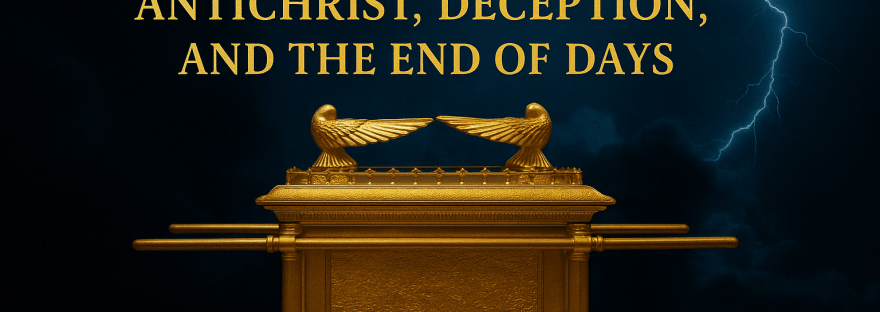
For centuries, the Ark of the Covenant has stirred both fascination and mystery. Hidden since the days of Jeremiah, it is remembered in Scripture as the earthly throne of God’s presence (Exodus 25:22). To Israel, it symbolized covenant, holiness, and power. To the nations, it represented a dangerous and untouchable force.
But what if this Ark were to be rediscovered in our generation? Could its unveiling play a role in the rise of Antichrist and the final deception of the last days?
This question forms the heart of our new series: The Ark of the Covenant as a Prophetic Game Changer.
Why the Ark Matters in Prophecy
The Ark is more than an artifact. It connects directly to prophecy:
God’s covenant faithfulness — The Ark contained the tablets of the Law, Aaron’s rod, and manna (Hebrews 9:4). Each reminds us that God does not forget His promises.
The Temple question — Daniel, Jesus, and Paul all speak of a future desecration in a restored temple (Daniel 9:27; Matthew 24:15; 2 Thessalonians 2:4). The Ark’s discovery could ignite calls to rebuild.
Revelation’s imagery — John sees the Ark in heaven, linked with God’s final judgments (Revelation 11:19).
The Antichrist and Deception
Scripture warns that the Antichrist will rise “with all power, signs, and lying wonders” (2 Thessalonians 2:9). If the Ark were uncovered, it could become a rallying point for global attention:
Used by Israel as proof of divine favor.
Exploited by Antichrist as a tool to demand worship.
Twisted into a counterfeit sign of God’s presence.
Satan has always sought to imitate what is holy (2 Corinthians 11:14). The Ark could serve as a powerful stage for the final deception.
How This Fits in the End Times
Our series explores multiple theories about how the Ark might intersect with prophecy:
Catalyst for the Third Temple — sparking religious and political momentum in Jerusalem.
Symbol of false security — Israel trusting in the Ark instead of the God of the Ark, as in Jeremiah’s day (Jeremiah 7:4).
Global spectacle — nations enraged, yet drawn into the drama of Israel’s covenantal claims.
Foreshadow of Revelation 11:19 — the Ark seen in heaven before God’s final judgments.
Why We Must Be Watchful
Jesus told us to “watch” (Matthew 24:42). Not to speculate endlessly, but to discern the times with sober clarity. If the Ark were to reappear, it would not be a cause for superstition or misplaced hope — but for renewed confidence in God’s Word, which cannot fail.
The Ark points us not to Antichrist, but to Christ. It reminds us that God dwells with His people, that His covenant is sure, and that His Son will return to reign.
Closing Thought
The Ark of the Covenant is not a relic of the past. It is a symbol of God’s unchanging promises — promises that will culminate in Christ’s glorious return. Whether hidden in the earth or revealed in heaven, its true meaning is fulfilled in Jesus, the greater Ark, who is Himself the presence of God among us (John 1:14).
Let us watch, wait, and walk faithfully until that day.
The Man of Lawlessness (Antichrist) is a prophetic certainty (2 Thessalonians 2:3–4; Daniel 9:27; Matthew 24:15). The Ark of the Covenant is seen in heaven (Revelation 11:19).
However, the role of the earthly Ark in end-times prophecy is a matter of theory, not doctrine. Its rediscovery could align with prophecy (Temple rebuilding, Antichrist’s deception, global conflict), but Scripture does not require this for God’s plan to unfold.
We handle prophecy with reverence:
Certainties we hold tightly.
Theories we explore carefully.
Speculation we avoid.
Let Scripture remain our anchor as we watch and wait for Christ’s return.










Leave a comment