
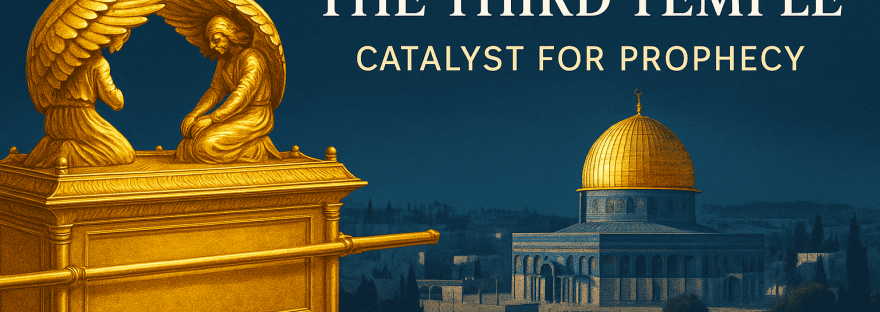
From the Series: The Ark of the Covenant as a Prophetic Game Changer
“Then he said to me, ‘This is the place where My throne and the place of the soles of My feet, where I will dwell in the midst of the children of Israel forever.’” — Ezekiel 43:7 (NKJV)
For centuries, Jewish longing for a restored Temple in Jerusalem has remained at the heart of biblical prophecy. The Temple was not merely a building; it was the center of worship, sacrifice, and God’s covenant presence. Scripture foretells a time when a temple will stand again — and in it, prophecy will unfold in dramatic and sobering ways.
But what could trigger such a monumental project in our day? For many, the rediscovery of the Ark of the Covenant would be the catalyst.
Why the Temple Matters
The Temple plays a central role in both Old and New Testament prophecy:
- Daniel’s Seventieth Week — the “abomination of desolation” occurs in the Temple (Daniel 9:27; Matthew 24:15).
- Paul’s Warning — the “man of sin” sits in the Temple of God, proclaiming himself as God (2 Thessalonians 2:4).
- Ezekiel’s Vision — a future, glorified Temple in the millennial kingdom (Ezekiel 40–48).
Without a temple, these prophecies cannot be literally fulfilled. That is why any movement toward rebuilding must be watched with discernment.
The Ark as a Catalyst
The Ark of the Covenant, long hidden from history, could provide the religious and symbolic momentum for rebuilding. Consider:
- Religious Authority — For observant Jews, the Ark represents the very presence of God. Its unveiling would validate Temple-centered worship.
- National Identity — The Ark is bound up with Israel’s history. Its return would unify the nation around a tangible link to God’s covenant.
- Global Attention — The world would not ignore such a discovery. The Ark could become the most significant archaeological find in history, drawing both fascination and hostility.
Like the return of the exiles in Ezra’s day, the Ark could be seen as a divine signal to “rise up and build” (Ezra 1:3).
Prophetic Implications
If the Ark were placed in a rebuilt Temple, several prophetic threads would converge:
- The Antichrist’s deception (2 Thessalonians 2:4) — sitting in the Temple, perhaps near or even above the Ark, demanding worship.
- The renewed sacrifices (Daniel 9:27) — reinstated in a rebuilt sanctuary, only to be halted by the Antichrist.
- The world’s rage (Zechariah 12:3) — Jerusalem becoming a burdensome stone as nations contend with Israel’s claim of covenant authority.
Far from confirming salvation, the Ark in the Temple would test where people place their trust — in ritual and relics, or in the living Christ.
A Call to Watchfulness
The Ark’s discovery, should it happen, would not be the fulfillment of hope but the unfolding of warning. Just as Jeremiah warned Israel against trusting “the temple of the Lord” as a false refuge (Jeremiah 7:4), so today we must be cautious not to confuse the symbols of covenant with the Lord of the covenant.
The true Temple is Christ Himself (John 2:19–21), and those in Him are the living stones of His spiritual house (1 Peter 2:5).
Reflection Questions
- Why is the Temple central to the unfolding of prophecy?
- How might the Ark’s discovery ignite both devotion and deception?
- In what ways can we ensure our trust remains in Christ, not in outward symbols?
Closing Prayer
Lord, give us discernment as we watch the times. Keep us from chasing after signs while ignoring the Savior. Let our hearts be fixed on Christ, the true Temple, who will return to reign in glory. Amen.
Note on Prophetic Theories
The Man of Lawlessness (Antichrist) is a prophetic certainty (2 Thessalonians 2:3–4; Daniel 9:27; Matthew 24:15). The Ark of the Covenant is seen in heaven (Revelation 11:19).
However, the role of the earthly Ark in end-times prophecy is a matter of theory, not doctrine. Its rediscovery could align with prophecy (Temple rebuilding, Antichrist’s deception, global conflict), but Scripture does not require this for God’s plan to unfold.
We handle prophecy with reverence:
- Certainties we hold tightly.
- Theories we explore carefully.
- Speculation we avoid.
Let Scripture remain our anchor as we watch and wait for Christ’s return.
Discover more from Rooted & Raised
Subscribe to get the latest posts sent to your email.

