Devotions, Family Devotionals

🏡 Kingdom Family Devotional — Day 3

Day 3

— “Blessed are those who mourn, for they shall be comforted.”

Matthew 5:4 NASB1995

🌬 A Home that Grieves Righteously

To mourn in this verse is to grieve over sin—our own, and the brokenness around us. It’s not surface sadness; it’s the ache of a heart awakened to God’s holiness. And in that grief, Jesus promises comfort.

In this season with older children, you have the privilege of guiding their conscience. Help them see sin not as mere rule-breaking, but as something that wounds relationship with God. Let your own mourning over sin lead them to understand both the seriousness of sin and the beauty of God’s mercy.

🕯 A Mother’s Role

Don’t hide your sorrow over sin. Let your children see the tears that come from a tender heart. But also let them see the joy of restoration. You are shaping how they will handle conviction—with avoidance or with repentance and hope.

📖 Talk About It:

  • What kind of mourning do you think Jesus is talking about?
  • When have you felt truly sorry before God? What happened next?

🧰 Kingdom Practice

Set aside time to read Psalm 51 together. Invite your children to quietly reflect and journal a prayer of confession. Afterwards, read 1 John 1:9 aloud as a reminder of God’s promise to forgive.

✍️ Prayer

Lord, teach us to mourn over sin, not with despair, but with hope. Let our home be a place where repentance is real and comfort is received. Shape my children to hate sin and love righteousness. In Jesus’ name, Amen

1–2 minutes

Leave a comment

Devotions, Teen Devotions

😎 Kingdom Teen Devotional — Day 3

“Blessed are those who mourn, for they shall be comforted.”

Matthew 5:4 NASB1995

🤔 When Sin Actually Hurts

This kind of mourning isn’t about losing your favorite hoodie. It’s the sorrow that hits when you realize your sin has hurt your relationship with God.

Sometimes it’s easier to scroll past conviction. But Jesus says those who actually feel their sin, who don’t numb it or brush it off, will be comforted by Him. When your heart breaks for what breaks His, He doesn’t reject you—He wraps you in mercy.

🔊 Real Talk:

  • When was the last time you felt truly sorry for something wrong you did?
  • What did you do with that feeling? Did you talk to God about it?

✨ Try This:

Read Psalm 51. Highlight anything that stands out. Then write a short confession prayer to God. Don’t be afraid of honesty—He’s already waiting.

✍️ Prayer:

God, I don’t want to ignore my sin. Teach me to care about what You care about. Thank You for comforting me when I come to You with a broken heart. Amen.

1–2 minutes

Leave a comment

Devotions, Family Devotionals

🏡 Kingdom Family Devotional — Day 2

Day 2

“Blessed are the poor in spirit, for theirs is the kingdom of heaven.”

Matthew 5:3 NASB1995

🤾 A Posture of Dependence

To be poor in spirit is to recognize our spiritual neediness before God. It’s to come empty so that He may fill. It is not shameful, but blessed. In a world that praises self-reliance, Jesus begins His Kingdom with the opposite: humility.

As a mother raising older children, your example of dependency on Christ is essential. When they see you turning to prayer, repenting with sincerity, and humbling yourself in daily life, they are watching the Kingdom unfold before their eyes.

🕯 A Mother’s Role

Your children are nearing adulthood—they’re watching how you handle failure, weakness, and need. Do they see a mom who hides her need or one who openly relies on the Lord? You lead by example when you confess sin, ask for prayer, and rejoice in God’s mercy.

📖 Talk About It:

  • Why is it hard to admit we need help?
  • What does it mean to be spiritually empty before God?

🧰 Kingdom Practice

Practice a night of prayer together this week. Each person can name one area where they need God’s help. Write them down and keep a list to revisit and give thanks as He answers.

✍️ Prayer

Father, teach us to be poor in spirit. Let our home be marked by humility, not pride; by prayer, not self-sufficiency. Help me model a dependent heart to my children as they step into maturity. In Jesus’ name, Amen.

1–2 minutes

Leave a comment

Children's Devotionals, Devotions

👑 Kingdom Kids Devotional — Day 2

Day 2

“Blessed are the poor in spirit, for theirs is the kingdom of heaven.”

Matthew 5:3

🎒Empty Pockets, Full Heart

Imagine you wanted to get into a big, beautiful castle. The king opens the door and says, “Only those with empty hands can come in.” That might sound strange—but it’s what Jesus meant when He said, “Blessed are the poor in spirit.”

Being poor in spirit means knowing we need God. We don’t come to Him saying, “Look at how good I am!” We come saying, “Jesus, I need You. I can’t do this on my own.” And when we come like that—He welcomes us into His Kingdom!

🏠 What About Long Ago?

Long ago, many kids just like you followed Jesus. They knew they didn’t need to be perfect or rich or popular. They needed Jesus. And that was enough.

💡 Think About It:

  • What does it mean to need Jesus?
  • Can you think of a time when you asked Him for help?

🙏 Let’s Pray:

Jesus, I know I need You every day. Help me to come to You with a humble heart and empty hands. I want to live in Your Kingdom! Amen.

1–2 minutes

Leave a comment

Devotions, Women's Devotionals

🌿 Kingdom Living Devotional — Day 2

Day 2

“Blessed are the poor in spirit, for theirs is the kingdom of heaven.”

Matthew 5:3, NASB1995

💧Empty to Enter

This is where the Kingdom begins—not with strength, success, or spiritual pride—but with poverty of spirit. Jesus’ first words in His sermon speak not to the self-sufficient, but to the soul who knows she has nothing apart from Him.

To be poor in spirit is to come before God emptied of self—aware of your sin, your deep need, your desperate dependence. It’s the opposite of self-righteousness. It’s the posture of the tax collector who beat his chest and said, “God, be merciful to me, the sinner!” (Luke 18:13).

We cannot enter the Kingdom clutching our goodness. We must come as beggars—hands open, heart bowed, trusting the riches of His mercy.

🕯 Ante-Nicene Example

The early church women understood this well. They weren’t trying to build platforms or prove their worth—they humbled themselves before God and each other. Many gave up wealth, status, and even their lives, like Perpetua, a noblewoman in Carthage, who surrendered everything to follow Christ with a heart poor in spirit and rich in faith. Her surrender became her testimony.

💭 Reflect

  • Do I recognize my daily dependence on the Lord, or do I still rely on my own strength?
  • Am I quick to acknowledge my sin before God—or do I resist being seen as “needy”?

🙏 Prayer

Jesus, I have nothing to offer but my need. Teach me what it means to be poor in spirit. Empty me of pride and self-reliance, and fill me with Your grace. For Yours is the Kingdom I long to belong to.

1–2 minutes

Leave a comment

Devotions, Teen Devotions

😎 Kingdom Teen Devotional — Day 2

“Blessed are the poor in spirit, for theirs is the kingdom of heaven.”

Matthew 5:3 NASB1995

📊 You Don’t Have to Fake It

Jesus doesn’t bless the ones who have it all together. He blesses the ones who know they don’t.

Being poor in spirit means admitting, “God, I need You.” In a world obsessed with confidence, image, and constant validation, Jesus says the ones who admit their need for Him are the ones who belong in His Kingdom.

You don’t have to fake perfection. You don’t have to pretend you’re fine when you’re not. Real strength is found in surrender.

🔊 Real Talk:

  • Are you pretending to be okay when you’re really struggling?
  • What would it look like to stop performing and just be real before God?

✨ Try This:

Spend 5 minutes journaling a prayer that starts with, “God, I need You because…” Be honest. Don’t try to impress Him. Just be real.

✍️ Prayer:

God, I don’t have it all together. I need You in my life. Help me stop hiding and start depending on You. Thank You for loving me just as I am. Amen.

1–2 minutes

Leave a comment

Holy Days, Summary

Appointed by God, Fulfilled in Christ

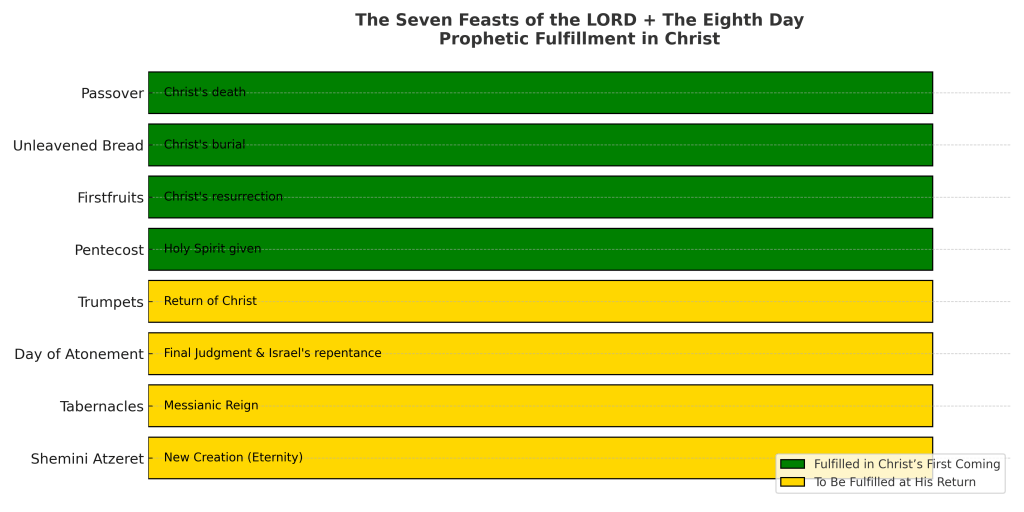
According to Leviticus 23, God established seven appointed feasts (moedim), and these were given in order as prophetic markers—each one fulfilled in Christ, either in His first coming or still to be fulfilled at His second coming.

Here’s a complete list:


🌿 SPRING FEASTS – Fulfilled in Christ’s First Coming

  1. Passover (Pesach)Christ’s crucifixion “Christ our Passover also has been sacrificed” (1 Cor. 5:7)
    • Fulfilled: Jesus died on Passover as the Lamb of God (John 1:29)
  2. Unleavened BreadChrist’s burial and sinlessness
    • Fulfilled: Jesus was buried, His body without sin or corruption (Acts 2:27)
  3. FirstfruitsChrist’s resurrection “Christ has been raised… the firstfruits of those who are asleep” (1 Cor. 15:20)
    • Fulfilled: Jesus rose on the day of Firstfruits, the “first of the harvest”
  4. Pentecost (Shavuot / Feast of Weeks)Giving of the Spirit “You will receive power when the Holy Spirit has come upon you…” (Acts 1:8)
    • Fulfilled: 50 days after Firstfruits, the Spirit was poured out (Acts 2)

🍂 FALL FEASTS – To Be Fulfilled at Christ’s Return

  1. Feast of Trumpets (Yom Teruah)Return of the King “…at the last trumpet… the dead will be raised” (1 Cor. 15:52; Matt. 24:31)
    • Awaiting Fulfillment: This feast foreshadows the resurrection, rapture, and announcement of the King’s return
  2. Day of Atonement (Yom Kippur)Final Judgment and National Repentance “They will look on Me whom they have pierced” (Zech. 12:10; Rom. 11:26–27)
    • Awaiting Fulfillment: A picture of Israel’s future repentance and the full revelation of Christ as High Priest and Judge
  3. Feast of Tabernacles (Sukkot)Millennial Kingdom, God dwelling with man “The tabernacle of God is among men…” (Rev. 21:3)
    • Awaiting Fulfillment: Points to the Messianic Kingdom and God’s permanent dwelling among His people

BONUS: Shemini Atzeret – The Eighth Day of Completion

Not a separate feast but a concluding assembly—a prophetic picture of eternity and the new creation. It follows Tabernacles and looks beyond the millennial reign into the eternal state where God dwells with His people forever (Revelation 21–22).


There are no additional holy days listed in Leviticus 23 beyond these seven feasts + the 8th Day. These encompass the entire redemptive timeline of Christ’s work—from the cross to the crown.

1–2 minutes

Leave a comment

Devotions, Teen Devotions

😎 Kingdom Teen Devotional — Day 1

“When Jesus saw the crowds, He went up on the mountain; and after He sat down, His disciples came to Him. He opened His mouth and began to teach them…”

Matthew 5:1–2 NASB1995

🔍 Who Are You Listening To?

Every day, you scroll past voices that tell you who you should be, how you should look, and what success means. But Jesus’ first move wasn’t to gain followers—it was to invite disciples to come close. He sat down and began to speak not to the world, but to those who wanted to truly hear Him.

The real question isn’t just what you’re listening to—it’s who you’re following. Are you showing up for Jesus’ words the same way you show up for YouTube, TikTok, or your group chat? He wants to teach you. But He won’t shout over the noise. You have to come near.

🔊 Real Talk:

  • What voices influence you the most in a day?
  • What would it look like to make space to hear Jesus more clearly?

✨ Try This:

Put your phone away for 10 minutes. Find a quiet place. Open your Bible to Matthew 5. Read verses 1–2. Ask Jesus to speak to your heart. Write down one thing that stands out.

✍️ Prayer:

Jesus, I want to hear from You more than the noise around me. Help me slow down and listen. Help me become a real disciple, not just a fan. Speak to my heart. Amen

1–2 minutes

Leave a comment

Editor's Picks, Kingdom Archives, Kingdom Discipleship

Why Look Back to Move Forward?

The Ante-Nicene Christians—those who lived between AD 33 and 325—weren’t superhuman saints. They were men and women like us. What made them distinct wasn’t special status or superior knowledge, but their radical faith, sacrificial love, and unwavering loyalty to the teachings of Christ. These were the disciples of the disciples, and their witness shook empires.


Who Were the Ante-Nicene Christians?

The term Ante-Nicene refers to the Christians who lived before the Council of Nicaea in AD 325. Their faith flourished not in freedom or comfort but in the midst of intense persecution. They didn’t rely on seminaries or institutionalized church systems. They followed the written Word of God, the oral teaching passed down from the Apostles, and the living guidance of the Holy Spirit (John 14:26; 1 John 2:27).

They were:

  • Disciples of disciples — directly trained by those who had been taught by the Apostles.
  • Anchored in Scripture — believing it to be complete and sufficient. They sought the Holy Spirit for understanding, not evolving human traditions.
  • Fluent in context — They lived in the same Greco-Roman world, understood the Koine Greek language, and read Scripture without needing to “bridge” historical gaps.
  • Unified and scattered — They met in homes, not cathedrals, yet they were deeply united in faith across continents because they trusted the Word and the Spirit—not centralized authority or councils.

By the early 4th century, Christianity had spread through nearly every province of the Roman Empire—and beyond. Eusebius, the early church historian, recorded that the message of Christ had reached “all the nations” even before Constantine’s reign (Eusebius, Ecclesiastical History, 3.1).


What Were They Known For?

Perhaps the most compelling testimony doesn’t come from Christians themselves, but from their Roman persecutors.

Tertullian, writing around AD 197, defended Christians against Roman accusations in his work Apologeticus. In chapter 39, he says:

“It is mainly the deeds of a love so noble that lead many to put a brand upon us. ‘See,’ they say, ‘how they love one another!’”

This wasn’t Tertullian boasting—it was his account of what the pagans were saying about Christians. Their persecutors were bewildered. These people didn’t just love their friends—they loved their enemies. They didn’t cling to life—they gave it away. They took in orphans, buried the poor, and rescued unwanted infants from death (Justin Martyr, First Apology, 67; Aristides, Apology).

Roman Emperor Julian the Apostate, a later critic of Christianity, begrudgingly admitted in the 4th century:

“It is disgraceful that the impious Galileans support not only their own poor but ours as well; all men see that our people lack aid from us.”
Letter to Arsacius, c. AD 362

Even when slandered or martyred, the early Church was unmistakably marked by this Kingdom love—poured out from a heart changed by the Spirit.


What Set Them Apart?

These early believers didn’t call themselves “theologians.” They didn’t take titles. They didn’t isolate into monasteries or create layers of leadership. Their lives were marked by humility, holiness, and servanthood.

They saw themselves as:

  • Slaves of Christ (Romans 6:22),
  • Aliens and strangers in this world (1 Peter 2:11),
  • Ambassadors of a Kingdom not of this earth (2 Corinthians 5:20).

They refused to kill, even in war or self-defense. They refused to worship Caesar or offer a pinch of incense, even if it cost them their life. Why? Because they believed what Jesus said in Matthew 5–7 was not just a poetic sermon—but the Constitution of Heaven.


Why This Matters Today

Today, the modern Church—especially in the West—has lost much of its saltiness. The world often can’t tell the difference between a false Christian and a real one. Even faithful churches struggle to impact the world the way the early church did. Why?

Because we’ve traded in Kingdom living for cultural acceptance. We’ve treated the Sermon on the Mount like a suggestion instead of the standard.

But if we are truly Christ’s—if we are His slaves and sons—we must return to that radical, holy, love-filled walk that marked the early believers. Not with pride in them, but with worship toward the same God who empowered them to persevere.

“They overcame him because of the blood of the Lamb and because of the word of their testimony, and they did not love their life even when faced with death.”
— Revelation 12:11 (NASB 1995)

I don’t glorify these early Christians—God already has. He called them “those of whom the world was not worthy” (Hebrews 11:38). They didn’t just die for Jesus—they lived completely for Him.


What’s Ahead

In the coming weeks, I’ll explore their writings, their testimonies, and most importantly, the Scriptures that shaped them. We’ll test everything—past and present—by the Word of God, seeking the interpretation of the Holy Spirit, not men.

Let’s walk this journey together, rooted in Scripture and raised in Christ.


📚 Sources & References

·  Scripture:

  • John 14:26
  • 1 John 2:27
  • Jude 3
  • Hebrews 11:38–40
  • Revelation 12:11
  • Romans 6:22
  • 1 Peter 2:11
  • 2 Corinthians 5:20
  • Matthew 5–7

·  Historical & Early Church Writings:

  • Tertullian, Apology, ch. 39 (c. AD 197)
  • Eusebius, Ecclesiastical History, 3.1
  • Justin Martyr, First Apology, ch. 67
  • Aristides, Apology
  • Emperor Julian, Letter to Arsacius (c. AD 362)
  • Rodney Stark, The Rise of Christianity, HarperOne, 1996
4–5 minutes

Leave a comment

Devotions, Family Devotionals

🏡 Kingdom Family Devotional — Day 1

Day 1

“When Jesus saw the crowds, He went up on the mountain; and after He sat down, His disciples came to Him. He opened His mouth and began to teach them…”
Matthew 5:1–2 NASB1995

🕯 Gathered to Listen

Before the words came, there was a pause. Jesus sat down. His disciples came close. This wasn’t a crowd performance—it was intimate. The King of heaven had something to say, and those who drew near would hear the foundation of His Kingdom.

As a family, we are invited to do the same: pause. Slow down. Open our hearts to Jesus’ voice and posture ourselves like His first disciples—eager to learn, willing to follow, and unafraid to be changed.

🏛 Early Church Families

In the earliest days of the church, there were no church buildings. Families gathered in homes, sometimes under threat of persecution. Fathers taught their children the words of Jesus. Mothers instructed through example and quiet strength. Children listened, learned, and often became bold witnesses themselves.

The Kingdom of God wasn’t something they just talked about—it was something they lived together, every day, in every circumstance.

🗣 Discuss Together:

  1. What does it mean to be a disciple of Jesus?
  2. What helps us listen to God as a family?
  3. Can we think of one way this week we can “come near” to Jesus together?

🧱 Kingdom Practice

  • Choose one night this week to turn off distractions (TV, phones) and sit together quietly.
  • Read one verse of Matthew 5 and talk about it. Let everyone share—even the youngest!
  • End with each person saying one sentence to Jesus.

🙏 Family Prayer

Lord Jesus, help our family to draw near to You. Teach us to listen. Help us make time for Your words and trust that You are always speaking to us through them. We want to follow You together. In Your name, Amen.

1–2 minutes

Leave a comment