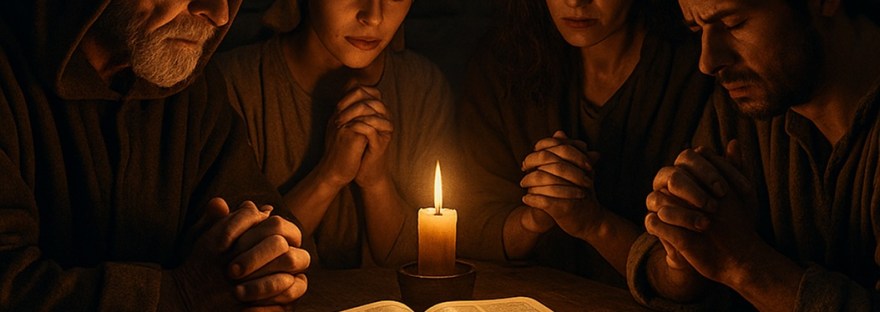
Devotions, Teen Devotions

😎The Mind Set on the Spirit — Day 8

“For the mind set on the flesh is death, but the mind set on the Spirit is life and peace.”
Romans 8:6, NASB1995

Train Your Mind

The world tells you to follow your heart. Scripture says: renew your mind.

Romans 8:6 doesn’t mince words—your mindset leads to death or life.
You can’t have a Spirit-filled walk with a flesh-fed mind.

The Spirit empowers you to discipline your thoughts, reject toxic inputs, and walk in clarity and peace—even when life is loud.

Reflection:
Are you feeding your mind with truth or distractions? What do you need to cut out?

Prayer:
Holy Spirit, I surrender my thoughts to You. Train my mind to seek You first and walk in peace. Amen.

Devotions, Family Devotionals

👩‍👧The Mind Set on the Spirit — Day 8

“For the mind set on the flesh is death, but the mind set on the Spirit is life and peace.”
Romans 8:6, NASB1995

Peaceful Homes Begin with Peaceful Minds

Children watch how we handle pressure, not just what we say.
Romans 8:6 reminds us that mindset determines peace.

When our minds are set on the Spirit—our home becomes a refuge, not a war zone.
When we’re anxious, we teach our kids to take their worries to the Lord, not to their emotions.

Discussion Prompt:
Ask your children:

  • What helps your mind feel peaceful?
  • How do we set our thoughts on God when we’re upset?

Prayer:
Lord, train our minds to seek You first. Let our home reflect Your peace by the power of the Holy Spirit. Amen.


Devotions, Women's Devotionals

👩‍🦰The Mind Set on the Spirit— Day 8

“For the mind set on the flesh is death, but the mind set on the Spirit is life and peace.”
Romans 8:6, NASB1995

Peace Begins in the Mind

Have you ever felt overwhelmed by your own thoughts?
Worry. Fear. Doubt. Busyness.

Romans 8:6 reminds us there is a better way—a mind set on the Spirit.
This isn’t passive thinking. It’s intentional. It’s redirecting your heart away from fleshly patterns and back toward the presence of God.

The result? Life and peace. Not artificial calm, but deep, Spirit-rooted rest.

Reflection:
What thoughts dominate your mind? Are they aligned with the Spirit or the flesh?

Prayer:
Holy Spirit, guard my thoughts today. Fix my mind on what is true, pure, and eternal. Give me Your peace. Amen.

Editor's Picks, The Six Solas

The Root of the Matter: Why the Solas Must Be Anchored in the Spirit

Most Christians today have never heard of the Solas—let alone the deeper truth behind them. They’ve been reduced to academic slogans in Reformed circles or historical trivia for Protestants. But these were once lived out—not just proclaimed—by the Ante-Nicene Church, the faithful believers between AD 33–325 who bore real Kingdom fruit.

While many know Sola Scriptura or Sola Fide, there’s one that has been tragically forgotten in both Protestant and Catholic traditions:

👉 Solo Spiritu Sancto — By the Holy Spirit Alone

This is the root of all the others…

Sola Scriptura (Scripture Alone)

God’s Word is the ultimate authority for faith and life—not church tradition or human opinion. Everything we believe and do must align with Scripture.

Sola Fide (Faith Alone)

We are justified (made right with God) through faith alone—not by works, rituals, or religious performance. True saving faith trusts fully in Christ.

Sola Gratia (Grace Alone)

Salvation is a free gift of God’s grace. We did not earn it, and we cannot deserve it. It is all by His mercy and love.

Solo Spiritu Sancto (By the Holy Spirit Alone)

We understand and walk in truth by the power of the Holy Spirit—not by intellect, tradition, or man’s wisdom. The Spirit teaches, convicts, empowers, and leads God’s people.

Solus Christus (Christ Alone)

Jesus Christ is the only mediator between God and man. Our hope, forgiveness, and eternal life come through Him alone—not saints, priests, or systems.

Soli Deo Gloria (To the Glory of God Alone)

Everything—including our salvation—is for God’s glory. We live, serve, and worship not for applause or status, but to magnify His name.

Without the Holy Spirit teaching us Scripture (Sola Scriptura), our faith becomes academic. Without the Spirit convicting us toward faith (Sola Fide) and leading us in grace (Sola Gratia), it becomes a transaction. Without the Spirit glorifying Christ alone (Solus Christus) and stirring us to live for God’s glory (Soli Deo Gloria), it becomes religious performance.

Instead of growing deep in Him, we debate endlessly. We lop off branches of doctrinal disagreement, but never deal with the root: that we’ve traded the Spirit’s authority for men’s interpretations. The fruit of this tree? Division, pride, and confusion.

The Ante-Nicene Church shows us a better way: a Church anchored in the Spirit, interpreting Scripture together, walking in radical obedience, and bearing fruit worthy of Christ.

2–3 minutes

Leave a comment

Kingdom Discipleship, The Six Solas

The Six Solas

Spirit-Led Foundations of the Early Church (AD 33–325)

A Journey Back to the Faith Once Delivered

“Thus says the Lord, ‘Stand by the ways and see and ask for the ancient paths, where the good way is, and walk in it; and you will find rest for your souls.’”
— Jeremiah 6:16, NASB1995


We live in a time when the foundations of our faith are being redefined—not always by secular forces, but often from within the Church. Doctrines are dissected. Theological systems debated. Denominations defended. And yet, many believers are still left feeling disconnected from the power, purity, and simplicity of the early Church.

This blog series is not an invitation to theological alignment.
It’s an invitation to spiritual awakening.

We’re going to journey through the Six Solas—but not as they were recited during the Reformation. We’ll explore them as they were lived and embodied by the men and women of the Ante-Nicene Church, who held fast to the faith from Pentecost to persecution—long before councils, creeds, or clerical systems took over.

Why Six?

You’ve likely heard of the Five Solas:

  • Sola Scriptura – Scripture Alone
  • Sola Fide – Faith Alone
  • Sola Gratia – Grace Alone
  • Solus Christus – Christ Alone
  • Soli Deo Gloria – Glory to God Alone

But there’s one more that pulses through them all—without which none can be truly understood or lived:

👉 Solo Spiritu Sancto — By the Holy Spirit Alone
The Holy Spirit is not a theological accessory.
He is the Interpreter of Scripture (1 Cor. 2:12–13),
the Power behind obedience (Rom. 8:13–14),
and the Bond of unity in the body of Christ (Eph. 4:3–4).

The early Church did not function by system, seminary, or state approval.
They walked in the power of the indwelling Spirit, clinging to the teachings of Jesus and His apostles, and loving not their lives—even to death.


What to Expect

Each post in this series will be a deep dive into one of the Six Solas, unpacked through:

  • The plain reading of Scripture (NASB 1995, with strict exegesis and no eisegesis)
  • The writings and practices of the Ante-Nicene Church (AD 33–325)
  • The challenges of today’s Church culture, and
  • A call to Spirit-led obedience in every area of life

Each entry will also be paired with a visual reflection to share and remember.
This is more than a teaching—it’s a transformational journey for those ready to go deeper.


Who Is This For?

  • The woman reading Scripture and wondering, “Why doesn’t my church look like this?”
  • The young believer longing to follow Christ without man’s traditions overshadowing His voice
  • The weary soul who’s tasted systems and is now asking, “Where is the Spirit?”

Will You Walk This Path?

The early believers didn’t have denominations, seminaries, or creeds.
What they had was Scripture, the Holy Spirit, a risen Christ, and unshakable faith.

Let’s return.
Let’s rebuild.
Let’s be rooted and raised by what the Spirit taught, the Apostles preached, and the early Church lived.

“Contend earnestly for the faith which was once for all handed down to the saints.”
— Jude 3

2–3 minutes

Leave a comment

Biblical Interpretation, Kingdom Discipleship

The Example of the Bereans — Testing All Things by the Word

How to Read the Bible Series

You’ve heard the message before.
A respected teacher, a moving sermon, a popular quote—sometimes repeated so often it feels like Scripture itself. But something unsettles your spirit. You don’t reject it outright, but you also can’t move on. You open your Bible, eyes scanning the text—not to be combative, but to be faithful. That’s the posture of the Bereans.

In a world full of noise, the Bereans teach us how to listen. They show us how to search—not for confirmation bias, but for truth. In Acts 17:11, their approach is honored by the Holy Spirit as “more noble-minded.” Why? Because they searched the Scriptures daily to see if what Paul said was true.


Scripture Focus:

“Now these were more noble-minded than those in Thessalonica, for they received the word with great eagerness, examining the Scriptures daily to see whether these things were so.”
Acts 17:11, NASB1995


Noble-Minded: Humble, Not Gullible

The Bereans weren’t suspicious; they were eager. They wanted truth. But they also understood that truth must be tested. They didn’t elevate Paul’s reputation or passion over the written Word. They weighed every teaching against what God had already spoken. That’s humility. That’s nobility.

And unlike modern approaches that rely on theological labels or commentaries, the Bereans didn’t have creeds, councils, or catechisms. They had the Scriptures—and they had the Spirit.


They Searched Daily

This wasn’t a surface reading or proof-texting session. The Greek term anakrinontes implies a careful, judicial inquiry—testing evidence, like a courtroom. They examined the Scriptures every day, not because they were uncertain of God, but because they wanted to be certain they were following Him. That level of discernment is not suspicion—it’s devotion.


Scripture Above All

If the Bereans tested Paul—an apostle who performed miracles and was personally commissioned by Christ—should we not test every preacher, author, and influencer today?

Even Jesus rebuked religious leaders for not knowing the Scriptures (Matthew 22:29). The early Church never placed man’s words above God’s. For them, Scripture wasn’t just a guide—it was the authority. And it still is.


Fruit of Berean Faithfulness

“Therefore many of them believed…” — Acts 17:12

Notice the fruit: belief. Not skepticism, not endless debate—but genuine, Spirit-born faith. Truth examined led to truth embraced.


What This Means for Us Today

  • Don’t treat Scripture like a filter; treat it like a foundation.
  • Don’t elevate personality over truth.
  • Don’t accept or reject based on tradition—test it all.
  • And don’t stop searching. The Holy Spirit loves to reveal what He has already spoken.

Return to the Word. Return to Discernment.

The Bereans weren’t exceptional because they had more access or intelligence. They were exceptional because they were faithful. Their nobility wasn’t in status—it was in submission to Scripture. This is how the early Church stayed grounded. This is how the remnant remains faithful today.

Be a Berean. Test everything. Cling to truth. And let the Spirit illuminate the Word—daily.

2–3 minutes

Leave a comment

Kingdom Discipleship, Love In Action

Be Merciful, Just as Your Father is Merciful

From the series “The Commands of Christ — Love in Action”


“Be merciful, just as your Father is merciful.”
— Luke 6:36, NASB1995


In a world that rewards retaliation and celebrates harshness as strength, Jesus calls His disciples to something radically different: mercy. Not a vague kindness. Not a passive tolerance. But divine, active mercy—poured out in the likeness of our Father in heaven.

This mercy isn’t based on merit. God doesn’t wait for us to be worthy of His compassion. While we were still sinners, Christ died for us (Romans 5:8). That’s the measure of His mercy—and the model for ours.

The command is not simply to be merciful, but as your Father is merciful. This is not human compassion raised slightly; it is a divine attribute extended through Spirit-filled people. And it reaches beyond those who love us. Jesus makes that clear. The merciful do good to those who hate them. They bless those who curse them. They pray for those who mistreat them (Luke 6:27–28).

The early Church understood this calling well. Their mercy wasn’t limited to emotional sympathy—it translated into action. They rescued abandoned infants from Roman garbage heaps, cared for plague victims when others fled, and fed both Christian and pagan neighbors during famines. Their acts of mercy confused the empire and reflected the heart of their King.

They were not trying to earn salvation. They were living out the nature of the One who saved them.

Tertullian observed, “It is our care of the helpless, our practice of lovingkindness, that brands us in the eyes of many of our opponents. ‘Look!’ they say, ‘How they love one another!’” (Apology, ch. 39). Mercy was their reputation.

And it should be ours.

We don’t get to choose who deserves mercy. We simply extend it—because our Father has extended it to us. The merciful show God’s heart to a hardened world. They reflect His character and reveal His kingdom.

So, we must ask ourselves: Do our enemies see mercy in us? Do the broken, the ignored, the undeserving find the compassion of the Father in our lives?

Mercy does not ignore justice. But it doesn’t wield justice as a sword of pride. It offers restoration, dignity, and love. It leans in when the flesh wants to pull away. It opens its arms when fear says to close them.

This is what the Kingdom looks like.


Sources:

Luke 6:27–36, NASB1995

Romans 5:6–8

Tertullian, Apology, Chapter 39

The Didache (ch. 1–2): Early instructions on showing mercy to the poor, forgiving quickly, and imitating the meekness of Christ

Lactantius, Divine Institutes, Book 6: Advocates for mercy as a divine attribute believers must mirror


2–3 minutes

Leave a comment

Biblical Interpretation, Kingdom Discipleship

The Role of the Holy Spirit in Reading Scripture

How to Read the Bible Series

You open your Bible, and the words lie before you.
But without the Author beside you, the meaning remains hidden. The Word is alive (Hebrews 4:12), yet it breathes only when the Spirit breathes into us. Many read the Bible as information; few read it as revelation. The early Church knew the difference—and their lives reflected it.

The Ante-Nicene believers didn’t read Scripture through systems. They weren’t led by councils or creeds. They were led by the Spirit of Truth. The Bereans searched daily, but they did not search alone. The Spirit was their Teacher—and He must be ours.


Scripture Focus:

“But when He, the Spirit of truth, comes, He will guide you into all the truth…”
John 16:13, NASB1995


The Spirit Is the Teacher

The Lord never left His people with a book and no Guide. Jesus promised that the Spirit would lead us into all truth—not through mystical experiences, but through the Word He authored. As Paul wrote:

“We have received… the Spirit who is from God, so that we may know the things freely given to us by God.”
1 Corinthians 2:12

The Spirit does not give new revelation but illumines what has already been given. He opens our eyes to behold (Psalm 119:18), convicts us of truth, and teaches with clarity. No theologian or denomination can replace His voice.


The Anointing That Abides

“You have no need for anyone to teach you… but His anointing teaches you about all things…”
1 John 2:27

This doesn’t reject godly teachers—it rejects dependence on man. The Bereans didn’t check with Paul’s résumé; they tested his message with Scripture, led by the Spirit. The early Church walked in the same pattern, trusting the Spirit’s conviction above the authority of men.


The Spirit Knows the Mind of God

He is not merely a Helper; He is God. He searches the deep things of God (1 Corinthians 2:10–11), and He helps us pray, read, and discern according to the will of the Father (Romans 8:27). When we read Scripture with the Spirit, we’re not just gathering knowledge—we are encountering the very thoughts of God.


The Spirit and the Word Are One

“The words that I have spoken to you are spirit and are life.”
John 6:63

The Holy Spirit will never contradict the written Word because He authored it. If a “revelation” or interpretation conflicts with Scripture, it is not from the Spirit. The Spirit always leads us back to Jesus, the Word made flesh, and He always glorifies the Father through obedience and truth.


Walking in Spirit-Led Reading

  • Pray before reading. Invite the Spirit to teach, correct, and reveal.
  • Read with surrender. Revelation follows obedience (John 7:17).
  • Let Scripture interpret Scripture. The Spirit wrote a unified message.
  • Test all things. Even beloved teachings must align with the Spirit’s Word.

Return to the Spirit. Return to Illumination.

We do not open the Bible to master it—we open it to be mastered by Christ through the Spirit. The early Church knew this. They did not walk by the traditions of men but by the illumination of the Holy Spirit through the Scriptures.

Let us walk as they walked. Let us read with the Author as our Teacher.

Return to the Word. Return to the Spirit. And find truth that transforms.


2–3 minutes

Leave a comment

Biblical Interpretation, Editor's Picks, Kingdom Discipleship

How to Read the Bible — Returning to the Way of the Bereans and the Ante-Nicene Church

How to Read the Bible Series

You hold the Bible in your hands.
Sixty-six books. One Author. One Spirit. One unfolding story of redemption. And yet, for many, it’s a confusing book—wrapped in mystery, buried under layers of tradition, or filtered through man-made systems. But that was never God’s design.

The earliest Christians didn’t read the Bible through denominational creeds or theological filters. They read it with open hearts, under the teaching of the Holy Spirit, and in the context of their Jewish and first-century world. They tested everything by the written Word—and followed it with their lives.

It’s time to return to their way.


Scripture Focus:

“Your word is a lamp to my feet and a light to my path.”
Psalm 119:105, NASB1995


Reading with the Author, Not Just About Him

The Bible is not a dead text. It is living and active (Hebrews 4:12) because it is breathed out by the Holy Spirit (2 Timothy 3:16). Without the Spirit, Scripture becomes information. With Him, it becomes transformation.

The Bereans didn’t rely on theological systems or traditions to interpret the Word. They relied on the Spirit and the Scriptures themselves. Their example calls us to read with reverence, discernment, and dependence—not on man, but on God.


The Early Church Read the Word as One Unified Story

They saw the Old and New Testaments not as opposites but as one unfolding plan of God. They understood the Jewish idioms and culture behind the text. They read the Word in its historical context, through Hebraic lenses, and with spiritual hunger.

They didn’t force Scripture to fit their beliefs. They submitted their beliefs to the Word.


Principles for Spirit-Led, Scripture-Faithful Reading

  1. Context Is King
    Who wrote it? To whom? What is happening? What covenant are they under? Read what’s there, not what tradition has imposed.
  2. Culture and Language Matter
    Jesus spoke as a Jew to Jews. Many truths are deeply rooted in Hebrew idioms and first-century thought. Misreading the cultural setting leads to misapplying truth.
  3. Scripture Interprets Scripture
    Isaiah 28:10 and 1 Corinthians 2:13 remind us: truth is confirmed in multiple witnesses across God’s Word. Don’t hang doctrines on isolated verses.
  4. Avoid Allegory Unless the Text Demands It
    The early Church read Scripture literally unless it clearly indicated symbolism (such as in visions or parables). They let the Spirit—not philosophy—determine meaning.
  5. Reject Traditions That Override Scripture
    Jesus warned about this (Matthew 15:9). When tradition silences the Word or redefines its meaning, we must return to the text and the Spirit.

Walking as the Early Church Walked

To read the Bible rightly, we must return to how it was written: in context, by the Spirit, and for the Church. The Bereans searched the Scriptures daily to test everything. The Ante-Nicene believers treasured the Word, often at the cost of their lives.

They didn’t read to affirm a system. They read to know and follow Christ.


Return to the Word. Return to the Spirit.

The Bible is not meant to be interpreted by the wisdom of men, but by the One who wrote it. The Holy Spirit still teaches, still convicts, still opens eyes. You don’t need a new method—you need the old path.

Read with prayer. Read with surrender. Read with the Spirit. And you will find Christ in every page.

2–3 minutes

Leave a comment

Holy Days, Passover

Passover (Pesach) — The Lamb, the Table, and the Bridegroom

Scripture Focus: Exodus 12; Leviticus 23:4–5; Matthew 26:17–30; John 1:29; 1 Corinthians 5:7; Revelation 19:7–9

As Passover begins at sundown on Saturday, April 12, 2025, we pause to remember a story of deliverance that God wrote into the very foundations of His covenant with Israel. Yet this deliverance was not just a shadow of things to come—it was a prophetic foreshadowing of a greater Lamb, a greater exodus, and a greater feast prepared for a Bride who has made herself ready.

The First Passover: A Sign of Substitutionary Deliverance

When the LORD instituted Passover in Exodus 12, He commanded each household to take a lamb, without blemish, and keep it until the fourteenth day of the first month. The lamb was not merely a ritual object—it was a substitute. It would die in place of the firstborn. Its blood was to be spread on the doorposts and lintel as a sign. The destroyer would pass over any home marked by the blood.

Here we see a vital gospel truth: Israel was not spared because of their own righteousness, but because of God’s mercy and provision. The blood of the lamb was the only difference between the spared and the struck.

Christ, Our Passover

The New Testament declares this plainly: “For Christ our Passover also has been sacrificed” (1 Corinthians 5:7b). John the Baptist recognized this when he cried, “Behold, the Lamb of God who takes away the sin of the world!” (John 1:29). The Passover lamb was not just a memorial of Egypt—it was a prophetic picture of the Lamb who would come to bear the judgment of God for sin.

Every detail of the Passover lamb was fulfilled in Jesus:

  • Without blemish (Exodus 12:5) — Christ was sinless (Hebrews 4:15).
  • None of its bones broken (Exodus 12:46) — fulfilled in John 19:36.
  • Slain at twilight — Jesus died at the ninth hour, the time of the evening sacrifice (Mark 15:34).

The Last Supper: A Betrothal Meal

On the night He was betrayed, Jesus sat at table with His disciples to celebrate Passover. But this meal, the Last Supper, was unlike any before it. The Lamb Himself was hosting. He took the bread and the cup, symbols of affliction and redemption, and redefined them in His own body and blood: “This is My body, which is given for you… This cup which is poured out for you is the new covenant in My blood” (Luke 22:19–20).

In Jewish wedding custom, a man would offer a cup of wine to the woman he desired to marry. If she accepted and drank, she agreed to become his bride. Jesus offered the cup that night to all who would enter covenant with Him. It was not only a remembrance of redemption but a proposal. In doing so, He wove wedding language into the Passover.

The Bridegroom’s Promise and the Wedding Feast

Jesus then said, “I will not drink of this fruit of the vine from now on until that day when I drink it new with you in My Father’s kingdom” (Matthew 26:29). This is the language of betrothal. Just as the Jewish bridegroom would go to prepare a place for his bride and return for her, Jesus promised, “I go to prepare a place for you… I will come again and receive you to Myself” (John 14:2–3).

Thus, the Passover is not only a remembrance of Egypt but a rehearsal for the Marriage Supper of the Lamb (Revelation 19:7–9). We, the Church, purified by the blood of the Lamb, are the Bride who waits, watches, and prepares herself in righteousness (Revelation 19:8).

Ramifications for the Disciple of Christ Today

  • Do we recognize the cost of our redemption? Passover demands that we never treat Christ’s body and blood as common or profane (Hebrews 10:29). To take communion without reverence is to forget the cross.
  • Are we living as a betrothed Bride? A woman betrothed in Jewish culture would remain faithful, pure, and expectant. Our lives should reflect the holiness and anticipation of the Bride awaiting her Bridegroom.
  • Are we ready for the feast? The parable of the ten virgins (Matthew 25:1–13) reminds us that only those who were prepared entered with the Bridegroom. We are called to spiritual readiness, clothed in righteousness, with lamps burning.

Devotional Thought for Families or Small Groups

Read Exodus 12:1–30 and Matthew 26:17–30 together. Discuss the significance of the lamb’s blood, the cup, and Christ’s promise to return. Consider asking:

  • Why did God command Israel to remember the Passover year after year?
  • How is Jesus both our Passover Lamb and Bridegroom?
  • What does it mean to be ready for His return?

Reflect: Take a quiet moment as a family or group to think on the Lamb who was slain. Consider the weight of sin, the wonder of substitution, and the joyful hope of the coming wedding feast.

Pray: Father, thank You for the blood of the Lamb that covers and cleanses us. Thank You for redeeming us from slavery to sin and death. Help us to live as Your beloved Bride—faithful, watchful, and filled with Your Spirit. May we long for the day when the Bridegroom returns and the marriage supper begins. Come quickly, Lord Jesus. Amen.

Come, Lord Jesus.

4–5 minutes

Leave a comment