“For those who are according to the flesh set their minds on the things of the flesh, but those who are according to the Spirit, the things of the Spirit.” — Romans 8:5 (NASB 1995)
In a home, habits of the mind shape the mood of the household. When our thoughts drift toward worry, resentment, or comparison, it impacts the atmosphere.
But the Spirit teaches us a better way—to set our minds on what is true, noble, and eternal. As mothers, our example invites children into a Spirit-led thought life.
Let’s model how to take thoughts captive and set them on Christ.
Family Talk:
What kinds of things do we think about most in this home?
How can we encourage each other to think like Jesus?
Prayer: Holy Spirit, renew our minds. Help us notice when our thoughts wander and bring them back to what is good and true. Amen.
“Do not quench the Spirit.” — 1 Thessalonians 5:19 (NASB 1995)
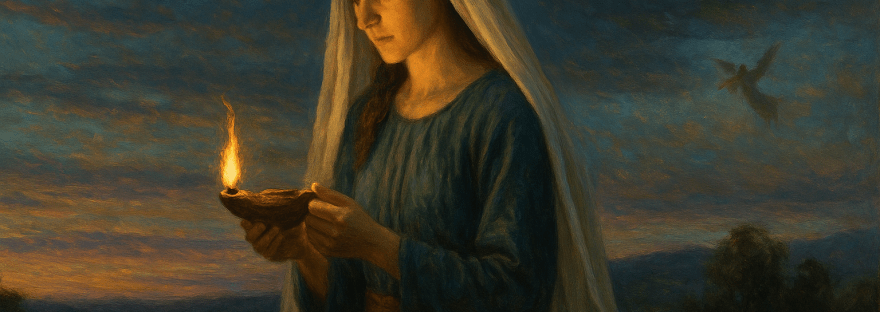
You were meant to burn bright for Christ—but ignoring the Holy Spirit is like dousing your soul’s fire with cold water.
It starts small: compromise, distraction, delay. Over time, the flame flickers out.
Paul says, “Do not quench the Spirit.” Don’t silence Him when He calls you to pray. Don’t scroll past conviction. Don’t make excuses when you’re nudged to speak truth or show kindness.
Let the fire grow.
Challenge: Take 5 quiet minutes today to ask, “Holy Spirit, have I been ignoring You?” Then listen.
Prayer: Holy Spirit, reignite my heart. I want to burn for You again. Don’t let me push You away. Lead me, speak to me, grow me. Amen.
“Do not quench the Spirit.” — 1 Thessalonians 5:19 (NASB 1995)
A mother’s attitude often shapes the spiritual temperature of the home. When we walk sensitive to the Spirit, our children learn what His presence feels like—gentle, convicting, joyful.
But when we ignore Him—through busyness, harshness, or indifference—it quietly dims the flame.
Let’s rekindle the fire. Open the Word. Speak truth. Pause to pray. Live repentantly and joyfully.
Family Talk:
Can you think of a time you felt the Holy Spirit nudging you?
What helps us keep our hearts warm toward God?
Prayer: Holy Spirit, keep our home tender toward You. Teach us not to ignore Your voice, but to treasure and follow it. Amen.
“Thus says the Lord, ‘Stand by the ways and see and ask for the ancient paths, where the good way is, and walk in it; and you will find rest for your souls.’” — Jeremiah 6:16 (NASB1995)
Returning to the Roots
We’ve walked through the Six Solas—not as distant doctrines, but as living truths anchored in Scripture and embodied by the early Church.
From the days of Pentecost through the fires of persecution, the Ante-Nicene believers lived with unwavering devotion:
Rooted in Sola Scriptura—holding fast to God’s Word alone
Empowered by Solo Spiritu Sancto—taught and led by the Spirit
Redeemed by Sola Gratia—transformed by grace, not license
Faithful through Sola Fide—a faith proven in obedience and endurance
Centered on Solus Christus—Christ alone, without mediators or politics
Living for Soli Deo Gloria—in life, death, and every ordinary moment
This wasn’t theory for them. It was Kingdom reality.
And it can be ours too.
The Church Before the Systems
Before councils. Before creeds. Before theology became divided by men.
There was a Church that:
Feared God more than Caesar
Knew the Word by heart
Followed the Spirit without apology
Loved one another with sacrificial joy
Rejected the world’s approval
Refused to compromise Christ
They were unknown on earth, but honored in heaven.
They had no denominations. No seminaries. No political clout. Yet the gates of hell could not prevail against them.
A Call to Us Today
This series was never about information—it was always about invitation.
To return. To rebuild. To resist what is man-made. To rediscover what is Spirit-led.
To ask:
“Is my faith shaped by the Word and Spirit—or by the systems of man?” “Is Christ central in my life—or simply included?” “Does my life glorify God—or merely reflect religious culture?”
Walk the Ancient Path
This is a call to:
Open your Bible and believe it as written
Invite the Holy Spirit to be your teacher, not your backup
Let grace train you—not excuse you
Walk in faith that obeys and endures
Exalt Christ—not platforms or personalities
Live to glorify God in the hidden places, not just the public ones
The early Church walked this path. So must we.
“Beloved, while I was making every effort to write you about our common salvation, I felt the necessity to write to you appealing that you contend earnestly for the faith which was once for all handed down to the saints.” — Jude 3
Kingdom Discipleship Reflection
Which of the Six Solas challenged me most? Why?
How am I living differently because of what I’ve seen in Scripture and the early Church?
What systems, assumptions, or comforts is the Spirit asking me to lay down?
This week, go before the Lord with empty hands and a ready heart. Ask:
“Lord, lead me back to what is true, pure, and eternal. Show me how to live the faith once delivered, by the power of Your Spirit.”
Let the ancient path become your daily walk.
“Now to the King eternal, immortal, invisible, the only God, be honor and glory forever and ever. Amen.” — 1 Timothy 1:17
“Now the Lord is the Spirit, and where the Spirit of the Lord is, there is liberty.” — Day 492 Corinthians 3:17 (NASB 1995)
So many women walk through life shackled by shame, fear, or the heavy weight of expectations. But Scripture says where the Spirit of the Lord is—there is freedom.
Not the world’s kind of freedom. This is spiritual liberty: freedom from sin, from fear, from condemnation, from the performance trap. The Holy Spirit brings you into the presence of the Lord, and in that presence, you are free to live, love, forgive, and flourish.
Reflection: What are you carrying today that Christ already set you free from?
Prayer: Spirit of the Lord, breathe freedom into every place of my life. Where I’ve been stuck or afraid, let me walk in the liberty You give. Amen.
“Now the Lord is the Spirit, and where the Spirit of the Lord is, there is liberty.” — Day 492 Corinthians 3:17 (NASB 1995)
Freedom isn’t just about doing what you want—it’s about becoming who you were created to be. The Holy Spirit removes chains that hold you back: guilt, addiction, anger, anxiety.
He doesn’t just whisper truth—He breaks strongholds with it.
If you’re in Christ, you’re not a prisoner. You’re free. Start living like it.
Challenge: Ask the Spirit today: What am I still bound by? What have You already freed me from?
Prayer: Holy Spirit, help me walk in the freedom Jesus gave me. Break every hidden chain and teach me what it means to live free. Amen.
“Now the Lord is the Spirit, and where the Spirit of the Lord is, there is liberty.” — Day 492 Corinthians 3:17 (NASB 1995)
Liberty in the Spirit isn’t chaos—it’s a peaceful order rooted in love. When the Holy Spirit is welcomed in a home, freedom flourishes. Children feel safe to grow, ask, and express. Mothers walk in grace, not guilt.
The atmosphere shifts where He dwells. Let us model and cultivate that freedom in our daily words and rhythms.
Family Talk:
What does “freedom in Jesus” feel like at home?
Are there areas where we’ve felt spiritually stuck or tense?
Prayer: Spirit of the Lord, we invite Your liberty into our home. Make our hearts and habits reflect the freedom we have in Christ. Amen.
Would you like to continue with Day 50?
Here is Day 50 of the Empowered: The Holy Spirit in the Life of the Believer devotional series, based on 1 Thessalonians 5:19 (NASB 1995):











Leave a comment