
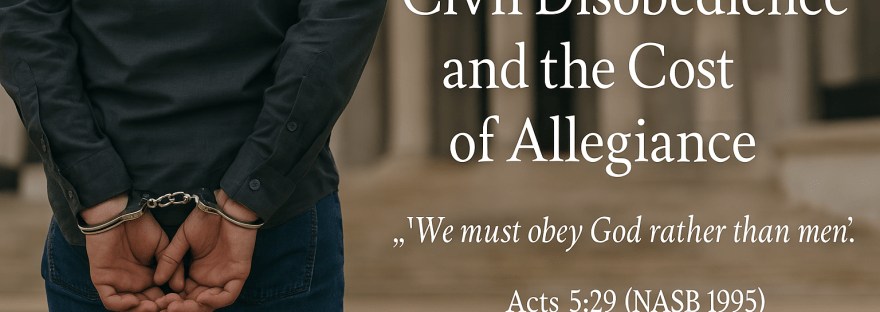
From the Series: Ordinary Saints: Lessons from the Ante-Nicene Church
Scripture quotations are from the New King James Version®.
Copyright © 1982 by Thomas Nelson. Used by permission. All rights reserved.
To the early Christians, allegiance to Jesus Christ was never just words. It was seen and proven in the way they lived. Every action, every relationship, and every response to authority flowed from a singular truth: Christ is Lord. They obeyed laws, paid taxes, and prayed for those in authority. Yet, they also understood this: obedience to earthly authority has limits. When human commands contradicted God’s Word, they chose Christ over Caesar, no matter the cost.
I am reminded of what is written:
“We must obey God rather than men.” (Acts 5:29)
This was not a rebellion rooted in pride or resistance for its own sake. It was faithful obedience, humble, Scripture-grounded, and Spirit-empowered. Their lives bore witness to a higher allegiance.
The early believers were not political agitators or revolutionaries. They sought peace, lived quietly, and respected governing authorities as ordained by God. As it is written:
“That you also aspire to lead a quiet life, to mind your own business, and to work with your own hands…” (1 Thessalonians 4:11–12)
Yet even in their submission, there was clarity. When rulers demanded what belonged to God alone, worship, devotion, or denial of Christ, they did not comply. They refused to offer incense to idols or call Caesar “Lord.” Their obedience to God set the limit on their obedience to man.
One can almost hear the weight of their conviction in words like these:
“We are ready to serve you, but we cannot worship your gods or call the emperor ‘Lord.’ Christ is our only King.”
This was not the language of defiance; it was the confession of allegiance.
They were not arrested as criminals in the traditional sense. They did not riot or incite rebellion; their “crime” was singular: they would not bow to anyone but Jesus Christ. Their resistance took the form of silence before magistrates, refusal of idolatrous acts, hymns from prison cells, and quiet acceptance of whatever sentence followed.
They did not curse the authorities. They did not demand their rights. Instead, they stood firm, peacefully, resolutely, and entrusted themselves to God.
The early church did not hide this reality from new believers. Discipleship included preparation for suffering. Leaders taught that following Christ might bring conflict with human authority. Such moments were not signs of failure, but evidence of faithfulness.
As one early Christian wrote:
“We pray for the empire… but we refuse to call Caesar ‘God.'”
There was no confusion in their hearts. They honored earthly authority, but they worshiped God alone.
And the cost was real.
To follow Christ in this way often meant losing everything that anchored a person to this world. Businesses collapsed because believers refused to participate in idolatrous practices. Positions of influence were lost. Families and communities rejected them. Many faced imprisonment, torture, and ultimately death.
Yet Scripture reveals their perspective:
“They departed from the presence of the council, rejoicing that they were counted worthy to suffer shame for His name.” (Acts 5:41)
They did not chase suffering, nor did they flee from it. Their eyes looked to a greater Kingdom, a righteous Judge, and an eternal inheritance that nothing could take from them.
As I consider this, I can already sense what may rise in the reader’s heart.
You might feel the tension. Does this mean you may one day have to choose between obedience to God and man? Scripture says yes. That realization feels sobering. It urges us to examine where our true allegiance lies, not in theory, but in practice.
At such moments, how can a believer discern what faithfulness requires? The early church offers us practical steps: Prayerfully seek wisdom in God’s Word and through the counsel of mature believers. Weigh whether the human command requires you to sin or deny Christ. Consider the motivations of your heart; are you acting out of devotion to Christ, or from anger or pride? Remember to pursue peace where possible, and to honor authority up to the point where obedience to God is compromised. These steps help ensure that any act of civil disobedience is truly an act of obedience to God, marked by humility, courage, and love.
You might also feel a quiet assurance take root. If that day comes, will God sustain you? He will. The same Spirit who strengthened the early church has not changed. God does not call His people to stand alone. He upholds them in the very moments they are tested. What He commands, He equips.
Let me share a recent example. In a country where churches were suddenly closed by authorities, a small group of believers continued to gather quietly in homes to pray and encourage one another. One member later shared, “We felt afraid, but God gave us peace each time we met. Even when some were questioned by police, the Spirit gave them words to answer. We saw God provide, protect, and keep our faith strong.” Stories like these remind us: God still sustains His people under pressure, and His faithfulness has not diminished.
There may also be a deeper stirring, an awareness that faith was never meant to be lived alone. Early believers stood together. They prayed and strengthened one another. Their courage was forged in community. The same holds true today. We are not meant to navigate these tensions alone. Instead, we do so within the Body of Christ. Here, truth is spoken, burdens are shared, and faith is refined.
To foster this unity and encourage one another, we can take practical steps together. Forming consistent prayer groups allows us to lift one another before God. Creating support circles or sharing networks helps meet practical needs when someone faces hardship for their faith. We can set aside regular times for honest conversations, inviting each person to share their struggles or doubts in a safe environment. Visiting one another, sharing meals, and offering to help with daily needs can lighten burdens and strengthen hearts. Through these acts of community, we reflect the love and encouragement that sustained the early church.
What, then, do we learn?
We learn that civil disobedience, when rooted in obedience to God, is faithfulness, not lawlessness. Following Christ costs something, as it always has. Our stand must be marked by humility, courage, and peace, not anger or pride.
To clarify, faithful civil disobedience is not simply following personal preference or disagreeing with a policy. The boundary is clear: when an earthly authority requires us to do what God forbids, or forbids what God commands, obedience to God must come first. It is not enough to act based on personal opinions or desires; the matter must be weighed carefully against Scripture, prayer, and wise counsel. In this way, true civil disobedience honors God’s commands, while mere preference or convenience does not.
And above all, let us take this to heart: our true calling is to bear faithful witness, even when it is costly. We are not rebels without cause. We are citizens of a higher Kingdom, ambassadors of a greater King, and servants of the One whose authority stands above all others. Our allegiance is not divided; it is clear, unwavering, and rooted in Christ alone.
Take a moment to reflect: In what areas of your life might your allegiance to Christ be tested? Are there relationships, habits, or situations where following Him would require courage or sacrifice? Invite the Holy Spirit to reveal any places where your devotion or obedience is being challenged. Bring these before God, ask Him for strength, wisdom, and faithfulness to choose Christ above all.
Our allegiance is undivided and intentional, rooted wholly in Christ.
This is the foundation on which we stand.
Sources:
- The Holy Bible — Acts 5:29, 41; 1 Thessalonians 4:11–12
- Tertullian, To Scapula
- Athenagoras, Apology
- Martyrdom of Polycarp, c. AD 155
- Eusebius, Church History
Discover more from Rooted & Raised
Subscribe to get the latest posts sent to your email.

