
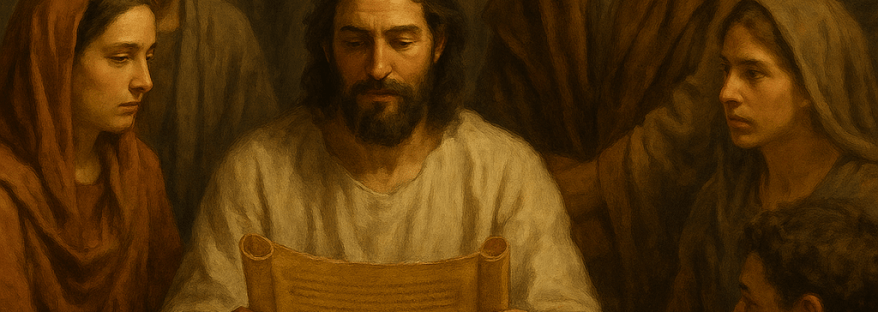
From the Series: Ordinary Saints: Lessons from the Ante-Nicene Church
Scripture quotations are from the New King James Version®.
Copyright © 1982 by Thomas Nelson. Used by permission. All rights reserved.
Contemporary approaches to Scripture frequently reflect denominational backgrounds, academic training, or philosophical frameworks. In contrast, the earliest Christians, those preceding the Council of Nicaea, exemplified a simple, Spirit-led, and grounded method of personal faithfulness. Their convictions were shaped primarily by direct experience and the guidance of the Holy Spirit, rather than by formal theological constructs. This distinction constitutes the central lesson of their legacy. Reflecting on these differences can encourage our group to consider how we engage with Scripture today. By drawing inspiration from the early church’s emphasis on simplicity and shared spiritual discernment, we may find meaningful ways to reexamine our own approach, prioritizing openness to the Spirit and a humble pursuit of faith together.
Prior to the establishment of creeds and councils that defined orthodoxy, these believers relied exclusively on God’s written Word. Although the New Testament canon was formalized later, the early church regarded apostolic writings as inspired and authoritative. Irenaeus affirmed, “The Scriptures are indeed perfect, since they were spoken by the Word of God and His Spirit.”
For these early Christians, Scripture was considered sufficient. Their focus remained on faithfully practicing its teachings rather than constructing elaborate theological systems.
Ante-Nicene Christians regarded the Holy Spirit as the Church’s primary Teacher. They drew upon passages such as 1 John 2:27: “The anointing you received from Him abides in you, and you have no need that anyone should teach you… His anointing teaches you about everything.” Their writings emphasize humility, prayer, and fasting in the pursuit of understanding, rather than reliance on tradition or doctrinal development.
This approach did not reflect individualism or rebellion but rather Spirit-led submission to the authority of Scripture. They trusted the Spirit to illuminate the Word for all believers, not solely for a select few.
The early Christians adhered to Scripture literally and uncompromisingly, enacting Jesus’ commands such as loving enemies and practicing radical forgiveness, even when this resulted in suffering. For example, during the persecution of Christians under Roman rule, many early believers responded to violence not with retaliation but with prayer and acts of kindness toward their persecutors. Accounts describe martyrs who forgave their executioners, imitating Jesus’ call to love one’s enemies even in the face of death. Such stories demonstrate how these Christians embodied Christ’s teachings not as abstract ideals but as daily practices that shaped their lives and witness.
- Do not resist an evil person.
- Give to those who ask.
- Turn the other cheek.
For these believers, Christ’s words were not merely admired; they were actively put into practice.
Allegorical interpretation emerged later, introduced by thinkers such as Origen and Clement of Alexandria, who were influenced more by Greek philosophy than by the early church’s emphasis on direct obedience. While allegory represented a departure from earlier straightforward readings, it has nonetheless enriched Christian understanding for many believers throughout history. Acknowledging the valuable contributions of allegorical interpretation allows us to respect the diversity of traditions within the Christian community.
Scripture was not interpreted in isolation. Early Christians gathered in homes, read the Gospels and Epistles aloud, and sought the Spirit’s guidance together. Despite lacking formal education, they recognized the clarity and power of God’s Word. As Clement of Rome urged, “Let us therefore hold steadfastly and unceasingly to our hope and the guarantee of our righteousness, who is Jesus Christ… Let us look steadfastly to Him.”
Ante-Nicene Christians aspired to be faithful servants rather than theologians. Their primary objective was transformation and obedience, rather than intellectual mastery.
What lessons can be drawn from their example for contemporary practice? In our group, we might apply these lessons through tangible practices such as praying together for the Spirit’s guidance before our discussions, reading Scripture aloud as a community, and sharing reflections on how we sense the Spirit leading us in our application of the text. We could also set aside regular times for group study, encourage each member to ask questions, and support one another in living out Jesus’ specific teachings in daily life. By incorporating these simple practices, we can more closely embody the early church’s approach.
- The Holy Spirit should be trusted to lead believers into a true understanding of Scripture.
- Prioritizing living out Jesus’ explicit commands is more important than generating complex theological systems.
- Studying Scripture together in community helps believers discern its meaning more clearly.
- Every developed doctrine should always be compared to Scripture’s plain meaning first.
By following the example of the Ante-Nicene Christians, it is possible to rediscover a faith that is simple, humble, and deeply rooted in the living Word of God. In such a faith, Scripture, illuminated by the Spirit and embodied within an obedient community, serves as the foundation.
Sources:
- The Holy Bible — 1 John 2:27
- Irenaeus, Against Heresies, 2.28.2
- Clement of Rome, 1 Clement 36
- Acts 2:42; John 14:26
Discover more from Rooted & Raised
Subscribe to get the latest posts sent to your email.

