Devotions, Women's Devotionals

🌿 Kingdom Living Devotional — Day 40

“Therefore you shall be perfect, as your heavenly Father is perfect.”

Matthew 5:48 NASB1995

🕊 Called to Complete Love

Jesus ends this section with a high call: perfection. But not flawlessness—fullness. The word means “complete,” especially in love. We are to love like the Father—fully, completely, without favoritism or condition.

This kind of maturity isn’t achieved through effort alone but through surrender. It’s a fruit of walking daily with Christ, letting Him shape every part of us until His character is visible in us.

🔗 Ante-Nicene Reflection

The early Church understood this call to completeness. They sought to be whole in their obedience, undivided in their love, and consistent in holiness. They didn’t settle for partial devotion.

💭 Reflect

  • Am I becoming more complete in love, or just more religious?
  • What part of my life still needs to reflect the Father more fully?

✨ Prayer

Lord, grow me into wholeness. Make my love complete. Shape me into the image of my Father in heaven. Amen.


Devotions, Women's Devotionals

🌿 Kingdom Living Devotional — Day 39

“So that you may prove yourselves to be sons of your Father who is in heaven; for He causes His sun to rise on the evil and the good…”

Matthew 5:45 NASB1995

🌟 Looking Like Our Father

When we love enemies and pray for those who hurt us, we reflect our Father. He gives sunshine and rain to all, regardless of how they treat Him. And Jesus says that when we do the same—we show we belong to Him.

The Kingdom life isn’t about reacting like the world. It’s about becoming like our Father. His mercy, His patience, His love—lived out in us.

🔗 Ante-Nicene Reflection

The early Church lived differently. Their love wasn’t selective. They embraced a radical, consistent witness of good to all people—even in persecution—because they desired to reflect God’s nature.

💭 Reflect

  • Do my responses reflect my Father’s heart?
  • Am I showing love that looks different from the world?

✨ Prayer

Father, I want to look like You. Help me to love without partiality, to do good even when it isn’t returned. Shape my heart after Yours. Amen.


Featured & Foundational, Featured Article

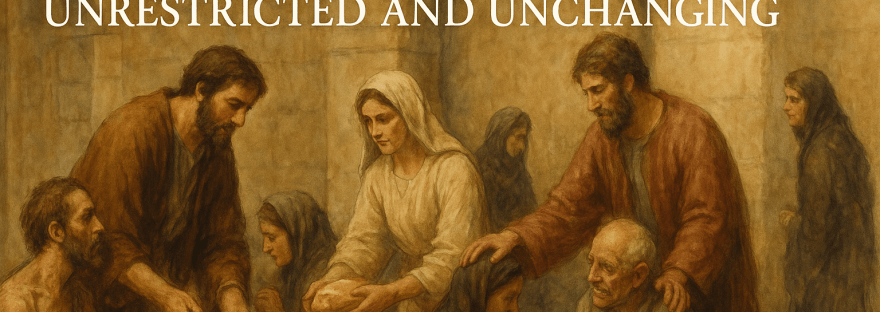
God’s Love: Unrestricted and Unchanging

There is a teaching, often repeated with great confidence, that God does not love anyone who is not “in Christ.” It sounds weighty, reverent, and even logical—until it is tested by the very Word of God.

The Scriptures do not describe God’s love as something hidden or conditional. They describe it as demonstrated, revealed, and poured out. It is not withheld until one believes; it is why one is drawn to believe.

Romans 5:8 tells us, “But God demonstrates His own love toward us, in that while we were yet sinners, Christ died for us.” This declaration is not veiled in mystery. It plainly states that God loved us before we were justified, reconciled, or sanctified. It is not union with Christ that produced His love; rather, it was His love that initiated the very mission of redemption.

When the Lord Jesus said, “Love your enemies… that you may be sons of your Father in heaven,” He grounded the command in God’s own nature: “for He causes His sun to rise on the evil and the good, and sends rain on the righteous and the unrighteous” (Matthew 5:44–45). If God’s love were only extended to those already in Christ, then His kindness toward the wicked would be hypocrisy. But Jesus makes clear: our Father loves even His enemies—and we are called to reflect that very love.

This love is not mere sentiment—it is action. The Father sent the Son not because we were worthy, but because we were lost. The mission of Christ was not the beginning of God’s love—it was the manifestation of what had always been in His heart. “For God so loved the world, that He gave His only begotten Son…” (John 3:16). Not the believing world. Not the elect world. The world.

The early Church understood this deeply. They did not preach a love confined to a theological category. They preached a Gospel that was for all men. They were ridiculed, slandered, and hunted—yet they loved their persecutors. They healed the sick, fed the poor, and offered hope to prisoners. Their writings and their lives bore witness that God’s love extended even to the enemies of the cross.

Justin Martyr wrote that Christ became man “for the sake of the human race,” and that the Father sent the Son “for the good of all men.” The Epistle to Diognetus describes God as sending His Son not to those who were already righteous, but to those who were corrupt and unworthy. The Church believed that God’s love was universal in offer and particular in reception—not because His love was limited, but because not all would receive it.

They lived what they believed. In Roman arenas, they forgave their killers. In plague-ridden cities, they stayed to care for the dying. In households and prisons, they offered the Gospel to every soul without distinction. Their theology was not an abstract system—it was the fragrance of Christ, poured out for the world.

This rich testimony stands in stark contrast to later teachings influenced by Stoic and Neoplatonic thought. These philosophies shaped views of God that emphasized impassibility—teaching that the divine could not experience change or passion. Within such a framework, God’s love became a selective extension of will, rather than the unchanging essence of His nature.

As these ideas entered Christian thought through certain teachers, the concept of divine love shifted. God’s affections were no longer seen as genuine or universally extended, but as fixed upon a predetermined few. The dynamic, pursuing love revealed in Scripture gave way to a colder logic—one where love became synonymous with election, and wrath with everyone else.

But the God of Scripture is not like the impassive gods of Greek philosophy. He is the God who weeps over Jerusalem, who is patient toward the wicked, who takes no pleasure in the death of the sinner, who rejoices over the lost sheep. He is not moved by merit, but by mercy. He is not controlled by our response, but He responds in faithful, pursuing love—so that we might turn and live.

If we are to return to the faith once for all delivered to the saints, we must recover this truth: God is love. Not selectively. Not reactively. Not philosophically. He is love by nature, and He has demonstrated that love by giving His Son—so that whoever believes in Him should not perish, but have everlasting life.

May we, like the early Church, live as those who have known this love—and extend it freely to all. For we are not loved because we are in Christ. We are in Christ because we were loved.

3–5 minutes

Leave a comment

Kingdom Discipleship, Kingdom Living

Without Spot or Wrinkle

Purity and Repentance in the Last Days

The Bride that Christ is returning for is not ashamed or apathetic—she is radiant, refined, and ready.

“That He might present the Church to Himself in splendor, without spot or wrinkle or any such thing, that she might be holy and without blemish.”
Ephesians 5:27

This is not an ideal—it is a promise. But it’s also a process. And that process is called repentance.


Purity Is Not Perfection, but Preparation

Jesus does not demand flawlessness—He calls for faithfulness. Holiness is not external performance; it is a heart surrendered and set apart for Him.

“Everyone who thus hopes in Him purifies himself as He is pure.”
1 John 3:3

The Bride doesn’t pretend she’s perfect. She clings to the One who is.


Repentance Is a Gift, Not a Punishment

“Those whom I love, I reprove and discipline. So be zealous and repent.”
Revelation 3:19

Repentance is not about guilt—it’s about grace. The early Christians saw repentance as a daily posture of the heart, a joyful returning to the One who loves and cleanses.

“Let us cleanse ourselves with tears of repentance, for He is merciful and quick to forgive.”
Hermas, Mandate 4


The Bride Purifies Herself by the Word

“Sanctify them in the truth; Your word is truth.”
John 17:17

The Church is not made pure by cultural standards or good intentions, but by the Word of God. The Scriptures, illuminated by the Spirit, reveal and remove what cannot remain.

  • Pride is replaced by humility
  • Bitterness is replaced by forgiveness
  • Lust is replaced by self-control
  • Idolatry is replaced by worship

This Purity Is for His Glory

“Let your garments always be white…”
Ecclesiastes 9:8

The Bride is not pure to earn love—but because she is already loved. Her radiance is a reflection of her Redeemer. She shines because He is her light.


What We Can Learn

  1. Holiness is the fruit of love, not fear.
  2. Repentance is a lifestyle of returning, not a one-time event.
  3. Purity flows from the Word and the Spirit.
  4. The Bride’s beauty reflects the glory of the Bridegroom.

Sources:

  • The Holy Bible — Ephesians 5:25–27; 1 John 3:3; Revelation 3:19; John 17:17; Ecclesiastes 9:8
  • Hermas, Mandate 4
  • Clement of Rome, 1 Clement 30
  • Didache, ch. 4
  • Tertullian, On Repentance

2–3 minutes

Leave a comment

Devotions, Family Devotionals

🏡 Kingdom Family Devotional — Day 39

“Your Father… causes His sun to rise on the evil and the good.”

Matthew 5:45 NASB1995

💕 A Family That Reflects the Father

Our Heavenly Father is kind and generous to everyone. He doesn’t wait for people to deserve it. And Jesus tells us that when we do the same, we show we are His children.

As a family, we can live this out daily—by being kind to neighbors, forgiving one another, and giving grace to those who don’t ask for it.

🕯 A Mother’s Role

Model generosity and mercy. Help your children see opportunities to reflect God’s love in their words and actions. Remind them that we love because He first loved us.

📖 Talk About It:

  • Do we treat others the way God treats us?
  • How can we reflect our Father better this week?

🪡 Kingdom Practice

As a family, write out one way each of you will reflect God’s love to someone outside your comfort zone this week.

✍️ Prayer:

Lord, help our family look like You. Let our actions show others that we belong to a loving, merciful Father. Amen.

Devotions, Teen Devotions

😎 Kingdom Teen Devotional — Day 39

“Be sons of your Father… who causes His sun to rise on the evil and the good.”

Matthew 5:45 NASB1995

🌟 Family Resemblance

God is ridiculously generous. He gives light and rain to everyone — even people who hate Him. Why? Because that’s who He is.

Jesus says when you live like that—with mercy, kindness, and grace to all—you look like your Father. The world doesn’t need more reaction. It needs reflection. Of Him.

🖊 Real Talk:

  • What would it take for your love to go beyond your friend circle?
  • Who in your life could use unexpected grace?

✨ Try This:

Do something kind for someone who hasn’t been kind to you. No strings. Just reflection.

✍️ Prayer:

God, make me look like You. Let my love stand out because it comes from You. Amen.

Children's Devotionals, Devotions

🧢 Kingdom Kids Devotional — Day 39

“God lets the sun shine on both good and bad people.”

Matthew 5:45 (Paraphrased)

☀️ Be Like Your Heavenly Father

God is kind to everyone, even people who aren’t kind to Him. When we love others the same way, we show the world what God is like.

You are God’s child when you act like Him. That means being kind to everyone—not just your friends.

🏛 Long Ago…

Christian children were taught that God loved everyone. They learned to show that same love by being kind and helpful, even to those who weren’t always nice.

💡 Think About It:

  • How does God treat people?
  • How can you show love to someone hard to love today?

✨ Let’s Pray:

Jesus, help me love like You do. Help me be kind like my Heavenly Father. Amen.

Kingdom Discipleship, Kingdom Living

Faithful in the Waiting

Perseverance and Hope in a Delaying World

The delay is not a denial.

Jesus told us that the Bridegroom would be delayed (Matthew 25:5), but He never told us to stop preparing. In the waiting, the Bride is not idle. She is being refined, proven, and strengthened.

“Blessed is that servant whom his master will find so doing when he comes.”
Luke 12:43

In a world of spiritual fatigue and cultural compromise, faithfulness becomes a prophetic witness. The one who endures in purity, hope, and trust—that one shines like a lamp in the dark.


Waiting Is Not Wasted

God uses delay to deepen devotion.

“For still the vision awaits its appointed time… If it seems slow, wait for it; it will surely come; it will not delay.”
Habakkuk 2:3

The early Church expected the Lord’s return, but they never let unmet expectations become spiritual apathy. They endured persecution, grief, injustice, and death—clinging to the hope of His appearing.

“Let us not grow weary or abandon our hope; the Lord is faithful and will come in His appointed time.”
Clement of Rome, 1 Clement 23


Faithfulness Means Obedience Over Time

“You have kept My word and have not denied My name. Because you have kept My word about patient endurance, I will keep you…”
Revelation 3:8–10

God is not looking for fast starters—but for faithful finishers. The Bride who will be ready is the one who:

  • Endures trials
  • Refuses compromise
  • Serves others in love
  • Stays rooted in the Word
  • Keeps her eyes on the King

Hope Strengthens the Heart

“Let us hold fast the confession of our hope without wavering, for He who promised is faithful.”
Hebrews 10:23

Hope is not wishful thinking—it is anchored in God’s faithfulness. It fuels perseverance. It reminds us that suffering is not the end. And it keeps the Bride looking up when the world tells her to give up.


What We Can Learn

  1. Waiting is not passive—it’s an active expression of trust.
  2. God refines us in delay, not just in deliverance.
  3. Faithfulness over time is the true measure of devotion.
  4. Hope is the anchor that keeps us rooted in love, not despair.

Sources:

  • The Holy Bible — Matthew 25:5; Luke 12:43; Habakkuk 2:3; Revelation 3:8–10; Hebrews 10:23; James 1:12
  • Clement of Rome, 1 Clement 23
  • Hermas, Mandate 9
  • Tertullian, On Patience
  • Didache, ch. 16

2–3 minutes

Leave a comment

Devotions, Family Devotionals

🏡 Kingdom Family Devotional — Day 38

“Love your enemies and pray for those who persecute you.”

Matthew 5:44 NASB1995

🌿 A Family That Loves Anyway

Kingdom families don’t just love the easy people—they learn to love the difficult ones too. When kids fight, when neighbors offend, when people are unfair—that’s when love shines brightest.

Jesus wants us to train our children to respond to hate with prayer and to hurt with healing.

🕯 A Mother’s Role

Help your children learn that prayer is powerful. Teach them that we don’t repay hurt with hurt—we repay it with love. Lead them in praying for those who are hard to love.

📖 Talk About It:

  • Has anyone been mean to our family?
  • How can we pray for them this week?

🪡 Kingdom Practice

Make a prayer list together of people who have been difficult. Pray for them every day this week and talk about what God shows you.

✍️ Prayer:

Lord, help our family reflect Your heart. Teach us to love when it’s hard, to forgive when we’re hurt, and to pray when we’re angry. Amen.

Devotions, Teen Devotions

😎 Kingdom Teen Devotional — Day 38

“Love your enemies and pray for those who persecute you.”

Matthew 5:44 NASB1995

🌟 Forgiveness Is Your Flex

Loving your enemies doesn’t mean letting them walk all over you—it means refusing to become like them. It means praying instead of posting, forgiving instead of holding on. This is next-level discipleship.

Jesus loved us when we were His enemies. And now, He calls us to do the same.

🖊 Real Talk:

  • Who gets under your skin the most right now?
  • What would change if you started praying for them instead of avoiding them?

✨ Try This:

Write the name of someone who’s hurt you. Pray for them this week. Ask God to help you let go.

✍️ Prayer:

Jesus, help me to love the hard people. I want to be like You, not like the world. Teach me how to bless instead of react. Amen.