Kingdom Discipleship, The Six Solas

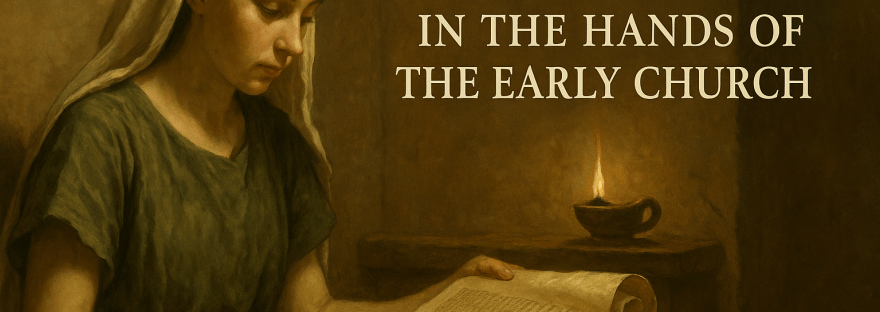
Sola Scriptura – Part 2: Scripture in the Hands of the Early Church

“You search the Scriptures because you think that in them you have eternal life; it is these that testify about Me.”
— John 5:39 (NASB1995)


How the Early Church Handled the Word

Before councils and confessions, before systematic theologies and seminaries, there were scrolls in homes, Scripture quoted in letters, and truth defended in blood.


The Ante-Nicene Church didn’t possess theological freedom to play with interpretations. They held to what was handed down. The Scriptures were not open to speculation. They were read, believed, memorized, and lived.

“Let us, then, not only call Him Lord, for that will not save us. For He says, ‘Not everyone who says to Me, Lord, Lord, will be saved, but he that does what is right.’ Let us, then, be His disciples, and obey His commands… by loving one another, by not committing adultery, by not speaking evil of one another.”
Second Epistle of Clement, c. AD 140

This was Sola Scriptura in action: not merely affirming that the Bible is true, but that it is binding, transforming, and meant to be obeyed.


Their View: Scripture as Final and Unified

While false teachers—like the Gnostics—claimed secret knowledge, the early Church clung to the clear, public, and preserved Word.

“These men draw nothing from the Scriptures which are properly called divine, but they boast that they possess more Gospels than there really are. But in reality, they are full of blasphemy.”
Irenaeus, Against Heresies, Book 3

They did not divide Old Testament from New. They saw one unified message:

  • The prophets foretold Christ.
  • The Gospels revealed Him.
  • The apostles explained Him.
  • The Church obeyed Him.

Scripture as the Standard for Doctrine

When disputes arose, they didn’t appeal to personal revelation or mystical interpretation. They returned to what was written.

“For if they would really make use of the Scriptures, they would see clearly that the heresies must be rejected… for the faith has been transmitted from the apostles to the Church through the Scriptures.”
Tertullian, Prescription Against Heretics, c. AD 200

They didn’t add to the Word with theological scaffolding. They didn’t twist the Word with philosophical grids. They received the Word as it was delivered and allowed the Spirit to teach them.

And this led to deep unity.


Scripture for the Ordinary Believer

The early Church was decentralized. There was no singular hierarchy dictating doctrine for all. The people had the Word—and many were literate enough to read or hear it.

Even uneducated believers were saturated in Scripture. They didn’t rely on spiritual elites to tell them what it meant. They were taught by the Holy Spirit, discipled in small gatherings, and held one another accountable to live it.

“Brethren, we ought to think of Jesus Christ as God, as the judge of the living and the dead, and we ought not to belittle our salvation. Let us then do His will, and not our own, obeying His commandments.”
Letter of Ignatius to the Magnesians, c. AD 110

This wasn’t Bible knowledge as trivia. It was Scripture as a way of life.


What We’ve Lost—and Must Recover

Much of today’s Church has traded:

  • Scripture for secondhand theology
  • Spirit-taught truth for institutionalized interpretations
  • Obedience for theological correctness

The early Church didn’t claim Sola Scriptura.
They lived it.

They believed that Scripture was:

  • Clear to the humble
  • Powerful to the obedient
  • Taught by the Spirit
  • Sufficient for salvation and godliness

And that hasn’t changed.


Kingdom Discipleship Reflection

  • Do I handle the Word as the early Church did—with reverence, humility, and obedience?
  • Have I unintentionally elevated teachings about Scripture over Scripture itself?
  • Am I living what I read, or merely affirming it as true?

This week, choose a New Testament command from Christ or His apostles. Write it out. Memorize it. Obey it.

Walk it out—not to earn salvation, but to walk as one who has been transformed by the truth.

“But prove yourselves doers of the word, and not merely hearers who delude themselves.”
— James 1:22 (NASB1995)


3–4 minutes

Leave a comment

Devotions, Women's Devotionals

👩‍🦰Testified and Assured— Day 10

“The Spirit Himself testifies with our spirit that we are children of God.”
Romans 8:16, NASB1995

Assurance in the Whisper

When doubt whispers, the Spirit speaks louder—not always in volume, but in truth.
The Holy Spirit testifies with your spirit—not just that you are loved or forgiven, but that you are God’s child.

This isn’t based on emotion or performance—it’s grounded in the presence of the Spirit who dwells in you.

You don’t have to strive for identity. You already have it.

Reflection:
Have you been listening to your doubts more than the Spirit’s assurance?

Prayer:
Holy Spirit, quiet my doubts and testify again that I am Yours. Let Your voice settle my heart in truth. Amen.

Children's Devotionals, Devotions

🧒Testified and Assured— Day 10

“The Spirit Himself testifies with our spirit that we are children of God.”
Romans 8:16, NASB1995

You Are God’s Child

When you believe in Jesus, God gives you His Spirit—and that’s how you know you’re part of His family!

The Holy Spirit tells your heart, “You belong to God!”

Even when you mess up, He reminds you that God still loves you and will never leave.

Try This:
Look in the mirror today and say: “I am a child of God.”

Prayer:
Holy Spirit, thank You for helping me remember I’m part of God’s family. Amen.

Devotions, Teen Devotions

😎Testified and Assured — Day 10

“The Spirit Himself testifies with our spirit that we are children of God.”
Romans 8:16, NASB1995

You’re Not Just a Christian. You’re a Child of God.

Identity is everything.
And if you ever wonder, “Am I really His?”—the Holy Spirit answers.

He speaks to your spirit, not through hype or performance, but through the unshakable truth of sonship.

Don’t look for assurance in your behavior or emotions—listen for it in the presence of the Spirit within you.

Challenge:
Journal about a time when the Holy Spirit reminded you that you were His.

Prayer:
Holy Spirit, ground me in the identity You confirm. Let me live as Your child—secure, known, and loved. Amen.

Devotions, Family Devotionals

👩‍👧Testified and Assured — Day 10

“The Spirit Himself testifies with our spirit that we are children of God.”
Romans 8:16, NASB1995

The Spirit Says, “You’re Mine.”

How does a child know they’re part of a family?
Not just by their last name—but by the daily, steady love they experience.

The Holy Spirit does the same. He doesn’t just give you a title—He gives you confidence and belonging.

Talk with your children about how the Spirit reassures us, especially on hard days.

Discussion Prompt:

  • Have you ever felt unsure about whether God still loves you?
  • How do we learn to trust the Spirit’s voice more than our feelings?

Prayer:
Holy Spirit, thank You for telling us we are Yours. Let our family walk with that assurance every day. Amen.

Devotions, Teen Devotions

😎Walk by the Spirit — Day 9

“But I say, walk by the Spirit, and you will not carry out the desire of the flesh.”
Galatians 5:16, NASB1995

Step by Step: Spirit Over Flesh

The battle between the flesh and the Spirit is real.
But the key isn’t fighting harder—it’s walking smarter.

Galatians 5:16 gives the strategy: walk by the Spirit, and you won’t carry out the desires of the flesh. That means the more you tune your heart to Him, the less power sin has over you.

Walking by the Spirit means being sensitive to His conviction, obeying quickly, and choosing holiness over hype.

Challenge:
Take time to ask the Holy Spirit, “Where am I walking ahead of You—or without You?”

Prayer:
Holy Spirit, I need You to lead every step. Keep me from paths that pull me away. Train me to walk in freedom. Amen.

Devotions, Women's Devotionals

👩‍🦰Walk by the Spirit — Day 9

“But I say, walk by the Spirit, and you will not carry out the desire of the flesh.”
Galatians 5:16, NASB1995

A Daily Walk, Not a Sprint

“Walk by the Spirit.” It sounds simple, but it’s profound.

This walk isn’t about bursts of inspiration—it’s about moment-by-moment choices to listen, yield, and obey. When we keep in step with Him, the flesh has no room to lead.

To walk by the Spirit is to trust God with your next step, not just the distant future. You don’t need to figure it all out—you need to follow the One who does.

Reflection:
What does it look like for you to walk with the Spirit in your current season?

Prayer:
Holy Spirit, help me to walk with You today—attentive, obedient, and free from the desires of the flesh. Amen.

Children's Devotionals, Devotions

🧒Walk by the Spirit — Day 9

“But I say, walk by the Spirit, and you will not carry out the desire of the flesh.”
Galatians 5:16, NASB1995

Walking with God

Imagine you’re walking next to your best friend. You talk, listen, and go the same way together.

That’s what it means to “walk by the Spirit.”
God’s Spirit wants to walk with you every day—at school, at home, and when you play.

And guess what? When you walk with Him, you won’t want to do wrong things. You’ll want to do what makes Him smile.

Try This:
When you take a walk today, pretend Jesus is walking with you. Talk to Him!

Prayer:
Holy Spirit, help me stay close to You and choose good things today. Amen.

Devotions, Family Devotionals

👩‍👧Walk by the Spirit — Day 9

“But I say, walk by the Spirit, and you will not carry out the desire of the flesh.”
Galatians 5:16, NASB1995

Living Side by Side with the Spirit

Paul didn’t say “run ahead of the Spirit” or “drag Him behind.”
He said walk—side by side.

When we walk with the Spirit as mothers and children, we model dependence—not perfection.
We teach our kids to pause before reacting, to listen for His voice, and to walk in love.

Walking by the Spirit is slow, steady obedience.
And in a busy world, it’s the most powerful witness.

Discussion Prompt:
Ask your children:

  • What does it mean to “walk with” someone?
  • How can we walk with the Holy Spirit as a family?

Prayer:
Holy Spirit, help our family stay in step with You. Teach us to walk together in love, joy, and self-control. Amen.

Kingdom Discipleship, The Six Solas

Sola Scriptura – Part 1: The Authority of Scripture in a Confused World

“All Scripture is inspired by God and profitable for teaching, for reproof, for correction, for training in righteousness; so that the man of God may be adequate, equipped for every good work.”
— 2 Timothy 3:16–17 (NASB1995)

The Crisis of Authority

Today, the Church is facing a quiet crisis: a confusion of voices. One pastor says one thing. A scholar says another. Social media amplifies theological personalities, and denominations defend their systems with zeal. But amid the noise, one question must anchor us:

Whose word holds ultimate authority?

For the early Church, the answer was not in a creed, council, or commentary. It was Scripture—the living, inspired Word of God, taught and made alive by the Holy Spirit.

When Paul wrote to Timothy, he reminded him that Scripture alone was sufficient to equip the man or woman of God for every good work. Not just some. Not with additions. Not filtered through theological frameworks.

The Ante-Nicene Church didn’t have Calvin, Augustine, or Luther. They had the Holy Spirit and the Scriptures.

They didn’t rely on philosophical systems to explain God’s character or salvation. They turned to what was written by the apostles and prophets, taught by the Spirit, and lived by faith.


The Ante-Nicene Church and the Word

The early believers were fiercely committed to the written Word. They viewed it as God’s voice to His people, not a puzzle to be allegorized or filtered through speculative reasoning.

“We have learned from none others the plan of our salvation, than from those through whom the Gospel has come down to us… For how should it be if the apostles themselves had not left us writings?”
Irenaeus, Against Heresies, Book 3, Chapter 1 (c. AD 180)

This statement from Irenaeus shows that the early Church viewed the Scriptures as apostolic, sufficient, and authoritative.

Even as false teachers rose—Gnostics, philosophers, and empire-friendly preachers—the faithful Church returned to the Scriptures as their guide. They would not trade what was written for what was imagined.

They didn’t need a system to unlock God’s truth. They had the Spirit to teach it.

“But the Helper, the Holy Spirit, whom the Father will send in My name, He will teach you all things, and bring to your remembrance all that I said to you.”
— John 14:26


Dangers of Departing from the Word

Much of today’s theological error doesn’t come from denying Scripture—it comes from replacing it with:

  • Allegorical reinterpretations
  • Theological traditions
  • Commentaries and creeds elevated above the text

This is not new. In the second and third centuries, false teachers tried to redefine the gospel through Greek philosophy or mystical symbolism. The faithful remnant responded by clinging to the Scriptures.

“These men, therefore, ought to be refuted, who bring forward hypotheses, and who do not keep to that manner of speaking which the Church has received from the apostles, and which is preserved by the succession of elders in the Churches.”
Irenaeus, Against Heresies Book 1, Chapter 8

Truth doesn’t need to evolve. It only needs to be believed, obeyed, and preached as it was given.


A Call to Return

Dear sister, dear brother:
You don’t need a seminary degree to walk in truth.

You need the Scriptures in your hands and the Spirit in your heart.

If the Word says it, and the Spirit confirms it, you can trust it. Even if councils reject it. Even if scholars scoff at it. Even if systems bend it.

The authority of Scripture isn’t just a doctrine. It’s a lifeline in a world gone mad. It’s the Shepherd’s voice in the midst of wolves. It’s our anchor when the winds of deception blow.

“Heaven and earth will pass away, but My words will not pass away.”
— Matthew 24:35


Kingdom Discipleship Reflection

  • Am I reading Scripture with a posture of humility, letting it shape me?
  • Have I allowed man-made systems to reinterpret what God has plainly spoken?
  • Am I relying on the Holy Spirit to understand Scripture, or someone else’s lens?

This week, open your Bible and read one Gospel through the eyes of a disciple—no commentaries, no podcasts, no study notes. Just you, the Word, and the Spirit.

Let Him speak. Let Him teach. Let Him anchor you.

“Sanctify them in the truth; Your word is truth.”
— John 17:17

3–4 minutes

Leave a comment