“Bear one another’s burdens, and thereby fulfill the law of Christ.” — Galatians 6:2 (NASB 1995)
We were never meant to carry everything alone. The Spirit draws us into community—a place where burdens are shared, tears are witnessed, and love is proven.
Bearing one another’s burdens doesn’t always mean fixing problems. Sometimes it means simply being there—present, prayerful, Spirit-led.
This is how we fulfill the law of Christ: love expressed in action, led by compassion, powered by the Holy Spirit.
Reflection: Whose burden have I been avoiding? How might the Spirit want me to come alongside them?
Prayer: Holy Spirit, teach me to walk with others in their pain, not away from it. Help me fulfill Christ’s law through Spirit-filled love. Amen.
From the series: Understanding the End Times — A Biblical Framework
“All Scripture is given by inspiration of God, and is profitable for doctrine, for reproof, for correction, for instruction in righteousness.” — 2 Timothy 3:16 (NKJV)
When you hear the word eschatology, it may sound intimidating, even academic. But in simple terms, eschatology means “the study of last things.” It’s about what God has revealed in His Word concerning the future — the return of Christ, the resurrection of the dead, the final judgment, and the new heavens and earth.
The question is: does this matter for our daily lives? According to Scripture, it matters more than we often realize. Eschatology shapes the way we live in the present, strengthens our faith, and calls us to walk as watchful disciples.
What Is Eschatology?
The word comes from two Greek terms:
eschatos = “last” or “final”
logos = “word, discourse, or study”
So eschatology simply means the study of the last things. Scripture uses this framework to reveal God’s purposes: the kingdom of Christ, the judgment of the nations, the resurrection of the dead, and the restoration of all creation.
Tribulation (Matthew 24:21) — a unique time of distress and judgment.
Rapture (1 Thessalonians 4:16–17) — the church caught up to meet Christ.
Apostasy (2 Thessalonians 2:3) — the great falling away before the man of sin is revealed.
Don’t let these terms overwhelm you. They are simply markers that help us explore what God has already revealed.
Why Study Prophecy?
Some Christians avoid prophecy, thinking it’s too divisive or complicated. But God says otherwise:
Hope — “Looking for the blessed hope and glorious appearing of our great God and Savior Jesus Christ.” (Titus 2:13)
Holiness — “Everyone who has this hope in Him purifies himself, just as He is pure.” (1 John 3:3)
Mission — “This gospel of the kingdom will be preached in all the world as a witness to all the nations, and then the end will come.” (Matthew 24:14)
Comfort — “Therefore comfort one another with these words.” (1 Thessalonians 4:18)
Far from being speculative, prophecy is intensely practical. It strengthens our endurance, calls us to holy living, fuels our urgency for the gospel, and comforts us with the promise of Christ’s return.
Can We Trust the Bible’s Prophecy?
Skeptics often ask: “How do you know these ancient texts haven’t been corrupted?” The evidence is overwhelming:
The Dead Sea Scrolls (dated ~150 BC) show Isaiah’s words copied with astonishing accuracy for over 1,000 years.
The New Testament is preserved in more than 5,800 Greek manuscripts — more than any other ancient document.
Archaeology repeatedly confirms Scripture:
The Cyrus Cylinder validates Isaiah’s prophecy of Cyrus by name (Isaiah 44:28).
The Tel Dan Stele confirms the dynasty of King David.
The Pilate Inscription affirms Pontius Pilate as prefect in Judea.
Even more compelling is fulfilled prophecy itself:
Messiah’s birth in Bethlehem (Micah 5:2; Matthew 2:1).
His entry into Jerusalem on a donkey (Zechariah 9:9; Matthew 21:4–5).
His piercing and suffering (Isaiah 53; Psalm 22).
If God has been this precise in what’s already fulfilled, we can trust Him for what is yet to come.
Apostasy — The Last Days Backdrop
Before the glory of Christ’s return, Scripture warns of a great departure from truth:
“Let no one deceive you by any means; for that Day will not come unless the falling away comes first, and the man of sin is revealed.” (2 Thessalonians 2:3)
“Now the Spirit expressly says that in latter times some will depart from the faith, giving heed to deceiving spirits and doctrines of demons.” (1 Timothy 4:1)
“Because lawlessness will abound, the love of many will grow cold.” (Matthew 24:12)
This isn’t mere personal struggle. Apostasy is a deliberate turning away from God’s truth — and it is the hallmark of the last days.
Watchfulness, Not Date-Setting
There is a danger on both sides:
Neglect — ignoring prophecy altogether.
Speculation — trying to set dates, which Jesus forbids (Matthew 24:36).
Instead, Christ commands: “Watch therefore, for you do not know what hour your Lord is coming.” (Matthew 24:42)
The call is to watchfulness, not panic. We may not know the exact day or hour, but we are called to recognize the season (1 Thessalonians 5:4–6).
Reflection
Eschatology is not meant to confuse us but to anchor us. God has given prophecy not to entertain our curiosity but to equip our faith. To ignore it is to ignore part of His Word. To abuse it is to twist His truth. But to embrace it rightly is to live with hope, holiness, mission, and comfort.
Reflection Questions
When you think of prophecy, do you feel overwhelmed, skeptical, or encouraged? Why?
Which of the four purposes of prophecy (hope, holiness, mission, comfort) do you most need to strengthen in your life right now?
How can you practice watchfulness without slipping into fear or speculation?
Closing Prayer
Father, thank You that You have revealed the end from the beginning. Thank You for the hope of Christ’s return, the call to holiness, the urgency of mission, and the comfort of Your promises. Guard us from deception in these last days. Teach us to live as watchful disciples, ready for the return of our Lord. In Jesus’ name, Amen.
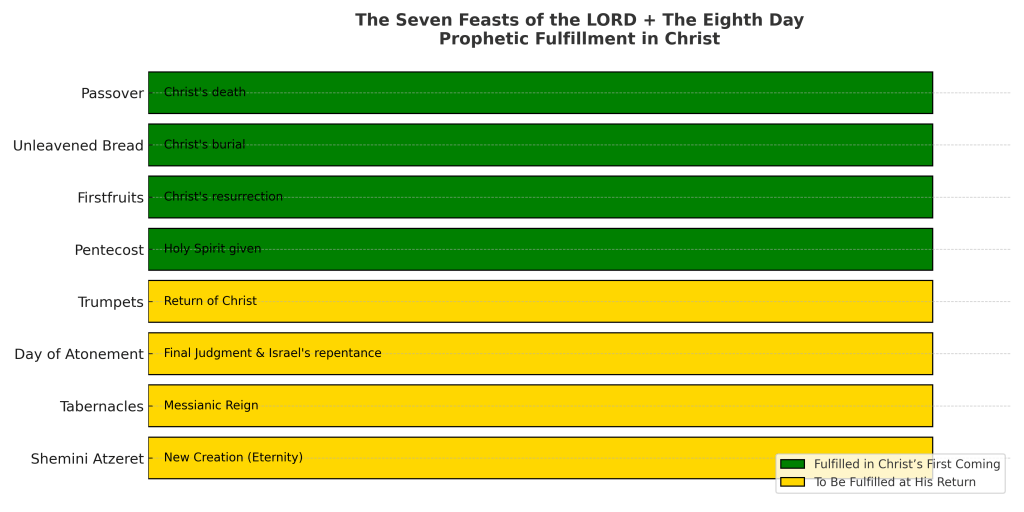
According to Leviticus 23, God established seven appointed feasts (moedim), and these were given in order as prophetic markers—each one fulfilled in Christ, either in His first coming or still to be fulfilled at His second coming.
Here’s a complete list:
🌿 SPRING FEASTS – Fulfilled in Christ’s First Coming
Passover (Pesach) – Christ’s crucifixion “Christ our Passover also has been sacrificed” (1 Cor. 5:7) • Fulfilled: Jesus died on Passover as the Lamb of God (John 1:29)
Unleavened Bread – Christ’s burial and sinlessness • Fulfilled: Jesus was buried, His body without sin or corruption (Acts 2:27)
Firstfruits – Christ’s resurrection “Christ has been raised… the firstfruits of those who are asleep” (1 Cor. 15:20) • Fulfilled: Jesus rose on the day of Firstfruits, the “first of the harvest”
Pentecost (Shavuot / Feast of Weeks) – Giving of the Spirit “You will receive power when the Holy Spirit has come upon you…” (Acts 1:8) • Fulfilled: 50 days after Firstfruits, the Spirit was poured out (Acts 2)
🍂 FALL FEASTS – To Be Fulfilled at Christ’s Return
Feast of Trumpets (Yom Teruah) – Return of the King “…at the last trumpet… the dead will be raised” (1 Cor. 15:52; Matt. 24:31) • Awaiting Fulfillment: This feast foreshadows the resurrection, rapture, and announcement of the King’s return
Day of Atonement (Yom Kippur) – Final Judgment and National Repentance “They will look on Me whom they have pierced” (Zech. 12:10; Rom. 11:26–27) • Awaiting Fulfillment: A picture of Israel’s future repentance and the full revelation of Christ as High Priest and Judge
Feast of Tabernacles (Sukkot) – Millennial Kingdom, God dwelling with man “The tabernacle of God is among men…” (Rev. 21:3) • Awaiting Fulfillment: Points to the Messianic Kingdom and God’s permanent dwelling among His people
✨ BONUS: Shemini Atzeret – The Eighth Day of Completion
Not a separate feast but a concluding assembly—a prophetic picture of eternity and the new creation. It follows Tabernacles and looks beyond the millennial reign into the eternal state where God dwells with His people forever (Revelation 21–22).
There are no additional holy days listed in Leviticus 23 beyond these seven feasts + the 8th Day. These encompass the entire redemptive timeline of Christ’s work—from the cross to the crown.








Leave a comment