Devotions, Teen Devotions

😎 Teen Devotional — Day 84

The Law of Christ = Love

“Bear one another’s burdens, and thereby fulfill the law of Christ.”Galatians 6:2 (NASB 1995)

You don’t have to “fix” everyone’s problems—but you are called to carry some of them. Not in your own strength, but in the Spirit’s.

Real strength shows up when you lift someone else’s load, even when it’s inconvenient.

That’s love. And that’s what the Spirit empowers.

Challenge:
Ask the Holy Spirit to show you one person who’s struggling. Then ask how you can come alongside them.

Prayer:
Holy Spirit, make me strong in love. Teach me to carry burdens with others, not just for them. Use me to bring real help and hope. Amen.

Children's Devotionals, Devotions

🧒 Children’s Devotional — Day 84

Help Carry the Load

“Bear one another’s burdens, and thereby fulfill the law of Christ.”Galatians 6:2 (NASB 1995)

Have you ever helped carry groceries? Or picked up something a friend dropped?

That’s what the Bible means when it says to “bear one another’s burdens.” The Holy Spirit helps us be kind when others are sad, hurt, or in need.

Try This:
Look for one way to help a friend or family member today.

Prayer:
Holy Spirit, show me how to help others when they’re having a hard time. I want to be kind like Jesus. Amen.

Devotions, Women's Devotionals

👩‍🦰 Women’s Devotional — Day 84

A Spirit-Led Sisterhood

“Bear one another’s burdens, and thereby fulfill the law of Christ.”Galatians 6:2 (NASB 1995)

We were never meant to carry everything alone. The Spirit draws us into community—a place where burdens are shared, tears are witnessed, and love is proven.

Bearing one another’s burdens doesn’t always mean fixing problems. Sometimes it means simply being there—present, prayerful, Spirit-led.

This is how we fulfill the law of Christ: love expressed in action, led by compassion, powered by the Holy Spirit.

Reflection:
Whose burden have I been avoiding? How might the Spirit want me to come alongside them?

Prayer:
Holy Spirit, teach me to walk with others in their pain, not away from it. Help me fulfill Christ’s law through Spirit-filled love. Amen.

Feast of Trumpets, Holy Days

Feast of Trumpets — The King Is Coming

Scripture Focus: Leviticus 23:23–25; Numbers 10:1–10; Matthew 24:29–31; 1 Thessalonians 4:16–17; Revelation 11:15


The Feast of Trumpets, known in Hebrew as Yom Teruah, means “Day of Blowing.” It begins at sundown on September 22, 2025. This day was unique among the appointed times of the Lord. It was a memorial day marked by the blast of trumpets and a sacred assembly. No specific reason was given in the Torah—only that Israel was to rest, gather, and listen for the sound.

But Scripture interprets Scripture. And when the trumpet sounds in the Word of God, it announces something critical: the arrival of a king, a call to assembly, or a declaration of war.

A Day of Blowing and Awakening

“Speak to the sons of Israel, saying, ‘In the seventh month on the first of the month you shall have a rest, a reminder by blowing of trumpets, a holy convocation’” (Leviticus 23:24).

In Numbers 10, trumpets were used to:

  • Call the congregation together (v. 2)
  • Signal the movement of the camp (v. 5)
  • Sound the alarm for war (v. 9)
  • Celebrate joyous occasions and offerings (v. 10)

In this way, the Feast of Trumpets prepares the people—a wake-up call for the coming High Holy Days.

The Prophetic Picture: The Return of the King

Jesus spoke of His return in unmistakable terms:

“And He will send forth His angels with a great trumpet and they will gather together His elect from the four winds…” (Matthew 24:31).

Paul says:

“For the Lord Himself will descend from heaven with a shout, with the voice of the archangel and with the trumpet of God, and the dead in Christ will rise first” (1 Thessalonians 4:16).

The trumpet will announce the coming of the true King—Jesus, returning to judge, to redeem, and to reign.

In Revelation 11:15, at the sounding of the seventh trumpet, loud voices in heaven declare:

“The kingdom of the world has become the kingdom of our Lord and of His Christ; and He will reign forever and ever.”

A Call to Readiness

Yom Teruah calls us to pause, reflect, and prepare. It comes without warning, as the new moon was not visible until it was observed and confirmed. This is why Jesus said:

“Of that day and hour no one knows… but the Father alone” (Matthew 24:36).

Just as the feast was dependent on watchfulness, so is our readiness for Christ’s return. Are we listening for the trumpet?

Devotional Reflection: Awake, Watch, Prepare

Read Together: Leviticus 23:23–25; 1 Thessalonians 4:16–17; Matthew 24:29–31

Discuss:

  • What did the trumpet signify in ancient Israel?
  • How does the sound of the trumpet relate to the second coming of Christ?
  • What does it mean to live in a state of spiritual readiness?
  • Are there areas of your life that need to come under the Lordship of the returning King?

Reflect: The Feast of Trumpets is both a warning and a promise. It reminds us that this world is not the end. Our King is coming, and He will not be late. Let the trumpet stir your heart toward repentance, worship, and joyful anticipation.

Pray: Lord, awaken us to the sound of Your trumpet. Shake us from spiritual slumber. Help us to live holy and alert, with lamps burning and hearts ready. We long for Your appearing. Come quickly, Lord Jesus. Amen.

The trumpet will sound. The King will return. Are we ready?

2–3 minutes

Leave a comment

Eschatology, From the Archives, The Last Days

Why Eschatology Matters

From the series: Understanding the End Times — A Biblical Framework

“All Scripture is given by inspiration of God, and is profitable for doctrine, for reproof, for correction, for instruction in righteousness.” — 2 Timothy 3:16 (NKJV)

When you hear the word eschatology, it may sound intimidating, even academic. But in simple terms, eschatology means “the study of last things.” It’s about what God has revealed in His Word concerning the future — the return of Christ, the resurrection of the dead, the final judgment, and the new heavens and earth.

The question is: does this matter for our daily lives? According to Scripture, it matters more than we often realize. Eschatology shapes the way we live in the present, strengthens our faith, and calls us to walk as watchful disciples.


What Is Eschatology?

The word comes from two Greek terms:

  • eschatos = “last” or “final”
  • logos = “word, discourse, or study”

So eschatology simply means the study of the last things. Scripture uses this framework to reveal God’s purposes: the kingdom of Christ, the judgment of the nations, the resurrection of the dead, and the restoration of all creation.

Along the way, you’ll encounter key words like:

  • Millennium (Revelation 20:1–6) — Christ’s 1,000-year reign.
  • Tribulation (Matthew 24:21) — a unique time of distress and judgment.
  • Rapture (1 Thessalonians 4:16–17) — the church caught up to meet Christ.
  • Apostasy (2 Thessalonians 2:3) — the great falling away before the man of sin is revealed.

Don’t let these terms overwhelm you. They are simply markers that help us explore what God has already revealed.


Why Study Prophecy?

Some Christians avoid prophecy, thinking it’s too divisive or complicated. But God says otherwise:

  • Hope“Looking for the blessed hope and glorious appearing of our great God and Savior Jesus Christ.” (Titus 2:13)
  • Holiness“Everyone who has this hope in Him purifies himself, just as He is pure.” (1 John 3:3)
  • Mission“This gospel of the kingdom will be preached in all the world as a witness to all the nations, and then the end will come.” (Matthew 24:14)
  • Comfort“Therefore comfort one another with these words.” (1 Thessalonians 4:18)

Far from being speculative, prophecy is intensely practical. It strengthens our endurance, calls us to holy living, fuels our urgency for the gospel, and comforts us with the promise of Christ’s return.


Can We Trust the Bible’s Prophecy?

Skeptics often ask: “How do you know these ancient texts haven’t been corrupted?” The evidence is overwhelming:

  • The Dead Sea Scrolls (dated ~150 BC) show Isaiah’s words copied with astonishing accuracy for over 1,000 years.
  • The New Testament is preserved in more than 5,800 Greek manuscripts — more than any other ancient document.
  • Archaeology repeatedly confirms Scripture:
    • The Cyrus Cylinder validates Isaiah’s prophecy of Cyrus by name (Isaiah 44:28).
    • The Tel Dan Stele confirms the dynasty of King David.
    • The Pilate Inscription affirms Pontius Pilate as prefect in Judea.

Even more compelling is fulfilled prophecy itself:

  • Messiah’s birth in Bethlehem (Micah 5:2; Matthew 2:1).
  • His entry into Jerusalem on a donkey (Zechariah 9:9; Matthew 21:4–5).
  • His piercing and suffering (Isaiah 53; Psalm 22).

If God has been this precise in what’s already fulfilled, we can trust Him for what is yet to come.


Apostasy — The Last Days Backdrop

Before the glory of Christ’s return, Scripture warns of a great departure from truth:

  • “Let no one deceive you by any means; for that Day will not come unless the falling away comes first, and the man of sin is revealed.” (2 Thessalonians 2:3)
  • “Now the Spirit expressly says that in latter times some will depart from the faith, giving heed to deceiving spirits and doctrines of demons.” (1 Timothy 4:1)
  • “Because lawlessness will abound, the love of many will grow cold.” (Matthew 24:12)

This isn’t mere personal struggle. Apostasy is a deliberate turning away from God’s truth — and it is the hallmark of the last days.


Watchfulness, Not Date-Setting

There is a danger on both sides:

  • Neglect — ignoring prophecy altogether.
  • Speculation — trying to set dates, which Jesus forbids (Matthew 24:36).

Instead, Christ commands: “Watch therefore, for you do not know what hour your Lord is coming.” (Matthew 24:42)

The call is to watchfulness, not panic. We may not know the exact day or hour, but we are called to recognize the season (1 Thessalonians 5:4–6).


Reflection

Eschatology is not meant to confuse us but to anchor us. God has given prophecy not to entertain our curiosity but to equip our faith. To ignore it is to ignore part of His Word. To abuse it is to twist His truth. But to embrace it rightly is to live with hope, holiness, mission, and comfort.


Reflection Questions

  1. When you think of prophecy, do you feel overwhelmed, skeptical, or encouraged? Why?
  2. Which of the four purposes of prophecy (hope, holiness, mission, comfort) do you most need to strengthen in your life right now?
  3. How can you practice watchfulness without slipping into fear or speculation?

Closing Prayer

Father, thank You that You have revealed the end from the beginning. Thank You for the hope of Christ’s return, the call to holiness, the urgency of mission, and the comfort of Your promises. Guard us from deception in these last days. Teach us to live as watchful disciples, ready for the return of our Lord. In Jesus’ name, Amen.


References & Further Reading

Scripture:

  • Titus 2:13 — the “blessed hope.”
  • Matthew 24:42 — command to watch.
  • 2 Timothy 4:8 — crown for those who love His appearing.
  • Revelation 1:3 — blessing for reading prophecy.

Early Church Witnesses:

  • Papias (AD 60–130), fragment recorded by Eusebius, affirming a literal 1,000-year reign.
  • Justin Martyr (Dialogue with Trypho, ch. 80) — affirms premillennial hope.

Archaeological & Textual:

  • Dead Sea Scrolls (1947–) — confirming OT prophetic manuscripts preserved with high accuracy.
  • Codex Sinaiticus (c. AD 350) — one of the oldest complete NT manuscripts.

Extra-Biblical Sources:

  • Josephus, Wars of the Jews (Book 6) — description of Jerusalem’s fall in AD 70.
  • Tacitus, Annals (Book 15) — Roman historian noting early Christians and persecution.

Leave a comment

Feast of Weeks, Holy Days

Pentecost (Shavuot)— The Spirit and the Harvest

Scripture Focus: Leviticus 23:15–22; Acts 1:4–8; Acts 2:1–41; John 14:16–17; Joel 2:28–32


Fifty days after the waving of the Firstfruits offering, the Feast of Weeks—known in Greek as Pentecost—was celebrated. It marked the end of the barley harvest and the beginning of the wheat harvest, a time of joyful gathering and thanksgiving. Yet in the fullness of time, God used this appointed day not only to gather grain, but to gather souls into His Kingdom.

The Count Leads to Completion

Leviticus 23 commands Israel to count seven complete Sabbaths from the day of Firstfruits, totaling fifty days (vv. 15–16). Then a new offering was to be presented to the LORD:

“You shall bring in from your dwelling places two loaves of bread for a wave offering… they shall be of fine flour, baked with leaven as first fruits to the Lord” (v. 17).

Unlike the earlier grain offerings, these two loaves were baked with leaven, symbolizing the full harvest of both Jew and Gentile—people from every nation, still imperfect, yet accepted in Christ.

The Fulfillment: The Holy Spirit Poured Out

In Acts 2, the early disciples were gathered in one place, as instructed by Jesus. Then suddenly:

“There came from heaven a noise like a violent rushing wind, and it filled the whole house… And they were all filled with the Holy Spirit” (Acts 2:2,4).

This was the fulfillment of what Jesus had promised: the Baptism of the Holy Spirit, the empowerment for witness (Acts 1:8), and the beginning of the Church’s public ministry.

It was also the fulfillment of Joel’s prophecy:

“It shall come about after this that I will pour out My Spirit on all mankind… And it will come about that whoever calls on the name of the Lord will be delivered” (Joel 2:28,32).

The result? Three thousand souls were added to the Church that day (Acts 2:41). The true harvest had begun.

The Role of the Spirit in the Believer’s Life

Pentecost is not just a historical event—it is a present reality. The same Spirit who descended at Pentecost dwells in every believer today:

  • He teaches and reminds us of Christ’s words (John 14:26)
  • He empowers us to witness (Acts 1:8)
  • He produces fruit in us (Galatians 5:22–23)
  • He convicts the world of sin and testifies of Christ (John 16:8,14)

The indwelling of the Spirit is both the seal of our salvation and the source of our sanctification. Through Him, we are transformed into the image of Christ (2 Corinthians 3:18).

Devotional Reflection: From Grain to Glory

Read Together: Leviticus 23:15–22; Acts 2:1–41; Joel 2:28–32

Discuss:

  • Why do you think God chose to pour out the Spirit on the day of Pentecost?
  • What do the two leavened loaves symbolize?
  • How does the Spirit equip you for witness and transformation?
  • What does it mean to live in daily dependence on the Spirit?

Reflect: Take time to thank God for the gift of the Holy Spirit. As the early Church was empowered to declare the mighty works of God, ask the Lord to fill your life with the same boldness, holiness, and harvest. We are no longer counting the days—we are living in the fulfillment.

Pray: Holy Spirit, we welcome You. As You filled the disciples at Pentecost, fill us anew. Empower us to speak truth, live boldly, and walk in step with Your leading. May our lives be a living offering to the Lord of the harvest. In Jesus’ name, Amen.

The fire has fallen. The harvest has begun.

2–4 minutes

Leave a comment

First Fruits, Holy Days

Firstfruits — He Is Risen!

Scripture Focus: Leviticus 23:9–14; 1 Corinthians 15:20–23; Matthew 28; Romans 6:8–11


On April 20, 2025, the Feast of Firstfruits is celebrated on the day after the weekly Sabbath during Passover week. This appointed time marks the beginning of the barley harvest in Israel, when the first sheaf (omer) was brought before the LORD as an offering of thanksgiving and trust in God’s provision. Yet for those who belong to Christ, this feast takes on even deeper significance. It is the day that death was defeated. It is the day the tomb was found empty.

What Is Firstfruits?

In Leviticus 23, the LORD commanded:

“When you enter the land which I am going to give to you and reap its harvest, then you shall bring in the sheaf of the first fruits of your harvest to the priest… He shall wave the sheaf before the Lord for you to be accepted” (vv. 10–11).

This sheaf represented the very first yield of the harvest. Offering it was a declaration of faith: if God accepted the first, He would bless the rest. It was an act of consecration and trust.

Jesus, the Firstfruits of the Resurrection

Paul connects this feast directly to Christ:

“But now Christ has been raised from the dead, the first fruits of those who are asleep” (1 Corinthians 15:20).

Just as the priest would wave the sheaf of barley as a representative of the harvest to come, so Jesus was raised as the first of a new creation—a living guarantee that those who belong to Him will also rise.

“For since by a man came death, by a man also came the resurrection of the dead. For as in Adam all die, so also in Christ all will be made alive. But each in his own order: Christ the first fruits, after that those who are Christ’s at His coming” (vv. 21–23).

His resurrection wasn’t an isolated miracle—it was the down payment of a coming harvest. The tomb is empty, and because of that, ours will be too.

Raised to New Life

Firstfruits is not just about the future resurrection. It also proclaims newness of life now:

“Now if we have died with Christ, we believe that we shall also live with Him… Consider yourselves to be dead to sin, but alive to God in Christ Jesus” (Romans 6:8, 11).

Resurrection is not only our hope—it is our identity. The same power that raised Jesus from the grave now works in those who believe (Ephesians 1:19–20).

Celebrating with Barley: A Symbol of Consecration

To mark this day, many believers choose to incorporate barley into their celebration as a physical reminder of the spiritual harvest. Barley was the first crop to ripen in Israel and was seen as a humble offering from the land—one that God Himself chose as the symbol of resurrection.

Ideas for a Simple Firstfruits Celebration:

  • Barley Bread or Soup: Prepare a meal using barley and pray together, giving thanks for Christ, our Firstfruits.
  • Wave Sheaf Symbol: Create a small bundle of barley or another grain and wave it before the Lord as a declaration that your life is His.
  • Thanksgiving and Testimony: Reflect on how Christ has brought resurrection life into your home. Share testimonies of spiritual renewal.
  • New Commitments: As the sheaf was a symbol of consecration, use this day to rededicate your heart, family, or home to God’s purposes.

Counting the Omer: From Resurrection to Empowerment

Leviticus 23:15–16 gives this command:

“You shall also count for yourselves from the day after the Sabbath, from the day when you brought in the sheaf of the wave offering; there shall be seven complete Sabbaths. You shall count fifty days to the day after the seventh Sabbath; then you shall present a new grain offering to the Lord.”

This count begins on Firstfruits and continues for fifty days until Shavuot (Pentecost). It was a season of expectancy—a time of waiting for harvest, revelation, and empowerment.

In Acts 1–2, we see the ultimate fulfillment of this period. From the resurrection to the pouring out of the Holy Spirit at Pentecost, the disciples waited together in prayer and obedience. On the fiftieth day, the Spirit descended.

For us today, counting the omer is a way to remember that salvation is not the end—it is the beginning of sanctification and mission. Each day is a step of preparation to be used by the Lord.

Suggestions for Counting the Omer:

  • Read one Psalm each day or walk through the Book of Acts.
  • Journal how God is forming Christ in you during this season.
  • Focus on “bearing fruit” in the Spirit: love, joy, peace…

We do not count up to Pentecost in obligation but in anticipation—we await the fullness of what God intends to do through His resurrected and Spirit-filled people.

Devotional Reflection: Living as the Harvest of God

Read Together: Leviticus 23:9–14; 1 Corinthians 15:20–23; Romans 6:8–11

Discuss:

  • What did the offering of Firstfruits symbolize for Israel?
  • How is Jesus the fulfillment of this feast?
  • How does our future resurrection shape the way we live now?
  • What does it mean to be “alive to God”?

Reflect: Thank God for the risen Christ. Let His resurrection become more than a doctrine—let it become your daily joy, strength, and expectation. We are not merely waiting for resurrection; we are already walking in it.

Pray: Father, thank You for raising Jesus from the dead as the firstfruits of the resurrection to come. Thank You that in Him we are made alive—now and forever. Help us to live each day in the power of His resurrection, bearing fruit that glorifies You. In Jesus’ name, Amen.

He is risen—and so shall we be.

Note:

Orthodox Judaism follows the Pharisaic / Rabbinic Interpretation (Majority of Modern Judaism), not necessarily a literal reading of Leviticus 23.

  • “Sabbath” = the first day of Unleavened Bread (which is a “High Sabbath,” not necessarily Saturday)
  • Therefore, Firstfruits = Nisan 16, regardless of the weekday
  • In 2025, Unleavened Bread begins at sundown April 13 (Nisan 15), so Firstfruits (Nisan 16) = April 14 evening to April 15 evening

Messianic Jews and many Christians who celebrate the feasts follow the Sadducean/Temple-era practice, which aligns with Jesus rising on Sunday and Paul calling Him the “Firstfruits” (1 Corinthians 15:20–23).

  • “Sabbath” = the weekly Sabbath (Saturday)
  • Firstfruits = the Sunday after that Sabbath, always a Sunday resurrection picture
  • In 2025, the weekly Sabbath during Passover week is April 19, so Firstfruits = Sunday, April 20
4–7 minutes


Leave a comment

Holy Days, Passover

🕊️ Passover: God’s Appointed Time

Passover was instituted by God Himself:


“Now this day will be a memorial to you, and you shall celebrate it as a feast to the LORD; throughout your generations you are to celebrate it as a permanent ordinance.”
Exodus 12:14, NASB 1995

Jesus honored the Passover with His disciples the night He was betrayed (Matthew 26:17–19). He did not replace it, but fulfilled its meaning as the Lamb of God (John 1:29; 1 Corinthians 5:7).

The early Church—especially Jewish believers and even many Gentile believers—continued to commemorate Christ’s death and resurrection in the context of Passover, not outside of it.


⚔️ The Schism: From Obedience to Imperial Power

🔹 Ignatius of Antioch (Early 2nd Century)

  • One of the earliest voices urging a departure from “Judaizing.”
  • He instructed believers to no longer observe “the Sabbath” as Jews did, but to honor “the Lord’s Day” (Sunday) instead.

This wasn’t merely honoring Christ’s resurrection—it became a repudiation of the Jewish calendar and practice.

🔹 Quartodeciman Controversy (2nd Century)

  • Quartodecimans (Latin for “Fourteeners”) observed the death of Christ on the 14th of Nisan, the biblical Passover.
  • Others (especially in Rome and Alexandria) preferred celebrating on a Sunday—regardless of the biblical calendar—to distinguish themselves from Jewish practices.

This dispute was widespread and intense. Yet the Quartodecimans were simply following the pattern found in Scripture—what the Apostles and early Church had done.

🔥 Council of Nicaea (AD 325)

This is where the divide became enshrined by law.

Emperor Constantine, who presided over the council (despite being unbaptized and still involved in pagan worship), said:

“…it appeared an unworthy thing that in the celebration of this most holy feast we should follow the practice of the Jews… Let us then have nothing in common with the detestable Jewish crowd…”
Eusebius, Life of Constantine, Book III, Chapter 18

They decreed that the resurrection should be celebrated on a Sunday, not according to the Jewish calendar, and thus severed the Church’s celebration of Christ’s death and resurrection from its biblical roots.


⚠️ The Result: Easter Replaces Passover

  • “Easter” eventually became associated with the pagan spring festival to the goddess Eostre (from which the English name derives).*
  • Biblical timing was replaced with ecclesiastical calendars.
  • Man-made tradition overtook God’s ordained moedim (appointed times).

“Thus you invalidated the word of God for the sake of your tradition.”
Matthew 15:6, NASB 1995


✝️ What Did the Early Believers Do?

The Ante-Nicene Church—those who followed Christ between the time of the Apostles and the Council of Nicaea—did not separate the crucifixion and resurrection from Passover. They recognized Jesus as the fulfillment of it, not a replacement.

They obeyed the appointed times (moedim) not as legalistic requirements but as prophetic celebrations pointing to Christ’s redemptive work.


🔥 Final Thoughts: Can Man Override God’s Calendar?

No.

Though councils may decree, emperors may impose, and theologians may rationalize, God’s Word stands.

“Heaven and earth will pass away, but My words will not pass away.”
Matthew 24:35, NASB 1995

God ordained the feasts as shadows of the substance in Christ (Colossians 2:16–17). They are not to be discarded, but fulfilled in truth and Spirit, not severed from their purpose.


✅ What We Know Historically

*The Name “Easter” Appears in English and German Only
The English word “Easter” is derived from the Old English Ēastre or Ēostre.

The 8th-century historian Bede (in De Natura Rerum and The Reckoning of Time) claimed that the month Ēosturmōnaþ (April) was named after a Saxon goddess called Ēostre, and that Christians adopted the name when celebrating Christ’s resurrection.

“Eosturmonath, which is now interpreted as the Paschal month, was once called after a goddess of theirs named Eostre…” — Bede, The Reckoning of Time, ch. 15

🔍 However:

Bede is the only ancient source who ever mentions this goddess.

There is no archaeological or written evidence (outside of Bede) for a goddess named Eostre being worshiped in Anglo-Saxon or Germanic paganism.

So, while the name might have originated from a springtime festival month, the goddess connection is weakly attested and largely speculative. Nevertheless, man-made tradition overtook God’s ordained moedim (appointed times).

3–4 minutes

Leave a comment

Holy Days, Summary

Appointed by God, Fulfilled in Christ

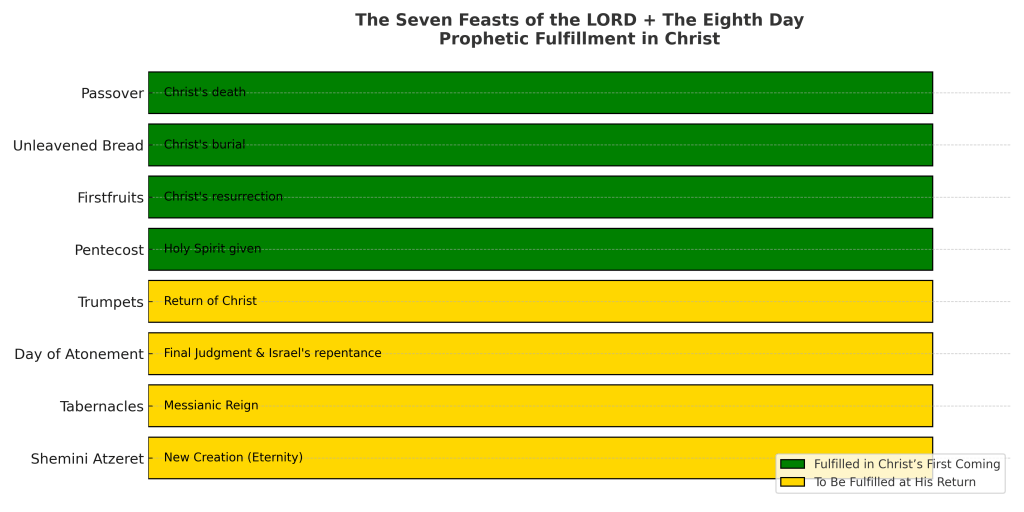
According to Leviticus 23, God established seven appointed feasts (moedim), and these were given in order as prophetic markers—each one fulfilled in Christ, either in His first coming or still to be fulfilled at His second coming.

Here’s a complete list:


🌿 SPRING FEASTS – Fulfilled in Christ’s First Coming

  1. Passover (Pesach)Christ’s crucifixion “Christ our Passover also has been sacrificed” (1 Cor. 5:7)
    • Fulfilled: Jesus died on Passover as the Lamb of God (John 1:29)
  2. Unleavened BreadChrist’s burial and sinlessness
    • Fulfilled: Jesus was buried, His body without sin or corruption (Acts 2:27)
  3. FirstfruitsChrist’s resurrection “Christ has been raised… the firstfruits of those who are asleep” (1 Cor. 15:20)
    • Fulfilled: Jesus rose on the day of Firstfruits, the “first of the harvest”
  4. Pentecost (Shavuot / Feast of Weeks)Giving of the Spirit “You will receive power when the Holy Spirit has come upon you…” (Acts 1:8)
    • Fulfilled: 50 days after Firstfruits, the Spirit was poured out (Acts 2)

🍂 FALL FEASTS – To Be Fulfilled at Christ’s Return

  1. Feast of Trumpets (Yom Teruah)Return of the King “…at the last trumpet… the dead will be raised” (1 Cor. 15:52; Matt. 24:31)
    • Awaiting Fulfillment: This feast foreshadows the resurrection, rapture, and announcement of the King’s return
  2. Day of Atonement (Yom Kippur)Final Judgment and National Repentance “They will look on Me whom they have pierced” (Zech. 12:10; Rom. 11:26–27)
    • Awaiting Fulfillment: A picture of Israel’s future repentance and the full revelation of Christ as High Priest and Judge
  3. Feast of Tabernacles (Sukkot)Millennial Kingdom, God dwelling with man “The tabernacle of God is among men…” (Rev. 21:3)
    • Awaiting Fulfillment: Points to the Messianic Kingdom and God’s permanent dwelling among His people

BONUS: Shemini Atzeret – The Eighth Day of Completion

Not a separate feast but a concluding assembly—a prophetic picture of eternity and the new creation. It follows Tabernacles and looks beyond the millennial reign into the eternal state where God dwells with His people forever (Revelation 21–22).


There are no additional holy days listed in Leviticus 23 beyond these seven feasts + the 8th Day. These encompass the entire redemptive timeline of Christ’s work—from the cross to the crown.

1–2 minutes

Leave a comment