“For each one will bear his own load.” — Galatians 6:5 (NASB 1995)
In Christ, we’re called to bear one another’s burdens (v.2), but that doesn’t mean we avoid responsibility for our own walk. The Spirit helps us discern the difference.
There are burdens we share—and loads we must carry ourselves. Your spiritual growth, your obedience, your calling—those are yours to steward.
The Spirit doesn’t remove responsibility. He empowers you to carry it faithfully.
Reflection: Am I waiting for someone else to carry what the Lord has asked me to bear?
Prayer: Holy Spirit, help me carry what is mine to carry. Teach me to be faithful and not depend on others for what You’ve entrusted to me. Amen.
“For each one will bear his own load.” — Galatians 6:5 (NASB 1995)
Spirit-led parenting doesn’t mean doing everything for our children. It means equipping them to carry their own spiritual and practical responsibilities.
We teach them to obey, to confess, to serve—not because we demand perfection, but because the Spirit empowers maturity.
Let’s raise children who walk in step with the Spirit—and carry their load with joy.
Family Talk:
What’s something you’re responsible for?
How can we carry our own load with God’s help?
Prayer: Holy Spirit, help our family take ownership of what You’ve given us. Teach us to be responsible and Spirit-filled in everything we do. Amen.
From the series: Understanding the End Times — A Biblical Framework
“And they lived and reigned with Christ for a thousand years.” — Revelation 20:4 (NKJV)
If the early church held firmly to the expectation of a literal reign of Christ on earth, why are there so many variations of Premillennial thought today?
Premillennialism simply means that Christ returns before the millennium. But within this broad view, believers have developed different understandings of how the details unfold. These streams matter, because they show where interpretation either remains consistent or drifts.
A Shared Foundation
All Premillennial views affirm that:
Christ will return bodily and visibly to this earth.
His reign will last for a literal 1,000 years.
The promises to Israel and the nations will be fulfilled in history, not only in eternity.
The differences arise when we ask: How does the Church fit into the Tribulation? How does Israel fit into God’s plan?
The Four Streams
1. Historic Premillennialism
The Church goes through the Tribulation.
The rapture and second coming are seen as one event.
Israel and the Church are often blended together.
Strength: Simplicity and ancient roots. Weakness: Blurs the Israel/Church distinction and struggles with imminence.
2. Dispensational Premillennialism
Maintains a clear distinction between Israel and the Church (1 Cor. 10:32).
The rapture is Pre-Tribulational, separate from the second coming.
God’s promises to Israel are irrevocable (Rom. 11:29).
Strength: Consistent literal interpretation, covenant faithfulness. Weakness: Often accused of being “new” (19th century), though it aligns with early Chiliast expectations when Scripture is read plainly.
3. Progressive Dispensationalism
Emphasizes an “already/not yet” kingdom.
Christ reigns spiritually now but will reign literally later.
Tends to soften Israel/Church distinctions.
Strength: Attempts to bridge gaps. Weakness: Risks muddling the clarity of God’s promises.
4. Non-Systematic Premillennialism
Some believers simply hold to a literal 1,000-year reign without attaching to a system.
They reject labels but affirm the plain reading of Revelation 20.
Strength: Simplicity. Weakness: Lack of framework can lead to confusion about Israel, the rapture, and the Tribulation.
The Dividing Line: Israel and the Church
The heart of the difference comes down to one question: Does the Church replace Israel, or are God’s promises to Israel still future?
Historic Premill often blends the two.
Dispensational Premill insists they remain distinct.
Progressive Premill blurs the line.
Romans 11:25–29 makes it clear: “Blindness in part has happened to Israel until the fullness of the Gentiles has come in… For the gifts and the calling of God are irrevocable.”
God is not finished with Israel. This truth anchors the Dispensational Premillennial view.
Why This Matters
Your view of Israel affects your view of the Church, the rapture, and the entire flow of prophecy. If God can cancel His promises to Israel, why trust His promises to us? But if His promises are irrevocable, then His Word stands firm forever.
Reflection
The different streams of Premillennialism remind us that methods matter. If we read God’s Word consistently, literally, and in context, the picture becomes clear: Christ will return before the millennium, and His plan for Israel and the Church remains distinct yet harmonious.
Reflection Questions
Which stream of Premillennialism have you heard most often in teaching or study?
Why does the Israel/Church distinction matter for interpreting prophecy?
How does God’s covenant faithfulness to Israel strengthen your confidence in His promises to you?
Closing Prayer
Lord, thank You for Your unchanging promises. Thank You that Your gifts and calling are irrevocable. Guard us from confusion, and help us to read Your Word with consistency. Keep us anchored in the hope of Christ’s coming kingdom, and strengthen our trust in Your covenant faithfulness. In Jesus’ name, Amen.
Revelation 20:1–6 — foundational text for all Premillennial views.
1 Thessalonians 4:16–17 — the rapture of the church.
1 Corinthians 15:51–52 — “we shall not all sleep, but we shall all be changed.”
Daniel 9:24–27 — prophecy of seventy weeks, framework for Israel’s future.
Jeremiah 30:7 — “the time of Jacob’s trouble,” distinct from church promises.
Romans 11:25–29 — God’s irrevocable covenant with Israel.
Early Church Witnesses:
Justin Martyr (AD 100–165), Dialogue with Trypho, ch. 80 — affirms a literal future kingdom.
Irenaeus (AD 130–200), Against Heresies 5.32–36 — details Christ’s reign on earth.
Tertullian (AD 155–220), Against Marcion 3.24 — supports an earthly kingdom.
Development of Streams:
Historic Premillennialism — traced in early church writings, including Papias and Irenaeus, but later without strong Israel/Church distinction.
Dispensational Premillennialism — formalized in the 19th century (John Nelson Darby, Plymouth Brethren), emphasizing Israel/Church distinction and Pre-Trib rapture.
Progressive Dispensationalism — late 20th-century development (Craig Blaising, Darrell Bock), combining “already/not yet” aspects of the kingdom.
Non-Systematic Premillennialism — believers who affirm Revelation 20 literally without full systemization.
Archaeological & Textual Evidence:
Dead Sea Scrolls — messianic expectations consistent with a future kingdom.
Codex Alexandrinus (5th century) — preserves Revelation 20 in literal form, showing no textual corruption.
Extra-Biblical / Scholarly Notes:
Eusebius, Ecclesiastical History — notes early millennialism and its decline under Origen and Augustine.
Hippolytus (AD 170–235), Commentary on Daniel — interprets prophecy literally, anticipating a future kingdom.
George Eldon Ladd, The Blessed Hope (1956) — modern articulation of Historic Premillennialism.
John Walvoord, The Rapture Question (1957) — defense of Pre-Tribulation rapture.
“But each one must examine his own work, and then he will have reason for boasting, but to himself alone, and not to another.” — Galatians 6:4 (NASB 1995)
In a world obsessed with comparing achievements, Paul calls believers to examine their own work. Not to prove themselves to others, but to walk in Spirit-led integrity.
The Spirit invites you to measure your growth—not by others’ successes—but by your own obedience. That quiet, faithful service God sees? That matters.
Don’t compare your ministry. Steward your assignment.
Reflection: Am I looking to others for validation—or asking the Spirit to examine my own heart?
Prayer: Holy Spirit, teach me to live faithfully before You. Let me examine my life by Your Word, not someone else’s success. Amen.
“But each one must examine his own work, and then he will have reason for boasting, but to himself alone, and not to another.” — Galatians 6:4 (NASB 1995)
Have you ever looked at someone else’s paper to see if you were doing it “right”?
God wants us to check our hearts—not copy others. The Holy Spirit helps us do what’s right, even when no one’s watching.
Try This: Ask God to help you obey today, even when others aren’t looking.
Prayer: Holy Spirit, help me do the right thing because it makes You happy—not because others see it. Amen.
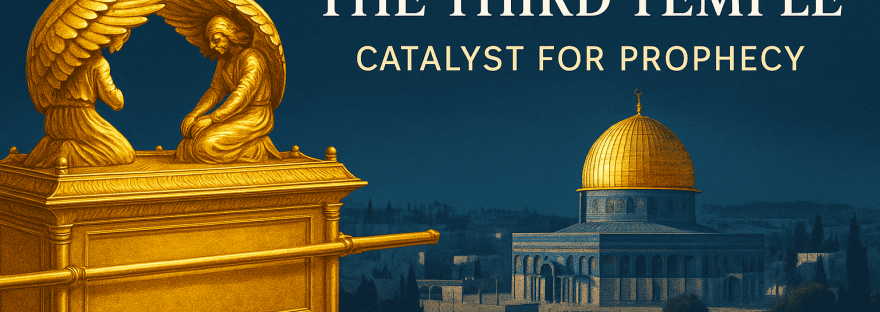
From the Series: The Ark of the Covenant as a Prophetic Game Changer
“Then he said to me, ‘This is the place where My throne and the place of the soles of My feet, where I will dwell in the midst of the children of Israel forever.’” — Ezekiel 43:7 (NKJV)
For centuries, Jewish longing for a restored Temple in Jerusalem has remained at the heart of biblical prophecy. The Temple was not merely a building; it was the center of worship, sacrifice, and God’s covenant presence. Scripture foretells a time when a temple will stand again — and in it, prophecy will unfold in dramatic and sobering ways.
But what could trigger such a monumental project in our day? For many, the rediscovery of the Ark of the Covenant would be the catalyst.
Why the Temple Matters
The Temple plays a central role in both Old and New Testament prophecy:
Daniel’s Seventieth Week — the “abomination of desolation” occurs in the Temple (Daniel 9:27; Matthew 24:15).
Paul’s Warning — the “man of sin” sits in the Temple of God, proclaiming himself as God (2 Thessalonians 2:4).
Ezekiel’s Vision — a future, glorified Temple in the millennial kingdom (Ezekiel 40–48).
Without a temple, these prophecies cannot be literally fulfilled. That is why any movement toward rebuilding must be watched with discernment.
The Ark as a Catalyst
The Ark of the Covenant, long hidden from history, could provide the religious and symbolic momentum for rebuilding. Consider:
Religious Authority — For observant Jews, the Ark represents the very presence of God. Its unveiling would validate Temple-centered worship.
National Identity — The Ark is bound up with Israel’s history. Its return would unify the nation around a tangible link to God’s covenant.
Global Attention — The world would not ignore such a discovery. The Ark could become the most significant archaeological find in history, drawing both fascination and hostility.
Like the return of the exiles in Ezra’s day, the Ark could be seen as a divine signal to “rise up and build” (Ezra 1:3).
Prophetic Implications
If the Ark were placed in a rebuilt Temple, several prophetic threads would converge:
The Antichrist’s deception (2 Thessalonians 2:4) — sitting in the Temple, perhaps near or even above the Ark, demanding worship.
The renewed sacrifices (Daniel 9:27) — reinstated in a rebuilt sanctuary, only to be halted by the Antichrist.
The world’s rage (Zechariah 12:3) — Jerusalem becoming a burdensome stone as nations contend with Israel’s claim of covenant authority.
Far from confirming salvation, the Ark in the Temple would test where people place their trust — in ritual and relics, or in the living Christ.
A Call to Watchfulness
The Ark’s discovery, should it happen, would not be the fulfillment of hope but the unfolding of warning. Just as Jeremiah warned Israel against trusting “the temple of the Lord” as a false refuge (Jeremiah 7:4), so today we must be cautious not to confuse the symbols of covenant with the Lord of the covenant.
The true Temple is Christ Himself (John 2:19–21), and those in Him are the living stones of His spiritual house (1 Peter 2:5).
Reflection Questions
Why is the Temple central to the unfolding of prophecy?
How might the Ark’s discovery ignite both devotion and deception?
In what ways can we ensure our trust remains in Christ, not in outward symbols?
Closing Prayer
Lord, give us discernment as we watch the times. Keep us from chasing after signs while ignoring the Savior. Let our hearts be fixed on Christ, the true Temple, who will return to reign in glory. Amen.
The Man of Lawlessness (Antichrist) is a prophetic certainty (2 Thessalonians 2:3–4; Daniel 9:27; Matthew 24:15). The Ark of the Covenant is seen in heaven (Revelation 11:19).
However, the role of the earthly Ark in end-times prophecy is a matter of theory, not doctrine. Its rediscovery could align with prophecy (Temple rebuilding, Antichrist’s deception, global conflict), but Scripture does not require this for God’s plan to unfold.
We handle prophecy with reverence:
Certainties we hold tightly.
Theories we explore carefully.
Speculation we avoid.
Let Scripture remain our anchor as we watch and wait for Christ’s return.
“But each one must examine his own work, and then he will have reason for boasting, but to himself alone, and not to another.” — Galatians 6:4 (NASB 1995)
You don’t have to outshine anyone in the kingdom. That’s not the goal.
The Spirit teaches us to examine, not compare. Real maturity isn’t about outperforming others—it’s about obeying Jesus in your lane.
Look at your own walk. Are you being faithful? That’s what matters.
Challenge: Unfollow one social media account that fuels unhealthy comparison. Spend that time examining your own walk with God.
Prayer: Holy Spirit, search me. Help me live with honest accountability and a heart that pleases You. Amen.
“But each one must examine his own work, and then he will have reason for boasting, but to himself alone, and not to another.” — Galatians 6:4 (NASB 1995)
Children learn quickly to look at what others are doing—especially when they feel behind or unnoticed. But the Spirit teaches us to look inward first.
Let’s help our families grow in self-examination, not self-comparison. This trains hearts to care more about obedience than applause.
Faithfulness is measured not by others—but by the Word and the Spirit within.
Family Talk:
What does it mean to “examine your own work”?
Why is it better than comparing ourselves to others?
Prayer: Holy Spirit, help our family walk in integrity. Teach us to examine our hearts and obey You with joy. Amen.
“For if anyone thinks that he is something when he is nothing, he deceives himself.” — Galatians 6:3 (NASB 1995)
Thinking you’re better than others isn’t confidence—it’s deception.
The Spirit opens our eyes to see that apart from Christ, we’re not “something”—we’re nothing. That realization doesn’t crush you; it frees you. Because once pride dies, grace can take root.
And that’s where real strength grows.
Challenge: Confess one area where pride has blinded you. Ask the Holy Spirit to replace it with humility.
Prayer: Holy Spirit, break any pride that’s hidden in me. Help me see myself rightly—humble, dependent, and loved by You. Amen.
“For if anyone thinks that he is something when he is nothing, he deceives himself.” — Galatians 6:3 (NASB 1995)
Humility isn’t thinking less of ourselves—it’s thinking of ourselves less. And in a world full of “me first” messaging, we need the Spirit’s help to model and teach that.
Children learn humility when they see us serve, confess, ask for help, and encourage others.
The Spirit frees us from the lie that we must be “something”—and reminds us that being in Christ is everything.
Family Talk:
Why do we sometimes think we’re better than others?
How can we stay humble and remember we need God and each other?
Prayer: Holy Spirit, make our family humble. Keep us from thinking too highly of ourselves, and teach us to love like Jesus. Amen.











Leave a comment