“But may it never be that I would boast, except in the cross of our Lord Jesus Christ, through which the world has been crucified to me, and I to the world.” — Galatians 6:14 (NASB 1995)
Everything in this world tempts us to find value in ourselves—our work, image, influence, or performance. But Paul flips it all: Boast only in the cross.
The Spirit reveals this: the world no longer owns us. Its applause doesn’t define us. We are crucified to it, and it to us. Our life is hidden in Christ.
Reflection: What am I tempted to boast in besides the cross?
Prayer: Holy Spirit, remind me that the cross is enough. Strip away my pride and help me glory in what Jesus did—nothing more. Amen.
“But may it never be that I would boast, except in the cross of our Lord Jesus Christ, through which the world has been crucified to me, and I to the world.” — Galatians 6:14 (NASB 1995)
We don’t brag about our toys, our grades, or how good we are.
We brag about Jesus—because He saved us!
That’s what Paul says in the Bible. The Holy Spirit helps us love the cross and live for Jesus.
Try This: Tell someone one thing you love about Jesus today.
Prayer: Holy Spirit, help me brag about Jesus, not myself. I’m so glad He loves me! Amen.
“But may it never be that I would boast, except in the cross of our Lord Jesus Christ, through which the world has been crucified to me, and I to the world.” — Galatians 6:14 (NASB 1995)
In a world obsessed with likes, clout, and showing off, Paul says, boast in the cross.
Why? Because the cross ends the world’s hold on you. You’re no longer owned by what people think. You’re free.
Let the Spirit lead you into a life that points to Christ—not self.
Challenge: Take inventory: what do you talk about most—yourself, your stuff, or your Savior?
Prayer: Holy Spirit, kill my pride. I want my life to boast in Jesus alone. Set me free from needing the world’s approval. Amen.
“But may it never be that I would boast, except in the cross of our Lord Jesus Christ, through which the world has been crucified to me, and I to the world.” — Galatians 6:14 (NASB 1995)
It’s natural for children to be proud of what they can do. But it’s supernatural to boast only in Jesus.
This kind of humility isn’t self-hate—it’s Spirit-born love for the cross.
As moms, we model this when we value Christ above everything else. The Spirit uses our example to shape their hearts.
Family Talk:
What kinds of things do people usually boast about?
Why does Paul say we should only boast in the cross?
Prayer: Holy Spirit, help our family see that Jesus is worth more than anything else. Let us boast only in Him. Amen.
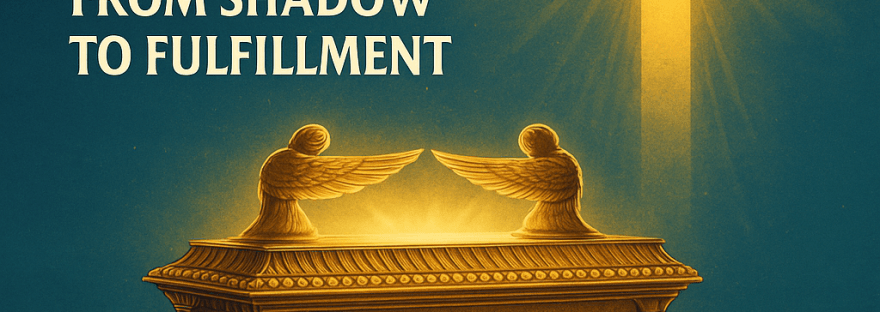
From the Series: The Ark of the Covenant as a Prophetic Game Changer
“For the law, having a shadow of the good things to come, and not the very image of the things, can never with these same sacrifices, which they offer continually year by year, make those who approach perfect.” — Hebrews 10:1 (NKJV)
The Ark of the Covenant was the most sacred object in Israel’s history. It symbolized God’s presence, His covenant, and His holiness. But as powerful as those symbols were, they were never the end in themselves. They were shadows pointing forward to Christ — the true presence of God, the ultimate mediator, and the fulfillment of all God’s promises.
The Mercy Seat — Christ Our Atonement
The mercy seat atop the Ark was sprinkled with sacrificial blood once a year on the Day of Atonement (Leviticus 16:14–15). This foreshadowed Christ, whose blood is the once-for-all atonement for sin:
“Whom God set forth as a propitiation by His blood, through faith.” — Romans 3:25
Christ’s cross became the true mercy seat, where wrath was satisfied and mercy was poured out.
The Tablets of the Covenant — Christ the Word Made Flesh
Inside the Ark were the stone tablets of the Law (Deuteronomy 10:5). They testified to God’s righteous standard. But Israel could not keep the Law perfectly. Christ fulfilled it completely:
“Do not think that I came to destroy the Law or the Prophets. I did not come to destroy but to fulfill.” — Matthew 5:17
He is the living Word, written not on stone but on hearts (2 Corinthians 3:3).
The Manna — Christ the Bread of Life
The golden pot of manna reminded Israel of God’s provision in the wilderness (Exodus 16:33). Jesus declared Himself the true bread from heaven:
“I am the bread of life. He who comes to Me shall never hunger, and he who believes in Me shall never thirst.” — John 6:35
The manna sustained for a day; Christ satisfies for eternity.
Aaron’s Rod That Budded — Christ the Resurrection and Life
Aaron’s rod budded with blossoms as a sign of God’s chosen priesthood (Numbers 17:8). This pointed forward to Christ, our eternal High Priest, confirmed by resurrection power:
“I am the resurrection and the life. He who believes in Me, though he may die, he shall live.” — John 11:25
The rod bloomed with life from death; Christ conquered the grave.
The Ark Itself — Christ With Us
Above all, the Ark was the meeting place of God and man:
“There I will meet with you, and I will speak with you from above the mercy seat.” — Exodus 25:22
In Christ, God came to dwell with us: “The Word became flesh and dwelt among us.” — John 1:14
Where the Ark was a shadow, Christ is the substance.
Our Hope and Assurance
If the Ark is ever rediscovered, it will testify to history. But Christ is greater than history. He is the fulfillment of every symbol within the Ark, the true presence of God, and the sure hope of salvation.
The Ark pointed forward to Him. He is the greater glory, the eternal mercy seat, and the King who will return.
Reflection Questions
How does each item in the Ark point to Christ’s work and identity?
Why is it dangerous to focus on relics or symbols apart from their fulfillment in Christ?
How can this understanding strengthen your confidence in God’s promises today?
Closing Prayer
Lord, thank You that every shadow finds its fulfillment in Christ. Keep us from clinging to symbols when we have the substance. Fix our eyes on Jesus, our mercy seat, our bread of life, our resurrection and our eternal King. Amen.
The Man of Lawlessness (Antichrist) is a prophetic certainty (2 Thessalonians 2:3–4; Daniel 9:27; Matthew 24:15). The Ark of the Covenant is seen in heaven (Revelation 11:19).
However, the role of the earthly Ark in end-times prophecy is a matter of theory, not doctrine. Its rediscovery could align with prophecy (Temple rebuilding, Antichrist’s deception, global conflict), but Scripture does not require this for God’s plan to unfold.
We handle prophecy with reverence:
Certainties we hold tightly.
Theories we explore carefully.
Speculation we avoid.
Let Scripture remain our anchor as we watch and wait for Christ’s return.
From the series: Understanding the End Times — A Biblical Framework
“And they lived and reigned with Christ for a thousand years.” — Revelation 20:4 (NKJV)
What does the Bible say about the future reign of Christ? Revelation 20 gives us a clear picture: after His return in glory, Jesus Christ will establish a kingdom on this earth, reigning for a thousand years. This is the heart of Premillennialism — the belief that Christ returns before the millennium to reign literally.
But is this view truly biblical, or is it a system imposed on the text? Let’s examine the evidence.
The Plain Reading of Revelation 20
Revelation 20:1–6 describes Satan bound for a thousand years, the saints reigning with Christ, and the first resurrection. The phrase “a thousand years” appears six times in just six verses.
If God repeats Himself, He wants us to notice. The simplest reading is that this is a literal thousand years. Just as Israel’s 70 years of captivity were literal (Jeremiah 25:11–12), so will Christ’s millennial reign be literal.
Old Testament Promises of Messiah’s Reign
The millennium isn’t confined to Revelation. The prophets repeatedly spoke of a future kingdom:
Zechariah 14:4, 9 — The Lord’s feet will stand on the Mount of Olives, and He will be King over all the earth.
Isaiah 2:2–4 — Nations stream to the mountain of the Lord, swords turned into plowshares, peace filling the earth.
Isaiah 11:6–9 — The wolf dwells with the lamb, and the earth is full of the knowledge of the Lord.
These aren’t vague ideals. They are specific promises awaiting fulfillment.
The Apostles’ Expectation
In Acts 1:6, the disciples asked: “Lord, will You at this time restore the kingdom to Israel?”
Jesus didn’t rebuke their expectation of a literal kingdom. He only said the timing was not for them to know (Acts 1:7). The kingdom itself was certain. Premillennialism honors that expectation.
God’s Covenant Faithfulness
Romans 11:25–29 makes it clear that God’s promises to Israel are irrevocable:
“Blindness in part has happened to Israel until the fullness of the Gentiles has come in. And so all Israel will be saved… For the gifts and the calling of God are irrevocable.”
Premillennialism safeguards God’s covenant faithfulness. He has not abandoned His promises to Abraham, Isaac, and Jacob.
The Character of Christ’s Return
Revelation 19 describes Christ’s return: a conquering King, striking the nations, ruling with a rod of iron. Psalm 2 promised the same.
If His return is literal, visible, and victorious, His reign must be too.
Consistency with His First Coming
Every prophecy of Christ’s first coming was fulfilled literally:
Born in Bethlehem (Micah 5:2; Matthew 2:1).
Riding on a donkey (Zechariah 9:9; Matthew 21:5).
Pierced hands and feet (Psalm 22:16; John 20:25–27).
If God fulfilled the first coming literally, why would we expect the second coming to be spiritualized?
Reflection
The case for Premillennialism isn’t complicated. It’s simply taking God at His Word. Revelation 20 says a thousand years — and we believe it. The prophets described a kingdom of peace and restoration — and we believe it. The apostles expected a restored kingdom for Israel — and we believe it.
Premillennialism is faith in God’s promises as written.
How does the repetition of “a thousand years” in Revelation 20 shape your view of the millennium?
Why is it important that Jesus did not rebuke the apostles’ expectation of a literal kingdom?
How does God’s covenant faithfulness to Israel strengthen your confidence in His promises to you?
Closing Prayer
Lord, thank You that Your promises are sure and Your covenants are unbreakable. Strengthen our faith to take You at Your Word, even when the world mocks or doubts. Help us to live in hope of Christ’s return and reign, and to long for the day when He will be King over all the earth. In Jesus’ name, Amen.
References & Further Reading
Scripture:
Revelation 19:11–16 — Christ’s visible return as conquering King.
Revelation 20:1–6 — the thousand-year reign repeated six times.
Zechariah 14:4, 9 — Messiah’s feet on the Mount of Olives; He reigns over all the earth.
Isaiah 2:2–4 — nations streaming to the Lord’s house, peace among nations.
Isaiah 11:6–9 — creation renewed under Messiah’s reign.
Acts 1:6–7 — disciples expecting the restoration of the kingdom to Israel.
Romans 11:25–29 — Israel’s salvation and God’s irrevocable promises.
Psalm 2:6–9 — the nations given to the Son as His inheritance.
Early Church Witnesses:
Papias (AD 60–130), cited in Eusebius, Ecclesiastical History 3.39 — affirmed a literal kingdom.
Justin Martyr, Dialogue with Trypho ch. 80 — defended belief in a literal 1,000-year reign.
Irenaeus, Against Heresies 5.32–36 — describes in detail the millennial kingdom.
Tertullian, Against Marcion 3.24 — anticipated Christ’s earthly reign.
Historical Development:
Premillennialism (Chiliasm) dominated the Ante-Nicene church.
Decline came with Origen’s allegorical method and Augustine’s City of God (20.7), which redefined the millennium as symbolic.
Archaeological & Textual Evidence:
Dead Sea Scrolls — confirm Jewish expectation of a coming Messianic kingdom (e.g., 4QFlorilegium).
Early church mosaics and inscriptions — often depict Christ as reigning King, reflecting literal expectation.
Codex Sinaiticus (c. AD 350) — preserves Revelation 20 intact, showing continuity in the text.
Extra-Biblical / Scholarly Notes:
Josephus, Antiquities of the Jews 18.1 — records Jewish messianic hope in the first century.
Hippolytus, Commentary on Daniel — interprets prophecy literally, expecting Christ’s reign.
Philip Schaff, History of the Christian Church — describes early dominance of Chiliasm.
George N. H. Peters, The Theocratic Kingdom (1884) — comprehensive defense of Premillennialism.
John MacArthur, The Second Coming (1999) — clear articulation of Christ’s literal return and reign.











Leave a comment