God Is Love, Kingdom Discipleship

Love That Warns: Truthful in Compassion, Bold in Loyalty

From the series “The Love of God: Revealed, Received, and Radiated”

A love that never warns is not love at all.
It is fear dressed in softness.
It seeks peace without righteousness, unity without truth, compassion without conviction.

But the love of God is not fragile. It tells the truth.
It does not flatter. It does not deceive. It does not ignore the path to destruction.

“Better is open rebuke than love that is concealed. Faithful are the wounds of a friend, but deceitful are the kisses of an enemy.”
Proverbs 27:5–6

The world offers a counterfeit love—a love that celebrates sin, silences conscience, and affirms rebellion. But God’s love calls people out of darkness into light. It wounds only to heal. It exposes only to restore.

“Those whom I love, I rebuke and discipline; therefore be zealous and repent.”
Revelation 3:19


The same Christ who wept over Jerusalem also called the Pharisees whitewashed tombs.
The same Paul who spoke of love in 1 Corinthians 13 warned of wolves in Acts 20.
The same Spirit who comforts the brokenhearted also convicts the world of sin, righteousness, and judgment (John 16:8).

To love someone is to want their salvation more than their approval.
To love the Church is to guard her from the deception that kills the soul.
To love the lost is to care enough to say, “This path leads to death.”


“Let love be without hypocrisy. Abhor what is evil; cling to what is good.”
Romans 12:9

Love does not affirm evil.
Love names it, flees from it, and calls others away from it.
Not from superiority, but from loyalty to the One who is holy.

This kind of love is rare. It is costly. It risks reputation and comfort. But it is the kind of love that Christ modeled and the early Church refused to surrender.


Ignatius of Antioch (AD 107):
“Do not be deceived… those who corrupt families shall not inherit the Kingdom. If they do not repent, they will be separated from God forever.”
Letter to the Ephesians, Ch. 16

Clement of Alexandria (AD 195):
“The physician who fears to use the knife lest he hurt, lets the infection spread. So too the teacher who will not expose falsehood has betrayed love.”
Stromata, Book VII

This was not cruelty—it was courage. They spoke plainly, because eternity was at stake. Their love was loyal to Christ, not to culture.


Today’s Church must recover this kind of love.
Not quarrelsome, but clear.
Not harsh, but holy.
Not soft-spoken when souls are at risk, but bold in loyalty to the truth of the gospel.

We do not love people by abandoning what is true.
We love them by calling them to the One who is the truth.
And when we do, we must be willing to be misunderstood—just as Christ was.


Sources & References

Love That Warns: Truthful in Compassion, Bold in Loyalty

Scripture (NASB 1995):

  • Proverbs 27:5–6 – “Better is open rebuke than love that is concealed…”
  • Revelation 3:19 – “Those whom I love, I rebuke and discipline…”
  • Romans 12:9 – “Let love be without hypocrisy…”
  • John 16:8 – “The Spirit will convict the world concerning sin…”

Ante-Nicene Sources:

  • Ignatius of Antioch, Letter to the Ephesians, Ch. 16.
    “Do not be deceived… those who corrupt families shall not inherit the Kingdom…”
    [Available at: EarlyChristianWritings.com]
  • Clement of Alexandria, Stromata, Book VII.
    “The physician who fears to use the knife… has betrayed love.”
    [Available at: CCEL.org or NewAdvent.org]
2–4 minutes

Leave a comment

God Is Love, Kingdom Discipleship

Love That Endures: Faithful Through Suffering and Trial

From the series “The Love of God: Revealed, Received, and Radiated”

The love of God does not collapse under pressure.
It does not vanish in hardship.
It does not abandon us in the valley or revoke its promise in the storm.

God’s love is not proven in prosperity—it is proven in perseverance.

“Who will separate us from the love of Christ? Will tribulation, or trouble, or persecution, or famine, or nakedness, or danger, or sword?”
Romans 8:35, NASB 1995

Paul’s answer is clear: Nothing.

Not affliction.
Not injustice.
Not loss, sickness, shame, or betrayal.
The love of Christ endures every blow and outlasts every fear.


The world preaches a love that thrives in ease and leaves when it’s tested.
But God’s love is made visible in suffering.
It is in the fire that the gold is refined—and it is in trial that love is proven.

“For I am convinced that neither death, nor life… will be able to separate us from the love of God…”
Romans 8:38–39

This isn’t poetic exaggeration. This was the testimony of believers who lost everything and still clung to the cross. Their faith wasn’t built on comfort—it was forged in suffering.


“Blessed is the one who perseveres under trial; for once he has been approved, he will receive the crown of life which the Lord has promised to those who love Him.”
James 1:12

True love is not seen in how loud our worship is on Sunday—it is seen in how steadfast we remain when everything else is stripped away.
To love God in suffering is to declare that He is worthy—no matter what He gives or withholds.

This was the testimony of the early Church.

They were beaten, imprisoned, starved, and burned.
They were disowned by families, slandered by rulers, and despised by culture.
But they never turned back.
Because they had encountered a love greater than the world could offer—and stronger than the world could break.


The Martyrdom of Polycarp (AD 155):
“Eighty and six years I have served Him, and He has done me no wrong. How then can I blaspheme my King and my Savior?”
Ch. 9

Polycarp did not plead for mercy. He did not curse his enemies. He stood in the flames because he knew the One who walked through fire before him.

Origen of Alexandria (AD 185–254):
“When God delays the suffering of His servants, He strengthens their soul with love, that they may endure to the end.”
Exhortation to Martyrdom, Ch. 20

They weren’t celebrated.
They were crushed.
But in their steadfast love, the Church grew.
Because a faith that endures in suffering speaks louder than a thousand sermons.


If the love of God dwells in us, it will not wither in adversity.
It will not retreat at the threat of loss.
It will hold fast—because it is anchored not in circumstance, but in the God who never changes.

“Though He slay me, I will hope in Him.”
Job 13:15

This kind of love is not a product of personality. It is the fruit of the Spirit. It is the result of walking so closely with Jesus that nothing—not even death—can make us let go.

The Church today must reclaim this witness.
Not a love that flickers in ease, but a love that endures.


Sources & References

Love That Endures: Faithful Through Suffering and Trial

Scripture (NASB 1995):

  • Romans 8:35–39 – “Who will separate us from the love of Christ?”
  • James 1:12 – “Blessed is the one who perseveres under trial…”
  • Job 13:15 – “Though He slay me, I will hope in Him.”

Ante-Nicene Sources:

  • The Martyrdom of Polycarp, Chapter 9.
    “Eighty and six years I have served Him, and He has done me no wrong…”
    [Available at: NewAdvent.org or EarlyChristianWritings.com]
  • Origen, Exhortation to Martyrdom, Chapter 20.
    “He strengthens their soul with love, that they may endure to the end.”
    [Available at: EarlyChristianWritings.com]
3–4 minutes

Leave a comment

God Is Love, Kingdom Discipleship

Love in Holiness: Set Apart by Love, Not Lawlessness

From the series “The Love of God: Revealed, Received, and Radiated”

Love is not permission to do what is right in our own eyes.
It is the power to do what is right in God’s.

The love of God is not passive. It is purifying.
It does not lower the standard—it fulfills it.
It does not ignore sin—it rescues from it.

If God is love, and that love now lives in us, then we must live as He lived—in holiness.

“Just as He who called you is holy, so be holy also in all your behavior; because it is written: ‘You shall be holy, for I am holy.’”
1 Peter 1:15–16

Holiness is not legalism. It is not asceticism.
Holiness is the character of God reflected through the life of a redeemed person.
And it is inseparable from love.


The Church was never meant to be known for compromise or cold religion. It was meant to be known by a love that obeys.

“For this is the love of God, that we keep His commandments; and His commandments are not burdensome.”
1 John 5:3

The love of God does not cancel the Word of God—it confirms it. It doesn’t reject commands; it makes them possible. Only a transformed heart can fulfill what God requires. That transformation is the work of His Spirit, not our self-discipline.

We don’t love God by dismissing His boundaries.
We love Him by walking in His ways.


“If you love Me, you will keep My commandments.”
John 14:15

These are the words of Jesus—not to enslave, but to awaken.
Holiness is not just abstaining from evil.
It is the pursuit of what is beautiful in God’s sight.

The early Church knew this. They rejected the world’s pleasures not out of pride, but out of devotion. They separated themselves from idolatry, immorality, and deceit—not because they were better, but because they had been born again.

Their love for God was visible in their choices.
Their desire for holiness was rooted in the cross.
They did not earn salvation—they walked in the salvation they had received.

The Didache (c. AD 50–100):
“There are two ways: one of life, and one of death… and this is the way of life: First, you shall love God who made you. Second, your neighbor as yourself… and whatsoever you do, do it in holiness and in the fear of God.”
Didache, Chapters 1–3


The love of God is not just a message to receive.
It is a life to be lived.

And if it is truly in us, we will hate what is evil and cling to what is good (Romans 12:9).
We will set aside every sin that entangles, because we have seen something better.
And we will walk in a purity that comes not from self-effort, but from surrender.

“Pursue peace with all men, and the sanctification without which no one will see the Lord.”
Hebrews 12:14


The Church today must remember what the Church once knew:
God’s love is holy.
It does not excuse sin—it delivers from it.
It does not affirm rebellion—it calls us into restoration.
It is not lawless—it is loyal to the heart of God.

To love Him is to walk as He walked.
To belong to Him is to be set apart.
And to be set apart is not to withdraw in pride—but to shine in purity.

We are not called to reflect the world.
We are called to reflect Christ.


Sources & References

Love in Holiness: Set Apart by Love, Not Lawlessness

Scripture (NASB 1995):

  • 1 Peter 1:15–16 – “Be holy, for I am holy.”
  • 1 John 5:3 – “This is the love of God, that we keep His commandments…”
  • John 14:15 – “If you love Me, you will keep My commandments.”
  • Romans 12:9 – “Abhor what is evil; cling to what is good.”
  • Hebrews 12:14 – “Pursue sanctification, without which no one will see the Lord.”

Ante-Nicene Source:

  • The Didache, Chapters 1–3.
    “There are two ways: one of life, and one of death… and whatsoever you do, do it in holiness…”
    [Available at: EarlyChristianWritings.com/didache.html]
3–4 minutes

Leave a comment

God Is Love, Kingdom Discipleship

The Early Church’s Witness of Love

From the series “The Love of God: Revealed, Received, and Radiated”

The Roman Empire didn’t fall to a revolution.
It wasn’t conquered by swords or silenced by riots.
It was pierced by love.

Long before Christianity became legal—before cathedrals rose, before councils met—the love of God spread from house to house, street to street, soul to soul.

It was not their arguments that made the early Church unstoppable.
It was their love.

They loved when hated.
They served when mocked.
They forgave when betrayed.
And they endured with joy, even when that love cost them their lives.


“By this all men will know that you are My disciples, if you have love for one another.”
John 13:35

This is how they lived—not because it was easy, but because it was the only way. They had no power, no political influence, no protected status. But they had the Holy Spirit. And the fruit of the Spirit is love (Galatians 5:22).

Their enemies saw it.
Their neighbors felt it.
Their persecutors couldn’t understand it.

Love didn’t make them weak—it made them unshakable.
They loved each other with radical generosity.
They loved outsiders with self-sacrifice.
They loved their enemies with unexplainable compassion.


Tertullian (Apology, Ch. 39):
“It is mainly the deeds of a love so noble that lead many to put a brand upon us. ‘See how they love one another,’ they say… ‘how they are ready even to die for one another.’”

In a world full of self-preservation, this kind of love was a threat.
In a society built on status and conquest, self-giving love disrupted the order.

They didn’t gather in stadiums. They met in homes.
They didn’t publish books. They memorized Scripture.
They didn’t fight back. They knelt down.

Their unity was not organizational—it was spiritual.
Their love was not emotional—it was cruciform.


During plagues, when the wealthy fled the cities, the Christians stayed behind. They cared for the dying—often catching the same illnesses that would kill them. And when their own bodies failed, they were remembered not for their protests, but for their love.

Even Rome’s enemies took note. The Emperor Julian (a pagan who tried to revive paganism and discredit Christianity) wrote with frustration:

“The impious Galileans support not only their poor, but ours as well. Everyone can see that our people lack aid from us.”
Letter to Arsacius, c. AD 362

The Church did not grow because it aligned with power.
It grew because it radiated the love of a crucified King.


The Epistle to Diognetus (2nd century):
“Christians dwell in the world, but are not of the world. They love all men, and are persecuted by all. They are unknown, and yet condemned; they are put to death, and yet restored to life.”
Epistle to Diognetus, Ch. 5–6

This was their witness. Not through debate or dominance, but through visible, supernatural love. A love that came from above. A love that had no worldly explanation.

They were not moved by the fear of man.
They were moved by the love of Christ.


The question is not whether this kind of love is possible.
The question is whether we believe in the same gospel they did.
Do we believe that the same Spirit who filled them fills us?

Because if we do, our love will not be optional.
It will be the evidence that Christ lives in us.
And the world will take notice—not because we demand it, but because they won’t be able to explain it.

This is the love that turned the world upside down.
And it’s still the only kind that can.

Sources & References

The Early Church’s Witness of Love

Scripture (NASB 1995):

  • John 13:35 – “By this all men will know that you are My disciples, if you have love for one another.”
  • Galatians 5:22 – “But the fruit of the Spirit is love…”

Ante-Nicene & Historical Sources:

  • Tertullian, Apology, Chapter 39.
    “See how they love one another… how they are ready even to die for one another.”
    [Available at: NewAdvent.org/fathers/0301.htm]
  • The Epistle to Diognetus, Chapters 5–6.
    “They love all men, and are persecuted by all…”
    [Available at: EarlyChristianWritings.com/diognetus.html]
  • Emperor Julian (Julian the Apostate), Letter to Arsacius (c. AD 362).
    “The impious Galileans support not only their poor, but ours as well…”
    [Referenced in: Rodney Stark, The Rise of Christianity, and other historical collections on late Roman correspondence.]
3–5 minutes

Leave a comment

God Is Love, Kingdom Discipleship

Love Your Enemies: The Forgotten Mark of Discipleship

From the series “The Love of God: Revealed, Received, and Radiated”

There is no clearer sign of Kingdom citizenship—and no more neglected command—than this: love your enemies.

Not tolerate them.
Not avoid them.
Not speak well of them when convenient.
Love them.

“But I say to you, love your enemies and pray for those who persecute you, so that you may prove yourselves to be sons of your Father who is in heaven…”
Matthew 5:44–45, NASB 1995

This is not hyperbole. This is not metaphor. It is the standard of the Kingdom, and it comes from the mouth of the King Himself.

To love those who are like us, who affirm us, who serve us—that requires no faith. But to love those who slander us, betray us, hurt us, or oppose us? That is a command that cannot be obeyed without the power of the Holy Spirit.


This kind of love is not natural. It is supernatural.
It cannot come from fallen flesh.
It must come from a heart renewed, crucified, and filled with the Spirit of Christ.

“Bless those who persecute you; bless and do not curse.”
Romans 12:14

“Do not be overcome by evil, but overcome evil with good.”
Romans 12:21

Enemy-love is not weakness.
It is not silence in the face of evil.
It is the refusal to let evil shape our response.
It is the choice to act in mercy even when justice is due, because God first showed us mercy.


We were all once enemies of God.

“While we were enemies, we were reconciled to God through the death of His Son…”
Romans 5:10

If we believe this, how can we hold hate in our hearts?
If we have received mercy while resisting Him, how can we withhold mercy from those who resist us?

This is not a peripheral issue.
This is not advanced Christianity.
This is basic obedience.

Jesus didn’t just teach it—He lived it.

He loved the ones who betrayed Him.
He forgave the ones who nailed Him to the cross.
He prayed for those who cursed Him with His final breath.

And He said: “Follow Me.”


The early Church did not soften this teaching. They embraced it. And they were known for it.

They refused to curse the emperors who fed them to beasts.
They did not raise swords against their persecutors.
They died praying for their murderers.
And the world took notice.

The Martyrdom of Polycarp (c. AD 155):
“We do not seek vengeance… but bless those who curse us, because Christ taught us to do so.”

Tertullian (Apology 37):
“We repay hatred with kindness, and injustice with mercy. We love those who kill us, because we follow One who was killed in love.”

They were not strong because they were admired.
They were strong because the love of God had broken them, remade them, and now shined through them.


If you love only those who love you, Jesus says you are no different from the world (Matthew 5:46–47).

Enemy-love is not optional.
It is not for the emotionally strong or spiritually elite.
It is for every citizen of Christ’s Kingdom.

And it is the clearest evidence that we belong to a different King.

This is not easy. It will cost your pride, your rights, your desire for retaliation. But it will also set you free.

Free from bitterness.
Free from the cycle of hatred.
Free to shine in a dark world that knows nothing of this kind of love.

This is the love that turned the world upside down once before.

It still can.

Sources & References

Love Your Enemies: The Forgotten Mark of Discipleship

Scripture (NASB 1995):

  • Matthew 5:44–45 – “Love your enemies and pray for those who persecute you…”
  • Matthew 5:46–47 – “If you love those who love you, what reward do you have?”
  • Romans 5:10 – “While we were enemies, we were reconciled to God…”
  • Romans 12:14 – “Bless those who persecute you…”
  • Romans 12:21 – “Do not be overcome by evil, but overcome evil with good.”

Ante-Nicene Sources:

  • The Martyrdom of Polycarp, Ch. 12–14.
    “We do not seek vengeance… but bless those who curse us, because Christ taught us to do so.”
    [Available at: EarlyChristianWritings.com or NewAdvent.org]
  • Tertullian, Apology, Ch. 37.
    “We repay hatred with kindness, and injustice with mercy. We love those who kill us…”
    [Available at: NewAdvent.org/fathers/0301.htm]
3–4 minutes

Leave a comment

God Is Love, Kingdom Discipleship

Love Manifested in Christ: The Cross Is the Measure

From the series “The Love of God: Revealed, Received, and Radiated”

If you want to know what God’s love looks like, look at the cross.

Not because the crucifixion was the first time God loved.
Not because wrath was satisfied and love was finally permitted to flow.
But because the cross was the full revelation of the love that had always existed in the heart of the Father.

Jesus didn’t come to persuade God to love us.
He came because God already did.

“But God demonstrates His own love toward us, in that while we were yet sinners, Christ died for us.”
Romans 5:8

The Son did not wait for us to repent. He didn’t demand that we first obey. He came while we were His enemies (Romans 5:10), dead in our sin, unworthy and unwilling. And it was in that place that the eternal love of God broke into the world—visible, personal, bleeding.


The cross was not an interruption in the character of God. It was the unveiling of it.

To see Jesus is to see the Father (John 14:9).
To hear His words, feel His compassion, and witness His mercy is to encounter the heart of the One who sent Him.

When Christ washed the feet of His disciples—including the one who would betray Him—He revealed a love not rooted in response, but in resolve.

When He healed the ear of the soldier who came to arrest Him, He revealed a love that overcomes evil with good.

When He looked at those who mocked Him and prayed, “Father, forgive them…”, He revealed the kind of love that doesn’t flinch under pressure or diminish under hatred.

This love is not abstract. It is not safe. It is not reserved for the deserving. It is poured out without caution, without condition, without calculation.

And that is what makes it holy.


If we are to understand the love of God, we must let go of what we’ve learned from the world.

This is not the love of human passion or performance.
It is not sentimental or self-centered.
It does not need applause.
It does not withhold until it is wanted.
It does not vanish when rejected.

God’s love is self-giving, sacrificial, and relentless.
It is powerful enough to endure death, and pure enough to rise from it.

“Greater love has no one than this, that one lay down his life for his friends.”
John 15:13

But Christ laid down His life not only for friends, but for enemies. That is the scandal and power of divine love. It meets us in rebellion, offers mercy without demand, and calls us into life with Him.


This is what the early Church defended—not just with their words, but with their blood.

They did not preach Christ because He made their lives easier.
They preached Him because they were convinced He was the love of God in human flesh.

Irenaeus of Lyons: “The Word of God, our Lord Jesus Christ… through His transcendent love, became what we are, that He might bring us to be even what He is.”
Against Heresies, Book V, Preface

Justin Martyr: “We, who once delighted in sin, now embrace righteousness; we who hated one another, now love one another… all through Him who loved us even to the cross.”
First Apology, Chapters 14–16

Epistle to Diognetus: “He sent the Creator and Fashioner of all things… not to tyrannize, but to persuade. Not to force, but to save.”
Epistle to Diognetus, Chapter 7–9

This love could not be killed in them because it had already died for them. It had overcome their fears, melted their pride, and claimed their hearts.


If the love of God in Christ doesn’t move us, it’s not because He has changed. It’s because we’ve settled for something less.

The cross is not a sentimental symbol.
It is the measurement of God’s love.
It is the place where mercy triumphed over judgment.
It is the doorway to life, the banner of victory, and the proof that God has never, and will never, stop loving the world He made.

This is the love that came.
This is the love that suffered.
This is the love that rose.

This is the love that still calls your name.


Sources & References

Scripture (NASB 1995):

  • Romans 5:6–8 – “While we were still helpless, at the right time Christ died for the ungodly…”
  • John 14:9 – “He who has seen Me has seen the Father.”
  • John 15:13 – “Greater love has no one than this…”
  • Romans 5:10 – “While we were enemies, we were reconciled to God…”

Ante-Nicene Sources:

  • Irenaeus of Lyons, Against Heresies, Book V, Preface.
    “Through His transcendent love, [Christ] became what we are…”
    [Available at: NewAdvent.org/fathers/0103500.htm]
  • Justin Martyr, First Apology, Chapters 14–16.
    “We… now love one another… all through Him who loved us even to the cross.”
    [Available at: CCEL.org or EarlyChristianWritings.com]
  • Epistle to Diognetus, Chapters 7–9.
    “He sent the Creator… not to tyrannize, but to persuade.”
    [Available at: EarlyChristianWritings.com/diognetus.html]
3–5 minutes

Leave a comment

Kingdom Discipleship, Kingdom Living

Armor of Light

Dressed for Battle, Clothed in Christ

The war within is real—but God has not left us exposed. The King has provided armor. Not made of metal, but of light. Not forged by man, but by the Spirit. It’s not something we take off and on—it’s something we put on daily as we walk in Christ.

“The night is far gone; the day is at hand. So then let us cast off the works of darkness and put on the armor of light.”
Romans 13:12


The Armor Is Christ Himself

“Put on the Lord Jesus Christ, and make no provision for the flesh…”
Romans 13:14

Spiritual armor is not a costume. It’s Christ formed in us—truth, righteousness, peace, faith, salvation, and the Word. It’s how we walk, think, speak, and fight in a world that loves darkness.


The Early Church Wore This Armor Publicly

They were not merely protected—they were marked. Their boldness, holiness, and endurance revealed the light within.

“We arm ourselves not with steel, but with truth and righteousness. These are the weapons of those who follow Christ.”
Tertullian, Apology 37

They stood firm, not because they were strong—but because they were clothed in Christ.


The Armor of God (Ephesians 6:10–18)

  • Belt of Truth — grounds and holds everything in place
  • Breastplate of Righteousness — protects your heart
  • Gospel Shoes of Peace — give you firm footing to advance
  • Shield of Faith — extinguishes enemy lies and fears
  • Helmet of Salvation — guards your mind with eternal perspective
  • Sword of the Spirit — the spoken Word of God
  • Prayer — the breath of the warrior, continual and alert

“Let all who put on Christ walk as those clothed with light, not returning to the shadows.”
Didache, ch. 10


What We Can Learn

  1. The armor of light is a life surrendered and shaped by Christ.
  2. Each piece of armor protects and empowers our daily walk.
  3. We are not defenseless—our weapons are spiritual and powerful.
  4. We fight not for victory, but from it.

Sources:

  • The Holy Bible — Romans 13:12–14; Ephesians 6:10–18; 2 Corinthians 10:3–5; Colossians 3:12–15
  • Tertullian, Apology 37
  • Didache, ch. 10
  • Clement of Alexandria, The Instructor
  • Ignatius of Antioch, Letter to the Ephesians

1–2 minutes

Leave a comment

God Is Love, Kingdom Discipleship

God Is Love: The Source, Standard, and Sustainer of True Love

From the series “The Love of God: Revealed, Received, and Radiated”

If we begin anywhere else, we will get everything else wrong.

God’s love is not just one part of who He is. He is not love in balance with other traits, as though His mercy and His justice take turns. Scripture doesn’t leave that option open. It says plainly and without apology: “God is love” (1 John 4:8).

That statement does not mean God overlooks sin. It does not mean He is permissive or pliable. It means that everything He does—whether mercy or judgment, kindness or discipline—flows from a heart that is eternally loving, eternally faithful, and eternally holy.

God is not waiting to become more loving.
He is not learning to be more gracious.
He is not stirred by your behavior into affection.
He is love—unchanging, eternal, and perfect.

The world has taught many of us to view God’s love as uncertain. It offers a version of God who is moody, conditional, and temperamental—always watching and waiting to withdraw from the sinner or the struggling saint. But the love of God is not like the love of men. It does not fluctuate. It cannot be manipulated. It flows from His being—not from your performance.

“If we are faithless, He remains faithful, for He cannot deny Himself.”
2 Timothy 2:13

God’s love was not awakened by creation—it is the reason for it. It was not born at the cross—it was revealed there. And it is not sustained by our strength—but by His unchanging character.


To see this love clearly, we must look at the Son.

“God demonstrates His own love toward us, in that while we were yet sinners, Christ died for us.”
Romans 5:8

The life, death, and resurrection of Jesus Christ reveal the Father’s love—not a sentimental emotion, but a holy, pursuing compassion that lays itself down for the undeserving.

Jesus did not come to change God’s mind about you. He came to show you what had always been true about God’s heart. He came to seek and to save. He came to serve and to give. He came to call, not to coerce. He came to invite the lost into communion with the Father—not by force, but by love.

Christ touched the unclean. He forgave the guilty. He loved His enemies. He died for those who mocked Him. This is not a new picture of God—it is the perfect revelation of the God who has always been.

“He who has seen Me has seen the Father.”
John 14:9


And yet, Christ’s earthly mission was not the end of this love being poured out—it was the beginning.

“The love of God has been poured out within our hearts through the Holy Spirit who was given to us.”
Romans 5:5

The same love that formed the world, fulfilled the Law, and conquered death is now within the believer—through the indwelling presence of the Holy Spirit. The Spirit does not offer us a memory of God’s love, but its living presence. He empowers us to walk in love, not as the world defines it, but as Christ demonstrated it.

The fruit of the Spirit begins with love (Galatians 5:22), because love is the root of Kingdom life. It is the proof of discipleship, the fulfillment of the Law, and the mark of divine rebirth.


The early Church knew this well.

They did not follow Christ because He offered them safety or favor in the eyes of the empire. They followed Him because they were convinced of His love—even to death. The Apostolic Fathers wrote about love not as a doctrine to be debated, but a truth to be obeyed.

Clement of Alexandria: “God is good and alone is good… and the good is essentially loving.” (Stromata IV)
Irenaeus of Lyons: “He became what we are, that He might bring us to be even what He is.” (Against Heresies V)
Ignatius of Antioch: “Our God, Jesus Christ… is the expression of the Father’s love, made flesh.” (Letter to the Ephesians)

They knew what the Scriptures taught.
They received what the Spirit gave.
They walked as Christ walked.
And they bore witness to a world that did not know this kind of love.


If we are to understand anything else in this series—God’s invitations, His warnings, His commands, and His promises—we must start here:

God is love.
His love is the source of your existence.
His Son is the standard of that love.
His Spirit is the sustainer of it in your life.

Anything less than this is not the gospel.


Sources & References

Scripture (NASB 1995):

  • 1 John 4:8 – “God is love.”
  • 2 Timothy 2:13 – “If we are faithless, He remains faithful…”
  • Romans 5:8 – “But God demonstrates His own love…”
  • John 14:9 – “He who has seen Me has seen the Father.”
  • Romans 5:5 – “The love of God has been poured out…”
  • Galatians 5:22 – “But the fruit of the Spirit is love…”

Ante-Nicene Sources:

  • Clement of Alexandria, Stromata (Book IV, Chapter 18) – “God is good and alone is good… and the good is essentially loving.”
    [Available at: CCEL.org or NewAdvent.org]

  • Irenaeus, Against Heresies (Book V, Preface) – “He became what we are, that He might bring us to be even what He is.”
    [Available at: NewAdvent.org/fathers/0103500.htm]
  • Ignatius of Antioch, Letter to the Ephesians (Chapter 18) – “Our God, Jesus Christ… is the expression of the Father’s love, made flesh.”
    [Available at: EarlyChristianWritings.com]
4–6 minutes

Leave a comment

Editor's Picks, God Is Love, Kingdom Discipleship

Love Empowered: The Holy Spirit and the Life of Christ Within

From the series “The Love of God: Revealed, Received, and Radiated”

It is one thing to speak of the love of God.
It is another to receive it.
But it is something far more profound to live it.

The love that created the world, the love that was nailed to a cross, is not meant to remain distant—admired but unreachable. The risen Christ did not ascend to leave us longing. He sent the Holy Spirit to abide with us, teach us, and form His love within us.

“The love of God has been poured out within our hearts through the Holy Spirit who was given to us.”
Romans 5:5

This is not a metaphor.
It is not a poetic way of saying we feel better when we believe.
It is the supernatural reality of regeneration.

Through the Holy Spirit, the love of God ceases to be a doctrine we study and becomes a presence we carry.


Many speak of love, but very few walk in it.
Why?
Because it cannot be manufactured by discipline, religious knowledge, or human willpower.

The love that forgives enemies, blesses persecutors, shows mercy to the undeserving, and remains faithful in suffering is not natural. It is the result of divine indwelling.

“But I say to you, love your enemies and pray for those who persecute you…”
Matthew 5:44

“By this all men will know that you are My disciples, if you have love for one another.”
John 13:35

These are not ideals for the spiritually gifted—they are commands for every believer. But without the Spirit, they are impossible.


When the Holy Spirit takes up residence in a believer, He does not merely convict and comfort. He conforms us to the image of Christ. He produces what we cannot:

“The fruit of the Spirit is love…”
Galatians 5:22

Notice where it begins: love. Not a feeling. Not attraction. Not tolerance.
A supernatural, self-denying, enemy-forgiving, holiness-seeking love that mirrors the life of Jesus Christ.

It is this kind of love that stunned the Roman Empire. The early Christians didn’t argue the culture into submission—they loved their enemies, cared for the sick during plagues, rescued abandoned infants, and refused to curse their executioners. And this wasn’t because of their willpower. It was the Spirit of Christ within them.


Tertullian (c. 160–220 AD) recorded that the pagans exclaimed:
“See how they love one another… and how ready they are to die for one another!”
Apology, Chapter 39

They loved with a kind of love the world could not explain—because it did not originate in them.
It came from heaven.
It flowed from a Person.
And it burned even when they were burned at the stake.


This is the love that dwells in every true follower of Christ.

It is not optional.
It is not theoretical.
It is not silent.

Where the Spirit is, there is love. And not merely for the brethren. The true test of love is not how we treat our friends, but how we treat our enemies.

“If anyone says, ‘I love God,’ and hates his brother, he is a liar…”
1 John 4:20

The early Church didn’t love one another because it made sense. They loved one another because the Spirit of the risen Christ had made them one. They didn’t love enemies to win debates—they loved them because they had died with Christ, and it was no longer they who lived, but He who lived in them.


This is what the Holy Spirit does.
He makes the love of God a living reality—poured out, overflowing, unstoppable.

Without Him, we cannot love as Christ loves.
With Him, we cannot help it.

Sources & References

Love Empowered: The Holy Spirit and the Life of Christ Within

Scripture (NASB 1995):

  • Romans 5:5 – “The love of God has been poured out within our hearts through the Holy Spirit…”
  • Galatians 5:22 – “The fruit of the Spirit is love…”
  • Matthew 5:44 – “Love your enemies…”
  • John 13:35 – “By this all men will know…”
  • 1 John 4:20 – “If anyone says, ‘I love God,’ and hates his brother, he is a liar…”

Ante-Nicene Sources:

  • Tertullian, Apology, Chapter 39.
    “See how they love one another… and how ready they are to die for one another!”
    [Available at: NewAdvent.org/fathers/0301.htm]
3–4 minutes

Leave a comment

Featured & Foundational, Featured Article

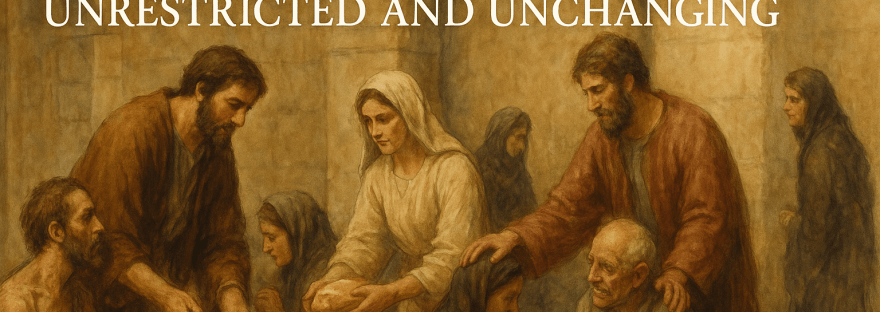
God’s Love: Unrestricted and Unchanging

There is a teaching, often repeated with great confidence, that God does not love anyone who is not “in Christ.” It sounds weighty, reverent, and even logical—until it is tested by the very Word of God.

The Scriptures do not describe God’s love as something hidden or conditional. They describe it as demonstrated, revealed, and poured out. It is not withheld until one believes; it is why one is drawn to believe.

Romans 5:8 tells us, “But God demonstrates His own love toward us, in that while we were yet sinners, Christ died for us.” This declaration is not veiled in mystery. It plainly states that God loved us before we were justified, reconciled, or sanctified. It is not union with Christ that produced His love; rather, it was His love that initiated the very mission of redemption.

When the Lord Jesus said, “Love your enemies… that you may be sons of your Father in heaven,” He grounded the command in God’s own nature: “for He causes His sun to rise on the evil and the good, and sends rain on the righteous and the unrighteous” (Matthew 5:44–45). If God’s love were only extended to those already in Christ, then His kindness toward the wicked would be hypocrisy. But Jesus makes clear: our Father loves even His enemies—and we are called to reflect that very love.

This love is not mere sentiment—it is action. The Father sent the Son not because we were worthy, but because we were lost. The mission of Christ was not the beginning of God’s love—it was the manifestation of what had always been in His heart. “For God so loved the world, that He gave His only begotten Son…” (John 3:16). Not the believing world. Not the elect world. The world.

The early Church understood this deeply. They did not preach a love confined to a theological category. They preached a Gospel that was for all men. They were ridiculed, slandered, and hunted—yet they loved their persecutors. They healed the sick, fed the poor, and offered hope to prisoners. Their writings and their lives bore witness that God’s love extended even to the enemies of the cross.

Justin Martyr wrote that Christ became man “for the sake of the human race,” and that the Father sent the Son “for the good of all men.” The Epistle to Diognetus describes God as sending His Son not to those who were already righteous, but to those who were corrupt and unworthy. The Church believed that God’s love was universal in offer and particular in reception—not because His love was limited, but because not all would receive it.

They lived what they believed. In Roman arenas, they forgave their killers. In plague-ridden cities, they stayed to care for the dying. In households and prisons, they offered the Gospel to every soul without distinction. Their theology was not an abstract system—it was the fragrance of Christ, poured out for the world.

This rich testimony stands in stark contrast to later teachings influenced by Stoic and Neoplatonic thought. These philosophies shaped views of God that emphasized impassibility—teaching that the divine could not experience change or passion. Within such a framework, God’s love became a selective extension of will, rather than the unchanging essence of His nature.

As these ideas entered Christian thought through certain teachers, the concept of divine love shifted. God’s affections were no longer seen as genuine or universally extended, but as fixed upon a predetermined few. The dynamic, pursuing love revealed in Scripture gave way to a colder logic—one where love became synonymous with election, and wrath with everyone else.

But the God of Scripture is not like the impassive gods of Greek philosophy. He is the God who weeps over Jerusalem, who is patient toward the wicked, who takes no pleasure in the death of the sinner, who rejoices over the lost sheep. He is not moved by merit, but by mercy. He is not controlled by our response, but He responds in faithful, pursuing love—so that we might turn and live.

If we are to return to the faith once for all delivered to the saints, we must recover this truth: God is love. Not selectively. Not reactively. Not philosophically. He is love by nature, and He has demonstrated that love by giving His Son—so that whoever believes in Him should not perish, but have everlasting life.

May we, like the early Church, live as those who have known this love—and extend it freely to all. For we are not loved because we are in Christ. We are in Christ because we were loved.

3–5 minutes

Leave a comment