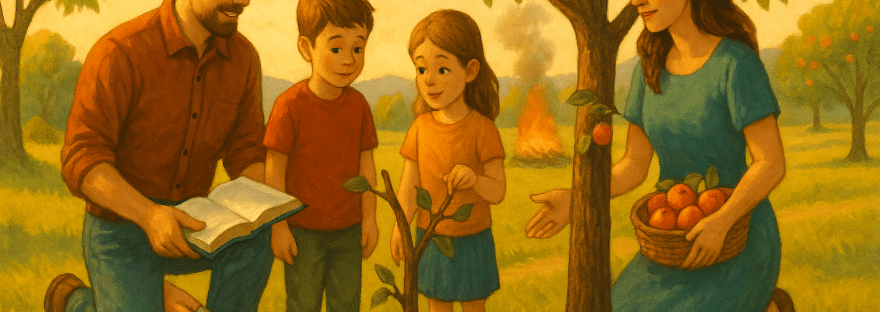
📖 “You are My friends if you do whatever I command you.” —John 15:14 (NKJV)
What does it mean to be a friend of Jesus?
He tells us: it means we listen to His voice and obey His Word.
That’s not something only pastors or teachers do. It’s something for every family member—young and old.
As a family, we’re invited to walk with Jesus, not just learn about Him. And friendship with Jesus grows stronger through simple obedience—together.
When your family makes choices that honor Him—how you speak, forgive, serve, and love—you’re living as His friends.
What an honor. What a relationship.
Family Reflection:
What’s one command of Jesus we can practice better as a family?
How can we remind each other that we’re walking with Him daily?
Prayer: Jesus, thank You for calling our family to be Your friends. Help us obey You not out of fear, but because we love You. Teach us to walk with You every day. Amen.
📖 “You are My friends if you do whatever I command you.” —John 15:14 (NKJV)
Do you have a best friend?
Jesus wants to be your very best friend—one you can talk to, trust, and follow every day.
But Jesus says something important: “If you obey Me, then you’re truly My friend.”
That means when we listen to what Jesus teaches us in the Bible—like being kind, telling the truth, and loving others—we show that we really care about Him.
Obeying Jesus isn’t just about rules. It’s about loving Him back.
You’re never too young to be a true friend of Jesus.
Think About It:
What is one thing Jesus asks us to do in the Bible?
How can you show Him you’re His friend today?
Prayer: Jesus, I want to be Your friend. Help me listen to You and obey what You say in the Bible. I love You. Amen.
📖 “You are My friends if you do whatever I command you.” —John 15:14 (NKJV)
The thought is almost too intimate to imagine: Jesus calls you His friend.
Not just His servant. Not merely His follower. But His friend—if you walk in obedience to His Word.
That’s not a burdensome demand. It’s a loving invitation. Because obedience flows out of love—not fear, not religion, not performance. Just love.
When you live in surrendered obedience, you don’t lose yourself—you find Him. You experience fellowship, peace, and joy that can’t be shaken.
Jesus doesn’t call everyone His friend—but those who abide and obey? He draws near to them in the sweetest intimacy.
He laid down His life for you. Will you walk with Him in obedience today?
Reflection Questions:
In what ways have you treated Jesus more like a distant king than a personal friend?
What is one area where you can walk in loving obedience today?
Prayer: Jesus, thank You for calling me Your friend. Help me walk in Your Word—not to earn Your love, but because I already have it. Draw me closer as I obey. Amen.
📖 “You are My friends if you do whatever I command you.” —John 15:14 (NKJV)
It’s easy to call someone your friend—but real friendship takes loyalty, trust, and time.
Jesus isn’t looking for fake followers or surface-level “likes.” He wants authentic friendship—the kind that’s shown through obedience.
That may sound intense, but it’s actually freeing.
Obedience doesn’t mean perfection. It means relationship. You read His Word because you care what He says. You follow Him because you trust Him. You obey—not to earn His love, but because you already have it.
He chose you. He calls you friend.
Challenge:
Be honest: Are you acting more like a fan of Jesus or a real friend?
What’s one command He’s given that you need to start obeying?
Prayer: Jesus, I want to be more than a fan—I want to be Your friend. Teach me to follow You with a real heart of obedience. Help me care about what matters to You. Amen.
Countdown to Convergence: How Agenda 2030, Today’s Headlines, and God’s Word Align
The way we use money is being transformed before our eyes — not by accident, but by design. Central banks around the world are moving rapidly toward CBDCs (Central Bank Digital Currencies), digital money issued and controlled directly by governments.
Headlines now read: “Federal Reserve Explores Digital Dollar” and “IMF Pushes for Cross-Border CBDC Integration.” While these developments are often marketed as tools for inclusion, safety, or convenience, Scripture shows us where they ultimately lead: the complete control of buying and selling.
Agenda 2030’s Economic Vision
Agenda 2030 declares goals such as:
Goal 8:“Promote sustained, inclusive and sustainable economic growth…”
Goal 9:“Build resilient infrastructure, promote inclusive and sustainable industrialization…”
On the surface, these sound admirable. But in practice, “inclusive” economies often mean programmable economies. Once physical cash is eliminated, every transaction will be digital — and subject to oversight, approval, and restriction.
Current Events in Motion
Over 100 nations are exploring or piloting CBDCs. China has already rolled out its “digital yuan.” Europe is testing the “Digital Euro.” The United States is laying groundwork through systems like FedNow.
Banks are closing physical branches, accelerating the shift to online-only banking.
Inflation, supply chain strain, and financial instability are being used as pressure points to justify a “new system.”
This is not a temporary trend. It is the infrastructure of a cashless world.
Prophecy Foretold This
Nearly 2,000 years ago, John wrote:
“…and that no one may buy or sell except one who has the mark or the name of the beast, or the number of his name.” (Revelation 13:17, c. AD 95, NKJV)
This passage has long seemed mysterious. But now, in an age of programmable digital currency, it is entirely possible.
Scripture also paints the futility of wealth in the last days:
“They will throw their silver into the streets, and their gold will be like refuse.” (Ezekiel 7:19, c. 590 BC, NKJV)
“Come now, you rich, weep and howl for your miseries that are coming upon you! Your riches are corrupted, and your garments are moth-eaten. Your gold and silver are corroded… You have heaped up treasure in the last days.” (James 5:1–3, c. AD 45, NKJV)
What the world trusts in will collapse. But what God has spoken will endure.
Why This Matters
CBDCs are more than money. They are programmable control:
Transactions can be restricted (for certain goods or services).
Money can be frozen (for non-compliance).
Currency can even be set to expire (forcing spending instead of saving).
This means no privacy, no independence, no freedom apart from the system. Once combined with digital ID and AI speech regulation, the complete Revelation 13 framework is in place.
God’s Pattern of Provision
But here is the hope: God has never abandoned His people to the systems of men.
In the wilderness, Israel received manna each day (Exodus 16, c. 1445 BC).
The widow of Zarephath saw her flour and oil miraculously sustained (1 Kings 17, c. 870 BC).
Jesus fed thousands with five loaves and two fish (John 6, c. AD 80).
When the world’s economy collapses, God’s economy still holds. Our provision is not bound by the Beast system, but by the hand of Almighty God.
A Call to Watchfulness
Jesus taught us: “Do not lay up for yourselves treasures on earth… but lay up for yourselves treasures in heaven.” (Matthew 6:19–21, c. AD 60, NKJV)
We prepare wisely and live carefully, but our ultimate trust is not in money, gold, or digital credits. It is in Christ. We watch with expectancy, not with fear.
Transforming Our World: The 2030 Agenda for Sustainable Development (UN, 2015)
Current Events
CBDC Pilot Programs — Recent Events & Announcements
India launches retail sandbox for digital rupee (CBDC pilot) On October 8, 2025, the Reserve Bank of India (RBI) announced a retail sandbox to allow fintech firms to test use-cases for the e-rupee.Reuters
India to pilot tokenization of Certificates of Deposit (wholesale CBDC layer) The RBI also launched a pilot program for tokenizing certificates of deposit, using the wholesale CBDC segment as infrastructure. Reuters
Uganda begins a CBDC pilot tied to broader tokenization scheme Uganda launched a pilot for its digital shilling, aiming to tokenize about $5.5 billion worth of real-world assets across sectors. Mariblock
Pakistan preparing CBDC pilot & virtual asset regulation Pakistan’s central bank is finalizing legislation to regulate virtual assets and is preparing to launch a CBDC pilot. Reuters
Japan continues its CBDC experiments The Bank of Japan publishes ongoing updates on its CBDC pilot/experimental phases as it explores design choices and capabilities. Bank of Japan
ECB adopts pilot for DLT settlement using central bank money The European Central Bank approved a plan (two tracks: “Pontes” as pilot, “Appia” for long term) to enable settlement on distributed ledger technology (DLT) using central bank money. European Central Bank
Global trends: many countries in CBDC exploration / pilot stage According to recent research, 114 countries are exploring CBDCs; of them, many are in development or pilot phases. CoinLedger Also, India’s e-rupee in circulation rose sharply by March 2025, marking it as a major pilot in scale. Atlantic Council
Branch Closures / Economic Restructuring in Banking
US branch closures accelerating In Q1 2025, U.S. banks closed a net 148 branches, up sharply from 21 in Q4 2024. Major banks contributing include U.S. Bancorp, Wells Fargo, Citizens, Bank of America, PNC, and Huntington. S&P Global
Deutsche Bank to cut branches and staff Deutsche Bank announced plans in 2025 to eliminate a “significant” number of branches and reduce roughly 2,000 jobs in its retail operations. The Economic Times+1
Lloyds Banking Group to close 49 more branches (UK) Lloyds announced it will shutter 49 more branches (across Lloyds, Halifax, Bank of Scotland) between 2025–2026, reducing its physical footprint. MoneyWeek
Santander’s acquisition of TSB may drive closures / cuts Santander UK’s acquisition of TSB raised concerns over branch overlap, job losses, and consolidation in its UK network. The Guardian
Branch changes & closings in Wisconsin banks (U.S.) Multiple small banks in Wisconsin have closed branches, relocated offices, or merged/converted structures in 2025. DFI
TD Bank branch shutdowns TD Bank (U.S.) filed to close over 38 branch locations across several states in 2025. Yahoo Finance
Global projections & rural impact It is projected that over 8,000 bank branches worldwide will shut down in 2025. In the U.S., rural and low-population areas are especially impacted. CoinLaw
ANZ cost cuts & restructuring ANZ (Australia) announced a transformation plan that includes $800 million in cost cuts and elimination of 4,500 jobs (many in retail/tech) by 2026 as part of restructuring. The Australian
📖 “I am the vine, you are the branches. He who abides in Me, and I in him, bears much fruit…” —John 15:5 (NKJV)
When Jesus used the picture of a vine and branches, He was talking about relationship.
Branches don’t grow fruit by trying harder. They grow fruit by staying connected to the vine. That’s what Jesus wants for our homes—for each of us to be firmly attached to Him.
How do we do that?
By spending time in the Word.
By praying together.
By obeying His voice and staying close to Him in our choices.
A connected family is a fruitful family. And the fruit of the Spirit—like love, joy, peace, and patience—begins to grow where Christ is at the center.
Family Reflection:
Are we growing together or just going through the motions?
What’s one thing we can do this week to stay better connected to Jesus as a family?
Prayer: Jesus, help our family stay connected to You. Let Your life flow through every part of our home. Grow Your fruit in us—together. Amen.
📖 “I am the vine, you are the branches…for without Me you can do nothing.” —John 15:5 (NKJV)
Sometimes life feels like a constant push to do better, be more, and prove yourself.
But Jesus flips that thinking on its head: “Without Me, you can do nothing.”
He’s not trying to crush your confidence—He’s showing you where true strength comes from. You weren’t created to try harder or look stronger—you were created to stay connected to Him.
Like a phone with no charger, you run dry without Jesus. But when you abide—spend time in His Word, talk to Him, and follow His leading—you’ll grow in ways you never could on your own.
Real growth. Real change. Real fruit.
Challenge: Ask yourself:
Am I trying to live for God… or with God?
What needs to change in my daily life to stay better connected to Him?
Prayer: Lord, help me stop striving in my own strength. Teach me to stay connected to You, so that I can grow in ways that matter. You are the source of everything good. Amen.
📖 “I am the vine, you are the branches.” —John 15:5a (NKJV)
Have you ever seen a tree branch full of apples or grapes?
That branch can only grow fruit if it stays connected to the tree or vine. If it breaks off, it can’t grow anything.
Jesus says we are like branches, and He is the vine. When we stay close to Him—by praying, reading the Bible, and obeying—we grow things like love, joy, and kindness.
But when we try to do life without Jesus, we get tired and grumpy. So stay connected to Him! Talk to Him. Listen. Trust Him. That’s how you grow.
Think About It:
How can you “stay close” to Jesus today?
What kind of fruit do you want to grow in your life?
Prayer: Jesus, help me stay close to You. I want to grow good fruit like love and kindness. Thank You for being with me every day. Amen.
📖 “I am the vine, you are the branches. He who abides in Me, and I in him, bears much fruit; for without Me you can do nothing.” —John 15:5 (NKJV)
The world tells us to be strong, independent, and self-sufficient. But Jesus says something radically different: “Without Me, you can do nothing.”
That’s not weakness—it’s truth. And it’s freeing.
You weren’t created to run on your own strength. You were created to abide in Christ—to stay connected to the true Vine, drawing daily life and nourishment from Him.
When we abide in Him, fruit grows—patience in chaos, joy in sorrow, peace in trials, love in hard places. Not because we’re amazing, but because He is.
The branch doesn’t strive to produce. It simply stays connected.
Reflection Questions:
What area of your life feels “fruitless” or heavy right now?
Are you abiding in Christ—or just trying harder?
Prayer: Jesus, help me abide in You. I don’t want to live in my own strength. Produce fruit in me that brings You glory. Keep me connected to You today. Amen.
📖 “Let not your heart be troubled, neither let it be afraid.” —John 14:27b (NKJV)
Life doesn’t always feel calm. There are days of stress, disappointment, fear, or grief—moments when your heart wants to run wild with worry.
But Jesus speaks into that noise with a quiet command: “Let not your heart be troubled.”
His words don’t ignore the hardship. They speak above it. Because Jesus has given us His peace (John 14:27a), we now have the power to resist fear and rest in Him.
As a family, you don’t have to live in a spirit of anxiety. You can choose peace together—by reading God’s Word, praying when problems come, and reminding one another that Jesus is near.
Family Reflection:
What usually troubles our hearts as a family?
How can we encourage each other to trust Jesus more?
Prayer: Jesus, thank You for calming our hearts and giving us peace. Help our family to rest in Your presence, especially when we feel afraid. Let Your voice be louder than our fears. Amen.