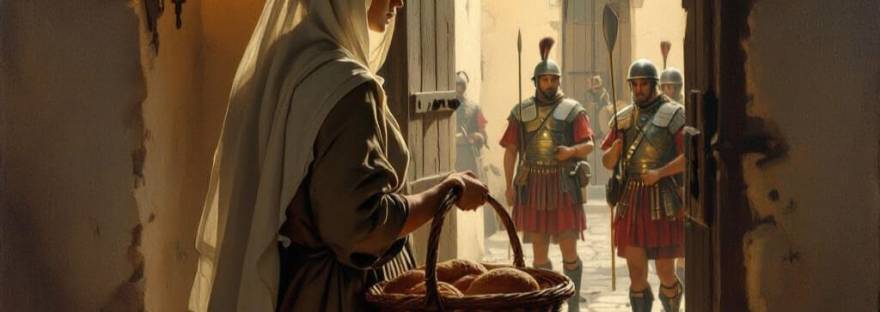
“See with what large letters I am writing to you with my own hand.” — Galatians 6:11 (NASB 1995)
Paul’s personal note reminds us that faith isn’t distant—it’s deeply personal. Our children learn when they see us write love into the margins of daily life.
The Spirit leads us to make faith visible. Not just in beliefs, but in how we serve, speak, and love—even when it costs.
Family Talk:
What makes something feel personal and important?
How can we show our love for Jesus in real, practical ways?
Prayer: Holy Spirit, help our family live out real faith—personal, sincere, and full of love. Let our actions reflect Your presence in us. Amen.
From the Series: The Ark of the Covenant as a Prophetic Game Changer
“Behold, I will make Jerusalem a cup of drunkenness to all the surrounding peoples, when they lay siege against Judah and Jerusalem. And it shall happen in that day that I will make Jerusalem a very heavy stone for all peoples; all who would heave it away will surely be cut in pieces, though all nations of the earth are gathered against it.” — Zechariah 12:2–3 (NKJV)
Few discoveries could shake the world like the unveiling of the Ark of the Covenant. More than gold or relic, it represents covenant, divine presence, and unmatched authority. If revealed, it would not remain a quiet archaeological triumph. It would become a global spectacle, igniting hope, outrage, and deception across nations.
The Nations in Uproar
Psalm 2 describes the nations raging against the Lord and His Anointed. The Ark’s discovery could serve as a flashpoint for this rage:
Israel’s claim — Proof of their covenantal history and divine election.
Islamic opposition — The Temple Mount as a contested site, already one of the world’s most volatile religious flashpoints.
Global politics — Superpowers vying for influence over the Holy City.
What Scripture describes in Zechariah 12 — all nations gathered against Jerusalem — suddenly becomes far more plausible if the Ark is unveiled.
A Stage for Antichrist
Revelation warns of a coming man of lawlessness who seizes global authority through deception:
A counterfeit sign of God’s presence — Antichrist could exploit the Ark as a prop to validate his authority (2 Thessalonians 2:9–10).
A tool for global unity — By promising peace while controlling access to the Ark and Temple, he could rally both worship and submission.
A demand for worship — Sitting in the temple of God, he proclaims himself as God (2 Thessalonians 2:4).
Satan has always imitated what is holy. The Ark may become one more counterfeit in his arsenal of deception.
Revelation’s Warning
Revelation 13 describes a world in awe of the beast, worshiping him and marveling at his authority. If the Ark plays into this deception, it will not be as a token of truth but as a snare for those who “did not receive the love of the truth, that they might be saved” (2 Thessalonians 2:10).
For those who know Christ, the Ark reminds us of God’s faithfulness. But for the world, it could become a stage for lies.
Our Hope Amid Rage
Believers are not called to fear global upheaval. Jesus told us: “When you see these things begin to happen, look up and lift up your heads, because your redemption draws near.” (Luke 21:28).
The Ark, if revealed, will not be the end — it will be another sign that God’s Word is true, that the nations are raging as foretold, and that Christ’s return is near.
Reflection Questions
How does the Ark’s potential rediscovery connect with Zechariah 12 and Psalm 2?
Why is it important to discern between true worship of God and counterfeit signs?
How can we prepare our hearts for a world increasingly hostile to Christ and His people?
Closing Prayer
Lord, give us wisdom to see through deception in these last days. When the nations rage, remind us that You have set Your King on Zion. Let us trust not in relics or political peace, but in Christ, who will return in power and glory. Amen.
The Man of Lawlessness (Antichrist) is a prophetic certainty (2 Thessalonians 2:3–4; Daniel 9:27; Matthew 24:15). The Ark of the Covenant is seen in heaven (Revelation 11:19).
However, the role of the earthly Ark in end-times prophecy is a matter of theory, not doctrine. Its rediscovery could align with prophecy (Temple rebuilding, Antichrist’s deception, global conflict), but Scripture does not require this for God’s plan to unfold.
We handle prophecy with reverence:
Certainties we hold tightly.
Theories we explore carefully.
Speculation we avoid.
Let Scripture remain our anchor as we watch and wait for Christ’s return.
“So then, while we have opportunity, let us do good to all people, and especially to those who are of the household of the faith.” — Galatians 6:10 (NASB 1995)
Doing good isn’t always about big gestures. Often it’s the small, Spirit-led moments: a smile, a prayer, a helping hand.
The Holy Spirit teaches us to be alert—not passive. To see each moment as a chance to sow kindness—especially toward God’s people.
Let’s help our children notice and act.
Family Talk:
What’s one small way we can do good for someone in our church this week?
Why is it important to care for God’s family?
Prayer: Holy Spirit, help our family recognize chances to do good. Grow in us a heart for Your people and eyes to see their needs. Amen.
“So then, while we have opportunity, let us do good to all people, and especially to those who are of the household of the faith.” — Galatians 6:10 (NASB 1995)
Doing good doesn’t require a platform—just a willing heart. The Spirit gives you daily chances to love radically and serve humbly.
And while the world may ignore faithfulness, God honors it. Especially when it’s directed toward His people.
Challenge: Reach out to someone in your church or youth group with encouragement or help today.
Prayer: Holy Spirit, show me where to do good—and help me act before the moment passes. Amen.
“So then, while we have opportunity, let us do good to all people, and especially to those who are of the household of the faith.” — Galatians 6:10 (NASB 1995)
God wants us to be kind to everyone. But He says we should especially love and care for people who love Him too—our church family!
The Holy Spirit helps us see chances to do good each day.
Try This: Do something kind today for someone in your church or Bible class.
Prayer: Holy Spirit, help me love all people and do good to others who love Jesus too. Amen.
“So then, while we have opportunity, let us do good to all people, and especially to those who are of the household of the faith.” — Galatians 6:10 (NASB 1995)
Opportunity doesn’t always knock loudly—it often whispers. A need. A moment. A chance to love, serve, or speak life.
The Spirit prompts us in these everyday chances to reflect Jesus. And He reminds us not to overlook our spiritual family—those walking this narrow road beside us.
You won’t always have this moment. Take it.
Reflection: Where might the Spirit be prompting me to do good today?
Prayer: Holy Spirit, help me recognize the opportunities You place before me. Let me do good to all, especially those in Your family. Amen.
From the series: Understanding the End Times — A Biblical Framework
“Be diligent to present yourself approved to God, a worker who does not need to be ashamed, rightly dividing the word of truth.” — 2 Timothy 2:15 (NKJV)
Why do Christians arrive at such different conclusions about prophecy? The answer is not always the text itself, but how we interpret it.
The method of interpretation — or hermeneutic — shapes whether we see prophecy as literal, symbolic, already fulfilled, or yet to come. If we want to rightly divide the Word of truth, we need to understand the rules of interpretation God has given us.
Literal vs. Allegorical
Premillennialism holds to the literal, grammatical-historical method: words mean what they say in their context, unless the text itself signals symbolism.
Amillennialism and Postmillennialism often spiritualize passages. For example, they interpret the “thousand years” of Revelation 20 as a vague symbol rather than a specific span.
But remember: when Christ fulfilled prophecy at His first coming, it was literal — born in Bethlehem (Micah 5:2), entering Jerusalem on a donkey (Zechariah 9:9), pierced for our transgressions (Isaiah 53:5). If His first coming was fulfilled literally, why would His second be different?
Typology vs. Allegory
God often uses types — historical patterns pointing forward to Christ. For example:
The Passover lamb → Christ the Lamb of God (1 Corinthians 5:7).
The bronze serpent → Christ lifted up on the cross (John 3:14–15).
Typology is anchored in history and affirmed by Scripture. Allegory, however, assigns hidden meanings not rooted in the author’s intent. Origen, for example, interpreted nearly every detail symbolically, often beyond the bounds of Scripture.
The difference is this: typology magnifies Christ; allegory invents man-made meaning.
Context Is King
Every verse has three levels of context:
Immediate context: Revelation 20 follows Revelation 19 — the reign follows Christ’s return, not the other way around.
Book context: Daniel’s prophecies of kingdoms align with Revelation’s visions.
Canonical context: promises to Israel in Ezekiel 36–37 harmonize with Paul’s teaching in Romans 11.
Pulling verses out of their context distorts meaning. Reading them in context reveals harmony.
Language Matters
Hebrew and Greek terms bring clarity:
Parousia — “presence, coming.”
Apokalypsis — “unveiling, revelation.”
Epiphaneia — “appearing, manifestation.”
These aren’t interchangeable. They highlight different facets of Christ’s return.
Also, idioms like “the Day of the Lord” carry Old Testament weight — a day of judgment, deliverance, and restoration. Recognizing these nuances keeps us anchored.
Near and Far Fulfillment
Many prophecies have layers of fulfillment:
Isaiah 7:14 — immediate sign for Ahaz, but ultimately fulfilled in the virgin birth of Christ.
Joel 2 — partially fulfilled at Pentecost (Acts 2), but awaiting final fulfillment in the Day of the Lord.
Prophecy often echoes across history, climaxing in Christ.
Progressive Revelation
God reveals truth progressively. Daniel was told, “Seal up the book until the time of the end” (Daniel 12:9). Revelation, by contrast, opens the scroll and explains what Daniel saw.
The New Testament expands on the Old — but never cancels it. Israel’s promises stand, clarified by the full revelation of Christ.
Distinguishing the Audiences
1 Corinthians 10:32 reminds us of three groups:
Israel — promises about land, nationhood, kingdom.
The Church — promises about being caught up and delivered from wrath.
The Nations — promises of judgment for rebellion.
Confusion arises when these audiences are blurred. For instance, Matthew 24 speaks of Judea, the Temple, and the Sabbath — Jewish markers, not church-age details.
Apocalyptic Imagery
Books like Daniel, Zechariah, and Revelation use symbols — but the text usually explains them:
Revelation 1:20 — lampstands = churches.
Daniel 7:17 — beasts = kingdoms.
Symbols make prophecy vivid but point to real events. They do not cancel literal fulfillment.
Can We Trust the Text?
Yes. The evidence is overwhelming:
The Dead Sea Scrolls confirm prophetic accuracy over 1,000 years.
The New Testament manuscripts outnumber and outdate any other ancient text.
Archaeology continues to affirm details, from Nebuchadnezzar’s Babylon to Pontius Pilate’s role.
If God has preserved His Word so carefully, we can trust His promises for the future.
Reflection
Hermeneutics matter. If we read prophecy literally, in context, respecting God’s progressive revelation, and distinguishing audiences, then the picture becomes clear. Prophecy isn’t confusing — it’s consistent. God is not the author of confusion, but of truth.
Reflection Questions
How does literal interpretation safeguard us from misreading prophecy?
Why is it dangerous to confuse Israel, the Church, and the Nations?
How does the reliability of Scripture strengthen your trust in God’s promises?
Closing Prayer
Lord, thank You for Your Word, which is living and true. Help us to handle it rightly, to read it in context, and to let it speak plainly. Keep us from inventing our own meanings, and anchor us in the promises You have made. We trust that what You have spoken will surely come to pass. In Jesus’ name, Amen.
Leave a comment