📖 “Nevertheless I tell you the truth. It is to your advantage that I go away; for if I do not go away, the Helper will not come to you; but if I depart, I will send Him to you.” —John 16:7 (NKJV)
Imagine hearing these words from Jesus: “It is to your advantage that I go away.”
How could losing Jesus possibly be good?
That’s likely what the disciples wondered. But Jesus wasn’t abandoning them—He was making room for something greater: The indwelling presence of the Holy Spirit.
He would no longer walk beside them— He would live within them.
This was not a downgrade. This was the divine upgrade.
The Helper—the Holy Spirit—would guide them into truth, strengthen them in weakness, and fill them with the very presence of God. That promise holds true for us today.
Dear sister, if you have placed your trust in Christ, He has not left you alone. You have His very Spirit within you.
And no matter what you face, that truth is to your advantage.
Reflection Questions:
Have you ever felt like Jesus was distant or silent?
How does it change your perspective to know that His Spirit is always with you?
Prayer: Jesus, thank You for not leaving me comfortless. Help me remember that the Holy Spirit is not just near—He is within. Teach me to rely on Him daily, and to see Your plan, even when it doesn’t make sense to me. Amen.
Published: October 30, 2025; Update November 14, 2025
U.S. Debt Update
Update: November 14, 2025
The Curve Is Now Turning Vertical
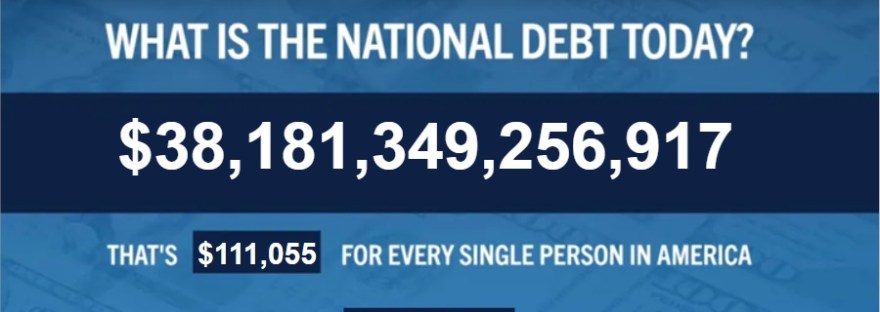
In just one day since the government reopened, the U.S. national debt surged again—this time reaching 💰$38,195,776,028,623 plus!
That’s an increase of over $14 billion in 24 hours, even after a twenty-three-day shutdown that should have slowed spending. Instead, the reopening produced an immediate “catch-up spike,” revealing what analysts have quietly warned for months:
The debt is no longer growing linearly. It is accelerating.
This is the beginning of what economists call runaway debt compounding, the same pattern that triggered collapses in 1933, 2008, and 2020—but now on a scale far beyond historical precedent.
Since my previous post on November 11, the U.S. national debt has continued its rapid upward trajectory. According to real-time tracking on the U.S. Debt Clock, the total has now topped $38.19 trillion.
Key points:
The gross debt has moved from the high $37 trillion range up into the $38 trillion threshold, marking a historic level.
The pace of accumulation remains unprecedented: reports show the debt rose by $1 trillion in about 71 days, and the rate of growth has nearly doubled compared to the prior 25-year average.
Interest costs and other mandatory outlays are now consuming a growing share of federal revenue and budget, meaning less flexibility for the government.
Why This Matters
Structural collapse approach: This data reinforces that the collapse is no longer hypothetical—it is already underway.
System stress indicator: When debt passes such a threshold and grows so fast, it signals the old system is failing and the need for a new financial architecture is increasing.
Timing alignment: The debt’s acceleration aligns perfectly with our model’s 2025-2027 “reset window.” The fact we’re exceeding $38T now means the internal timing of institutions is on track with our prophetic sequence.
Prophetic credibility: These numbers provide tangible evidence we can cite to show you that what Scripture described (global financial collapse, system failure) is manifesting now in real-time, not just theory.
🟦 Q4 2025 — “The Irreversible Bend” (NOW)
Global Indicators:
U.S. national debt crosses $38.19 trillion
Curve begins turning sharply vertical
Interest payments exceed defense spending
Government spending accelerates after shutdown
IMF and BIS warn openly of systemic stress
Prophetic Significance:
“Birth pains” intensify (Matt. 24:8)
Rising instability but false confidence
“As it was in the days of Noah” atmosphere (Matt. 24:37)
🟧 Q1 2026 — “Vertical Acceleration Phase”
Expected Economic Behavior:
Debt curve becomes visually near-vertical
Treasury liquidity strains
Credit markets destabilize
Early bank stress and asset seizures
Sovereign-debt worries broaden
Prophetic Significance:
World still says “Peace and safety” (1 Thess. 5:3)
System appears manageable — but structurally broken
Restrainer still present → collapse cannot complete
🟨 Q2 2026 — “The Calm Between Contractions”
Global Indicators:
Central banks run pilots quietly
Digital ID legislation resurfaces
UN/WEF treaty frameworks align
Middle East geopolitical pressure increases
Markets oscillate between stability & panic
Prophetic Significance:
Stage-setting intensifies
Convergence becomes impossible to ignore
Church still restrains full collapse
**🟥 Q3 2026 — The Rapture Window (Season, Not Date)
This period matches every major convergence indicator:
Global debt at breaking point
CBDC systems ready but not triggered
Geopolitical instability but not total war
Apostasy at record level
Surveillance grid completed but not mandated
Digital governance framework ready for deployment
Financial system fractured but not collapsed
Prophetic View:
Restrainer removed → world enters chaos
Sudden vacuum creates emotional, political, and spiritual desperation
Antichrist cannot rise until this point (2 Thess. 2:6–8)
⚠️ Note: We teach ZERO date-setting. This is a season of convergence, not a calculation.
🟥 Q4 2026 — “Global System Shock”
Post-Rapture Environment:
Mass confusion and destabilization
Markets freefall
Banks fail and consolidate
Global governance “emergency summits”
Middle East conflict escalates
Calls for “global peace & financial stability” intensify
Prophetic Significance:
Conditions perfect for Daniel 9:27 leader
The world demands a global problem-solver
Revelation’s economic system rises from crisis
🟩 2027 — “Implementation of the New System”
Global Indicators:
CBDCs deployed
Digital ID tied to financial access
Biometric verification normalized
UN/WEF treaty obligations activated
10-region governance begins formation
Prophetic Significance:
Beast system infrastructure fully active
Artificial “peace” established
Covenant with many confirmed
First half of Daniel’s 70th week begins
Government Reopens — But the Numbers Tell the Real Story
That’s an increase of $64 billion in just 13 days, even during a partial government shutdown.
Metric
Veterans Day 2025
Oct 29 2025 (Last Update)
Change
Total National Debt
$38.181 T
$38.117 T
+ $0.064 T
Debt per Citizen
$111,055
$109,982
+ $1,073
Debt per Taxpayer
$328,220
$324,801
+ $3,419
Federal Spending (Official)
$7.026 T
$6.972 T
+ $0.054 T
Federal Deficit (Official)
$1.770 T
$1.708 T
+ $0.062 T
On a day meant to honor those who defended our nation’s freedom, the debt clock silently reminds us that economic bondage is deepening. While Washington prepares to reopen tomorrow, it does so with the highest recorded debt in U.S. history — a figure growing even in “shutdown.”
This moment marks the beginning of the five-quarter countdown model (Q4 2025 → Q4 2026) outlined in The Debt Pressure Point:
Quarter
Forecast Focus
Notes
Q4 2025
Government reopening; liquidity squeeze
Record deficit; Treasury draws down reserves
Q1 2026
Short-term relief; Fed “soft landing” narrative
Artificial calm before deeper contraction
Q2 2026
Escalation of debt-service strain
Interest payments exceed defense spending
Q3 2026
Market correction; fiscal panic
Foreign divestment intensifies
Q4 2026
Structural breaking point
Policy intervention or systemic reset
Even if Congress avoids further shutdowns, debt accumulation has reached a self-compounding stage. At over $38 trillion, the federal debt now grows faster than GDP, while interest payments consume an ever-larger share of tax revenue. Each short-term “reopening” simply restarts the countdown to the next fiscal cliff.
Every empire in history has reached a similar moment — when debt and division outweighed discipline and unity. The numbers themselves are not merely fiscal; they are prophetic indicators of a world racing toward convergence.
As Proverbs 22:7 reminds us:
“The rich rules over the poor, And the borrower is servant to the lender.” (NKJV)
The Clock Has Passed Midnight
Published: October 30, 2025
As of October 29, 2025, the U.S. national debt has surpassed $38 trillion. In just 75 days, over $1 trillion was added—$382 billion of which came during a 23-day federal shutdown. Interest payments alone now exceed $1 trillion per year. This pace is unsustainable.
Behind the curtain, central banks are scrambling to maintain control through rate cuts and digital currency pilots. Global supply chains are under strain. Social unrest and blame-shifting are escalating. Meanwhile, an invisible infrastructure of surveillance, ESG compliance, and centralized control is being built around us—all in the name of “safety,” “equity,” and “sustainability.”
This timeline offers a hypothetical—but biblically watchful—quarter-by-quarter breakdown of how the global convergence may accelerate from Q4 2025 through Q4 2026. It is not fearmongering—it’s spiritual preparation.
Q4 2025 (Oct–Dec)
$38+ trillion debt milestone reached
Ongoing federal shutdowns or patchwork funding deals
Fed rate cuts begin to preserve liquidity
Amazon and other major corporations announce mass layoffs (30,000+)
This quarter marks the point of no return for U.S. debt. It also likely sees a visible bifurcation of society: those clinging to a failing fiat system, and those being quietly ushered into a digital prison.
Q1 2026 (Jan–Mar)
Major bank and insurer collapses/mergers begin
Supply chain breakdowns disrupt food and medicine access
Political blame games & extremism scapegoating intensify
Infrastructure retooled for surveillance (15-minute cities)
Persecution of Christians intensifies; extremism redefined
Globalist summits promise final solution to instability
The Rapture? If not already, this may be the moment
As with Noah and Lot, sudden judgment follows false peace. This quarter may begin with celebration—and end with disappearance.
Q4 2026 (Oct–Dec)
U.S. debt potentially hits $39 trillion
Final burial of fiat currency; CBDC goes nationwide
Nation-states surrender autonomy under emergency coalitions
Revelation 13 system begins to solidify
Public speech controls, censorship codified globally
Israel becomes global flashpoint—Ezekiel 38 near?
Apostasy surges as fear overtakes truth
The world celebrates “peace & security”… until sudden destruction
For those left behind, the illusion of unity shatters. The Beast rises from the chaos, demanding worship and control.
A Season to Watch and Warn
This timeline is not prophecy—but it reflects prophecy.
Every milestone, every merger, every mandate… is pointing to the soon return of Christ for His Bride, and the swift descent of this world into deception and wrath.
“Now when these things begin to happen, look up and lift up your heads, because your redemption draws near.” — Luke 21:28 (NKJV)
Are you ready? Is your lamp full of oil? Have you warned those around you?
📖 “But because I have said these things to you, sorrow has filled your heart.” —John 16:6 (NKJV)
Some truths are heavy for the heart. Jesus had just told His disciples He was going away—and the weight of that truth filled them with sorrow.
In our homes, we often try to protect our children from sorrow. But Jesus didn’t avoid the truth—He spoke it in love, even when it brought tears.
And here’s why: Sorrow, when given to God, prepares the heart for His greater purpose.
His leaving would bring the Spirit. His absence would train them to walk by faith. Their grief would become the soil for greater growth.
As mothers, we can teach our children that sorrow isn’t the enemy. It’s a signal that we need to trust Jesus more—not less.
Let’s show our children how to bring their sadness to the Savior, and look beyond their tears to the hope He has promised.
Family Talk:
How do we usually respond when someone in the family feels sad?
Can you think of a time when God used something sad to help you grow?
Prayer: Lord, help us not to hide from sorrow but to bring it to You. Let our home be a place where truth is spoken in love and sorrow becomes a doorway to Your comfort and power. Teach our children to trust You in all things. Amen.
📖 “But because I have said these things to you, sorrow has filled your heart.” —John 16:6 (NKJV)
Let’s be real: sometimes truth hurts.
Jesus didn’t hide hard realities from His disciples. He told them plainly—He was leaving. And not only that, but following Him would come with suffering, rejection, and loss.
And their reaction? Sorrow filled their hearts.
They weren’t just disappointed—they were devastated. But here’s the twist: What brought them sorrow was actually part of God’s greater plan to bring life, freedom, and the Holy Spirit into their lives.
Sometimes, God’s truth confronts you before it comforts you.
You hear something in Scripture that challenges your lifestyle.
You realize a relationship isn’t honoring to Christ.
You’re convicted to step out in faith even though it costs you something.
And suddenly—your heart feels heavy. But don’t stop there.
Jesus doesn’t expose truth to crush you—He reveals truth to set you free.
Think About It:
What truth has God been showing you lately that’s hard to hear?
Have you mistaken conviction for cruelty?
Prayer: Lord, when Your truth hurts, help me not to shut down. Teach me to receive even the hard words with trust, knowing You are always working for my good. Replace sorrow with faith and fear with peace. Amen.
📖 “But because I have said these things to you, sorrow has filled your heart.” —John 16:6 (NKJV)
Have you ever felt really sad because of something someone told you?
That’s how Jesus’ disciples felt. He told them He was going away, and they didn’t understand. They were afraid and confused—and their hearts felt full of sadness.
But Jesus wasn’t trying to scare them. He was trying to help them understand something very important.
Even though He was going away, He wasn’t leaving them alone. He was sending the Holy Spirit to be with them—and to live in them.
Sometimes, when we hear hard things or feel sad, we don’t see what God is doing. But He is always good. He always has a plan. And He never leaves His children alone.
Think About It:
What do you do when you feel sad or don’t understand something about God?
How does it feel to know that Jesus sends His Spirit to comfort us?
Prayer: Jesus, thank You for loving me even when I feel sad or scared. Help me remember that You are always with me and that You have a good plan—even when I don’t understand. Amen.
📖 “But because I have said these things to you, sorrow has filled your heart.” —John 16:6 (NKJV)
Sometimes sorrow comes not because of the world’s cruelty, but because of Christ’s honesty.
Jesus had just revealed painful truth: He was going away. Not only that, but His disciples would be hated, cast out, and even killed for His Name.
No wonder sorrow filled their hearts.
But here’s the heart-piercing irony: They were sorrowful about the very thing that would bring them hope.
His going wasn’t loss—it was the plan of redemption. His departure meant the Spirit’s arrival. His cross meant our cleansing. His silence before Pilate meant our justification before God.
Dear sister, sorrow is not always a sign that something is wrong— Sometimes it’s the sign that something greater is about to be revealed.
When Jesus leads us through sorrowful seasons, He is not being cruel. He is being kind enough to prepare us.
Trust the Shepherd—even when the path is painful. Because what feels like loss may be the very thing that opens the way to life.
Reflection Questions:
Can you think of a time when sorrow blinded you to the bigger plan?
What sorrow are you facing now that you need to bring under Jesus’ truth?
Prayer: Lord, sorrow sometimes fills my heart when You reveal hard things. Help me trust that You are still good, still present, and still working. Teach me to lean into Your love, even when the path leads through pain. Amen.
📖 “But now I go away to Him who sent Me, and none of you asks Me, ‘Where are You going?’” —John 16:5 (NKJV)
Have you ever been so overwhelmed by emotion that you stopped thinking clearly? Maybe something hit hard—grief, disappointment, betrayal—and instead of reaching out to God, you shut down.
That’s what happened with Jesus’ disciples.
He told them He was leaving, and instead of asking, “Where are You going?” they just got sad. So sad, they missed the bigger picture—what Jesus was really trying to show them.
They were focused on loss. Jesus was focused on victory.
He wasn’t just leaving—He was going back to the Father to prepare something greater. The cross wasn’t the end of the story—it was the bridge to everything that mattered.
Don’t let your emotions block your faith. Ask the hard questions. Draw near to Jesus—even when your heart hurts.
He’s going somewhere holy. And He’s taking you with Him.
Think About It:
When you’re hurt, do you shut down or run to Jesus?
What question have you avoided asking God because it felt too painful?
Prayer: Jesus, sometimes I get so overwhelmed that I forget to ask what You’re doing. Help me not to shut down or turn away, but to seek You even when I’m hurting. I know You are good, and I want to follow wherever You lead. Amen.
📖 “But now I go away to Him who sent Me, and none of you asks Me, ‘Where are You going?’” —John 16:5 (NKJV)
Jesus told His friends He was going away. But they were so sad and confused, they didn’t ask Him where He was going.
Sometimes, when we feel upset or don’t understand something, we stop asking questions. We might just feel bad… and forget to go to Jesus.
But Jesus wants us to talk to Him—even when we’re sad, confused, or scared.
If His disciples had asked, they would’ve heard something amazing: He was going to His Father in Heaven… and He was making a way for us to come too.
So the next time something feels hard or confusing, remember: You can always ask Jesus. He’s never too far to hear you—and He always answers in love.
Think About It:
Why do you think Jesus wanted His disciples to ask where He was going?
What is something you want to ask Jesus about today?
Prayer: Jesus, thank You for always listening. Even when I don’t understand, help me come to You with my questions. I want to know You more and trust where You’re going. Amen.
📖 “But now I go away to Him who sent Me, and none of you asks Me, ‘Where are You going?’” —John 16:5 (NKJV)
Have you ever been so overwhelmed by grief or fear that you couldn’t ask the question that really needed to be asked?
Jesus had just shared painful truth with His disciples—persecution, sorrow, rejection. But instead of asking, “Where are You going?” (a question that could have brought comfort and clarity), they were weighed down with sorrow.
How often do we do the same?
We focus so much on the pain that we forget to turn our hearts toward Jesus’ greater plan. We forget to ask Him what He’s doing. Where He’s going. How He’s still working.
The disciples saw Jesus’ departure as loss. But it was the pathway to victory—the sending of the Spirit, the opening of the Gospel to the nations, and the fulfillment of God’s redemptive plan.
Don’t let sorrow silence your seeking. Ask Him. Trust Him. Let Him lift your eyes above the grief to the greater glory.
Reflection Questions:
Have you been so weighed down by hardship that you stopped seeking Jesus’ heart in the situation?
What question might the Lord be inviting you to ask today?
Prayer: Jesus, I don’t want sorrow to blind me to what You’re doing. Teach me to seek You, to ask the questions that lead to truth, and to trust that Your plan is always better—even when I don’t understand. Amen.
From local banks to international finance, the world’s economy is being restructured. Cash is disappearing, physical bank branches are closing, and digital systems are rapidly taking over. Governments and central banks are promoting digital currencies and biometric IDs as the future of commerce.
Headlines read: “Central Banks Roll Out Global Digital Currency” and “Digital ID and CBDCs Now Required for Access to Services.”
The Bible warned of this long ago: a final global economic system where no one can buy or sell without allegiance to the Beast.
Agenda 2030’s Economic Framework
Agenda 2030 frames its goals in terms of fairness and sustainability:
Goal 8:“Promote sustained, inclusive and sustainable economic growth…”
Goal 10:“Reduce inequality within and among countries.”
Goal 17: Global partnerships for implementation — especially financial systems.
At first glance, these goals appear noble. But in practice, they create the scaffolding for a tightly controlled economy in which every transaction is monitored and governed.
Current Events in Motion
CBDCs (Central Bank Digital Currencies) are in pilot programs across dozens of nations, with many preparing for full implementation.
Digital IDs are increasingly required for banking access and services.
Cashless society initiatives are accelerating, with many retailers refusing cash.
Bank consolidations are reducing local access, forcing dependence on digital systems.
Carbon credits and energy allowances are being linked to spending and movement.
Together, these trends move the world toward a fully traceable, controllable, and centralized financial system.
Prophecy Foretold This
The Bible clearly describes this final economic order:
“He causes all, both small and great, rich and poor, free and slave, to receive a mark on their right hand or on their foreheads, and that no one may buy or sell except one who has the mark or the name of the beast, or the number of his name.” (Revelation 13:16–17, c. AD 95, NKJV)
“Through his cunning he shall cause deceit to prosper under his rule; and he shall exalt himself in his heart. He shall destroy many in their prosperity. He shall even rise against the Prince of princes; but he shall be broken without human means.” (Daniel 8:25, c. 530 BC, NKJV)
“Come now, you rich, weep and howl for your miseries that are coming upon you! … You have heaped up treasure in the last days.” (James 5:1–3, c. AD 45, NKJV)
“They will throw their silver into the streets, and their gold will be like refuse; their silver and their gold will not be able to deliver them in the day of the wrath of the Lord.” (Ezekiel 7:19, c. 590 BC, NKJV)
This is not just another financial shift. It is the last economic system — spiritually binding and globally enforced.
Why This Matters
There will be no economic system after this one. It is the final order before Christ returns.
Control of money means control of life. When all transactions are monitored, allegiance becomes mandatory.
Neutrality will no longer be possible. People will either align with Christ or with the Beast.
The illusion of “fairness” will mask a reality of coercion and worship.
God’s Pattern of Provision
But God has always provided for His people outside corrupt systems:
In Egypt, God raised Joseph to preserve His people through famine (Genesis 41, c. 1875 BC).
In the wilderness, God gave Israel manna each day (Exodus 16, c. 1445 BC).
In the early church, believers shared their resources so that none lacked (Acts 2:44–45, c. AD 30).
Jesus promised: “Seek first the kingdom of God and His righteousness, and all these things shall be added to you.” (Matthew 6:33, c. AD 60, NKJV).
Though the Beast system seeks to enslave through economy, God’s kingdom provides true freedom and eternal security.
A Call to Watchfulness
Christians must not be deceived by the promises of inclusivity, equality, and progress that surround digital finance.
Recognize that digital IDs, CBDCs, and cashless systems are not neutral tools — they are the infrastructure for Revelation 13.
Prepare spiritually and practically, knowing that hardship may come, but God is faithful.
Proclaim boldly that salvation and provision are in Christ, not in the Beast’s economy.
Progress on the digital euro(European Central Bank October 29, 2025) – ECB’s update on preparation phase completion and next steps toward technical readiness.
Central Bank Digital Currency Tracker(Atlantic Council July 10, 2025) – Interactive tracker of 134 jurisdictions’ CBDC progress, including 2025 expansions in India and US halt.
Are We Now A Mostly Cashless Society in 2025? (Racine County Eye October 24, 2025) – Explores pros/cons of cashless shift, including security risks and government control over accounts; notes outdated bank infrastructure as a barrier.
The Price of Going Cashless – Economy and Ecology (IPS Journal November 4, 2025) – Examines global elimination of cash via QR codes and mobile payments in China, India, and Europe; highlights human rights concerns like exclusion of the unbanked.
How Close Are We to a Cashless Society? 2025 Guide (Tech.co July 1, 2025) – 84% of US payments digital in 2025; Sweden predicted as first fully cashless by end-2025; discusses business implications and consumer resistance.
The Future of Cash: Is a Cashless Society Inevitable?(Global Banking & Finance Review March 4, 2025) – Digital wallets to hit 40% of e-commerce by 2025; spotlights Singapore’s Hawkers Go Digital and Thailand’s wallet stimulus schemes.
The Future of Cashless Society: Are We Ready? (Analytics Insight March 23, 2025) – Global cashless volumes up 80% from 2020-2025 to 1.9 trillion transactions; Australia nearing 98% cashless, with accessibility concerns for seniors.
Cashless society (Wikipedia October 28, 2025) – UK MPs push to mandate cash acceptance for vulnerable groups; Singapore’s Smart Nation initiative targets cashless economy amid aging population.