Apostacy, The Last Days

Preparing the Bride — A Church Without Spot or Wrinkle


(The Great Falling Away, Part 10 — Conclusion)

“That He might present to Himself the church in all her glory, having no spot or wrinkle or any such thing; but that she would be holy and blameless.”
— Ephesians 5:27, NASB1995


The End Goal Is Not Reform—It’s Readiness

Throughout this series, we’ve traced how the Church drifted:

  • From Spirit-led simplicity to man-made systems
  • From shared priesthood to clerical control
  • From purity to power
  • From Christ alone to Christ plus

But Christ isn’t coming for a well-branded ministry or a culturally relevant congregation.
He’s coming for a bride—holy, radiant, and ready.


What Does It Mean to Be Without Spot or Wrinkle?

1. Spotless — Cleansed by Christ

  • Washed in His blood (Revelation 7:14)
  • Covered in righteousness—not works
  • Living in repentance, not rebellion

2. Without Wrinkle — Uncreased by the World

  • Not conformed to worldly patterns (Romans 12:2)
  • Not tied to traditions that nullify truth
  • Not blemished by compromise or double-mindedness

3. Holy — Set Apart

  • Separate from the world’s values and goals
  • Different in speech, purity, and love
  • Walking in obedience, not excuses

4. Blameless — Above Reproach

  • Living by the Spirit, not in the flesh
  • Bearing good fruit, not worldly acclaim
  • Living faithfully until He returns

The Bride Prepares Herself

“It was given to her to clothe herself in fine linen, bright and clean…”
— Revelation 19:8

This is not passive waiting. This is active preparation through:

  • Daily repentance
  • Immersing in Scripture
  • Relinquishing idols
  • Remaining in prayer and holiness
  • Listening to the Spirit, not the crowd

Look Around… Look Within

The modern Church is comfortable, visible, and polished.
But is she pure?

Christ is not returning for crowds or campaigns.
He’s returning for those who belong to Him—who hear His voice and follow.


Application for Today

  • Am I preparing for the return of the Bridegroom?
  • Am I clothed in the righteousness of Christ—or the accolades of men?
  • Have I come out of Babylon, or am I still entangled?
  • Will I be found ready—or just religious?

Revelation 22:17

“The Spirit and the bride say, ‘Come.’”

This is not just a cry for Him to come.
It’s the call of the bride to the world.
A beckoning from a pure Church that says:
“Come out. Come home. Come to Christ.”


Series Conclusion: The Call Remains

The Great Falling Away is real.
But so is the Great Returning—for those who will hear it.

“Come out of her, My people…”
“…so that He might present to Himself the church… holy and blameless.”
Leave a comment

Apostacy, The Last Days

The Modern Echo — Has the Reformation Been Reversed?


(The Great Falling Away, Part 9)

“For they exchanged the truth of God for a lie, and worshiped and served the creature rather than the Creator…”
— Romans 1:25, NASB1995


What Was Recovered… Is Being Replaced

The Reformation gave God’s people back what had been stolen:

  • The Word of God in their language
  • The freedom to approach God directly
  • The assurance of salvation by grace through faith

But in recent decades, that truth has begun to fade—not by force, but by neglect, compromise, and distraction.


How Is the Modern Church Reversing the Reformation?

1. Scripture is No Longer Central (Sola Scriptura Reversed)

  • Sermons are motivational, not expository
  • Human wisdom is blended with theology
  • The Bible is treated as optional—or reinterpreted to fit culture

2. Faith Becomes Performance (Sola Fide Reversed)

  • Salvation is portrayed as try harder rather than trust Christ
  • Obedience is confused with earning
  • People question if they’re ever “doing enough”

3. Church Becomes Institution Again

  • Mega structures and leadership hierarchies resemble Rome
  • Spiritual authority is centralized
  • Programs replace prayer and presence

4. Christ is Replaced by Systems (Solus Christus Reversed)

  • Counseling replaces discipleship
  • Strategy replaces the Spirit
  • Pastors and theologians become mediators of truth

5. God’s Glory is Shared with Man (Soli Deo Gloria Reversed)

  • Ministries are built around personalities
  • Celebrity culture thrives in pulpits
  • The applause of man is mistaken for the blessing of God

From Remnant to Routine

“Having a form of godliness, but denying its power…”
— 2 Timothy 3:5

We may use biblical language… but lack biblical substance.
We may sing of surrender… but live in self.
We may look alive… but be lukewarm.


The Call Remains: Come Out. Return. Remain.

“Hold fast what you have, so that no one will take your crown.”
— Revelation 3:11

The Reformation must not be remembered—it must be revived.


Application for Today

  • Is my life shaped by Scripture—or opinion?
  • Do I live in faith—or performance?
  • Am I following a system—or Christ?
  • Do I want God’s glory—or man’s approval?

Revelation 18:4

“Come out of her, My people…”

Leave a comment

Apostacy, The Last Days

The Cry for Reformation — When Light Broke Through Again


(The Great Falling Away, Part 8)

“Your word is a lamp to my feet and a light to my path.”
— Psalm 119:105, NASB1995


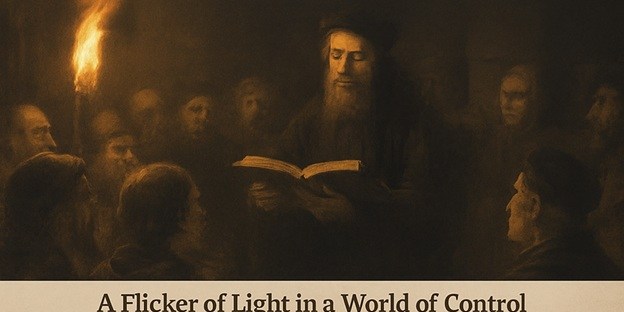
A Flicker of Light in a World of Control

For centuries, the Word of God had been kept from the people. The Church governed with fear, tradition, and political power.
But God was not silent.

He raised up voices across Europe—men who dared to challenge religious tyranny and call the Church back to Scripture, faith, and freedom in Christ.

These weren’t perfect men. But they ignited a return to the Word that would shake nations.


The Early Reformers and Pre-Reformers

John Wycliffe (c. 1320s–1384)

  • Translated the Bible into English
  • Declared Scripture as the final authority
  • Rejected transubstantiation and papal supremacy
  • Called the Pope the “antichrist”

Jan Hus (c. 1372–1415)

  • Preached against indulgences and corrupt clergy
  • Influenced by Wycliffe’s writings
  • Burned at the stake for refusing to recant

Martin Luther (1483–1546)

  • Nailed the 95 Theses to the church door in 1517
  • Denounced the sale of indulgences
  • Declared salvation is by grace through faith, not works
  • Translated the Bible into German for the people

William Tyndale (c. 1494–1536)

  • Translated the New Testament into English
  • Declared that even a plowboy should know the Word
  • Hunted, betrayed, and burned alive for giving the people Scripture

The Price of Truth

These reformers didn’t seek rebellion—they sought restoration.
They paid dearly:

  • Excommunication
  • Torture
  • Martyrdom
  • Misrepresentation

But they feared God more than man.


What Did the Reformation Restore?

  1. Sola Scriptura — Scripture alone is our authority
  2. Sola Fide — Justification by faith alone
  3. Sola Gratia — Salvation by grace alone
  4. Solus Christus — Christ alone is mediator
  5. Soli Deo Gloria — All glory to God alone

These weren’t slogans—they were cries of the heart.


Application for Today

Ask yourself:

  • Have I taken the Bible for granted?
  • Do I trust tradition—or test all things by the Word?
  • Would I still stand if it cost me everything?

Revelation 3:2–3

“Wake up, and strengthen the things that remain… Remember what you have received and heard; and keep it, and repent.”

Leave a comment

Apostacy, The Last Days

The Rise of Human Authority — From Priesthood of Believers to Control of Conscience


(The Great Falling Away, Part 7)

“You are not to be called Rabbi; for One is your Teacher, and you are all brothers.”
— Matthew 23:8, NASB1995


From Shared Priesthood to Religious Tyranny

In the earliest Church, all believers were priests—filled with the Spirit, taught by Christ, and united in fellowship (1 Peter 2:9).

But as the centuries progressed, that shared spiritual authority was replaced by hierarchies, titles, and layers of control.

The goal became obedience to the Church, not obedience to Christ.


How Conscience Was Captured

1. Clerical Elevation

  • Bishops were elevated above the congregation
  • Priests became intermediaries between God and man
  • The laity were considered spiritually dependent and unqualified

2. Tradition Over Scripture

  • Church tradition was declared equal (or superior) to Scripture
  • Papal decrees became law
  • Scripture was locked in Latin and guarded by clergy

3. Confession and Penance

  • Believers were required to confess sins to a priest
  • Penance (works) replaced repentance and grace
  • Assurance of salvation became impossible without priestly involvement

4. The Eucharist and Transubstantiation

  • Only priests could perform the “miracle” of turning bread and wine into Christ
  • The Mass became a daily sacrifice for sin—controlled by clergy

5. Censorship and Persecution

  • Anyone who interpreted Scripture differently was labeled a heretic
  • Bibles were burned. Voices were silenced.
  • Fear replaced freedom

But Christ’s Word Still Stands:

“You shall know the truth, and the truth will make you free.”
— John 8:32, NASB1995

The Holy Spirit never relinquished His role. He still convicts, teaches, and leads every believer who abides in Christ.


Reclaiming the Priesthood of All Believers

“But you are a chosen race, a royal priesthood… so that you may proclaim the excellencies of Him…”
— 1 Peter 2:9, NASB1995

The early Church didn’t rely on religious elites:

  • They met in homes
  • Taught one another in love
  • Relied on the Spirit—not a central authority

What Was Lost?

  • Freedom of Conscience
  • Access to God through Christ alone
  • Confidence in salvation through faith—not sacraments

Instead, man’s word became binding, and Christ’s words became buried.


Application for Today

Ask yourself:

  • Do I rely on a religious system more than the Spirit of God?
  • Am I personally seeking, reading, and obeying the Word?
  • Have I allowed someone else to rule my conscience?

Hebrews 4:16

“Let us draw near with confidence to the throne of grace…”

Leave a comment

Apostacy, The Last Days

Light in the Darkness — Remnants of Faith Through the Medieval Church


(The Great Falling Away, Part 6)

“The light shines in the darkness, and the darkness did not comprehend it.”
— John 1:5, NASB1995


Darkness Covered the Institutional Church… But Not All Was Lost

While apostasy had taken root through hierarchy, false doctrine, and worldly power, God remained faithful.
Throughout the medieval centuries, a remnant remained—scattered men and women, clinging to Scripture, guided by the Holy Spirit, and often hunted for their faith.

They were not famous. But they were faithful.


Who Were the Remnant?

The Paulicians (6th–9th c.)

  • Rejected the Roman hierarchy and infant baptism
  • Held to Scripture alone
  • Persecuted relentlessly by the Byzantine Church

The Bogomils & Cathars

  • Sought purity and spiritual living
  • Rejected the corruption of the clergy
  • Often blended with heretical views, yet their rejection of Rome was rooted in conscience and conviction

The Waldensians (12th c.)

  • Embraced poverty and itinerant preaching
  • Translated and memorized Scripture
  • Called heretics for preaching without permission

The Lollards (14th c.)

  • Followers of John Wycliffe
  • Opposed transubstantiation and papal authority
  • Risked death to read and share the Bible in English

What Marked These Remnant Believers?

  1. Scripture Over Systems
    They risked their lives to read and live by the Word—not church tradition.
  2. Obedience Over Comfort
    Many were martyred, exiled, or silenced… yet they obeyed the voice of the Shepherd.
  3. Spirit-Led Faith Over Institutional Religion
    Though outside the “approved church,” they walked in truth and bore fruit.

“They overcame him because of the blood of the Lamb and because of the word of their testimony…”
— Revelation 12:11


The Cost Was High

  • Families burned at the stake
  • Entire villages slaughtered
  • Scriptures confiscated and forbidden
  • Truth hidden under Latin, locked behind walls of clerical authority

Yet the light never went out. God always had a witness.


Application for Today

The remnant remind us that the Church is not a building or a system—it’s a people who follow Christ at all cost.

Ask yourself:

  • Would I cling to Scripture if it meant being rejected or hunted?
  • Do I value popularity over purity?
  • Am I part of the faithful remnant—or just the religious crowd?

Isaiah 10:20–21

“Now it will come about… that the remnant of Israel… will truly rely on the Lord, the Holy One of Israel.”

Leave a comment

Apostacy, The Last Days

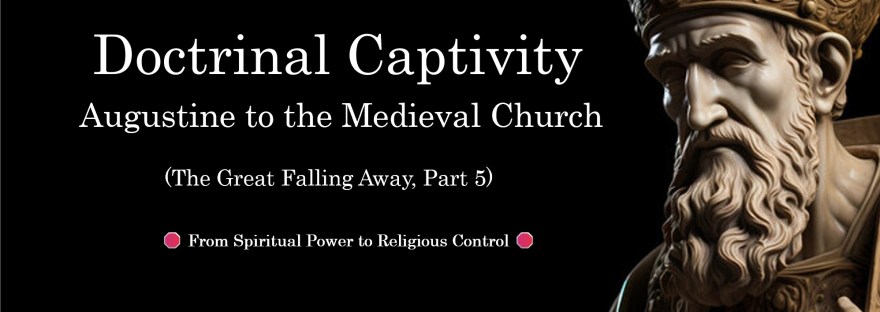
Doctrinal Captivity — Augustine to the Medieval Church


(The Great Falling Away, Part 5)

“For such men are false apostles, deceitful workers, disguising themselves as apostles of Christ. No wonder, for even Satan disguises himself as an angel of light.”
— 2 Corinthians 11:13–14, NASB1995


From Spiritual Power to Religious Control

By the 4th and 5th centuries, the Church had merged with political power, and that shift required new theological justification. Enter Augustine of Hippo—a brilliant thinker whose teachings would redefine free will, grace, and the Church itself for the next thousand years.

Though sincere, Augustine’s influence laid much of the doctrinal foundation for the Medieval Church—and with it, centuries of spiritual captivity.


Augustine’s Doctrinal Shifts

1. Free Will Reinterpreted

  • Taught that the will of man was enslaved by sin—rendering true choice impossible without God first regenerating the soul.
  • Introduced the idea that faith itself is a gift given only to the elect.

2. Grace Became Selective

  • God’s grace was seen as irresistible and given only to those unconditionally chosen.
  • The call of salvation became exclusive—not an open invitation.

3. Salvation Became Institutional

  • Emphasized the visible Church as the only means of grace.
  • Sacraments were tied to salvation; baptism regenerated the soul—especially infants.

4. Persecution Justified

  • Believed the state could use force to correct heresy, citing the parable of the banquet (Luke 14:23) to “compel them to come in.”
  • This thinking laid the groundwork for inquisitions, forced conversions, and doctrinal suppression.

Councils, Creeds, and Control

Following Augustine’s influence:

  • Councils replaced congregational discernment.
  • Creeds dictated what could be believed.
  • The Roman Church declared itself the one true church—unchallenged and uncorrectable.

The Holy Spirit’s leadership was gradually replaced with hierarchy, formality, and fear.


The Church Became a Gatekeeper, Not a Servant

Rather than pointing people to Jesus, the Church began standing between God and man, declaring:

  • Who could receive grace
  • Who could speak truth
  • Who could be saved

“You shut the kingdom of heaven in people’s faces…” — Matthew 23:13


Application for Today

Ask yourself:

  • Have I allowed tradition or theology to override the Word and the Spirit?
  • Am I part of a system that controls faith—or fosters it?
  • Do I believe God’s grace is available to all—or only a few?

Scriptural Truth Remains:

“The grace of God has appeared, bringing salvation to all men…”
— Titus 2:11, NASB1995

Leave a comment

Apostacy, The Last Days

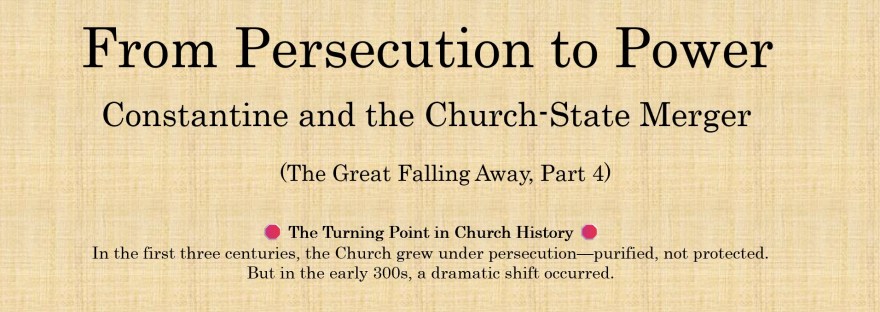
From Persecution to Power — Constantine and the Church-State Merger (AD 312–337)

(The Great Falling Away, Part 4)

“They profess to know God, but by their deeds they deny Him, being detestable and disobedient and worthless for any good deed.”
— Titus 1:16, NASB1995


The Turning Point in Church History

In the first three centuries, the Church grew under persecution—purified, not protected. But in the early 300s, a dramatic shift occurred:

Christianity became legalized, then preferred, and eventually politically empowered—all under the Roman Emperor Constantine.

What looked like a victory for the Gospel… was actually the great acceleration of apostasy.


The Context of Constantine’s Rise

  • Rome was fractured, and civil war loomed.
  • Constantine claimed to see a vision: “In this sign, conquer”—a cross with military implications.
  • He issued the Edict of Milan in AD 313, granting Christians freedom to worship.
  • By AD 325, he presided over the Council of Nicaea to unify Christianity… under imperial control.

What Changed After Constantine

1. Church and State Became Allies

  • Bishops gained political power, prestige, and property.
  • Christianity became entangled with empire, no longer separate from the world.

2. Wealth and Buildings Replaced Simplicity

  • Lavish basilicas replaced house churches.
  • Imperial favor flowed in—but so did compromise.

3. Faith Became a Civic Identity

  • People converted for safety, status, and social advantage.
  • Persecution of pagans and “heretics” began—not by Rome, but by the Church.

4. Creeds and Councils Replaced the Holy Spirit

  • The Nicene Creed established doctrinal boundaries—but was enforced by imperial decree.
  • Spirit-led discernment gave way to imperial-backed orthodoxy.

This Was Not Reformation… It Was Deformation

What began in Acts was Christ-centered, Spirit-led, and world-rejected.
What emerged under Constantine was emperor-approved, politically-entwined, and carnally compromised.

“Do not be bound together with unbelievers; for what partnership have righteousness and lawlessness…?”
— 2 Corinthians 6:14


Apostasy Took on a Robe and Crown

  • The Gospel of the Kingdom was replaced by Christendom—a territorial religion.
  • Bishops became magistrates, and the Church became a governing institution.
  • Constantine was called “Bishop of Bishops”—yet was never baptized until his deathbed.

Application for Today

We must not confuse institutional success with faithfulness.

Ask yourself:

  • Is my church modeled after the Acts church—or after Rome?
  • Are we seeking power, comfort, and visibility—or holiness, sacrifice, and truth?
  • Would we still follow Jesus if persecution returned?

Leave a comment

Apostacy, The Last Days

When the Church Met the Philosophers — The Beginning of Doctrinal Erosion

(The Great Falling Away, Part 3)


“See to it that no one takes you captive through philosophy and empty deception, according to the tradition of men, according to the elementary principles of the world, rather than according to Christ.”
— Colossians 2:8, NASB1995


What Happens When the Church Marries the World’s Wisdom?

After the death of the apostles, the Church entered a vulnerable season. Persecution raged, heresies spread, and a longing for intellectual respectability crept in.

In an effort to defend the faith, some early apologists turned to the tools of Greek philosophy—but in doing so, they opened the door to a slow, steady erosion of Spirit-led doctrine.


Greek Philosophies That Influenced Early Christianity

Platonism:

  • Taught the material world was inferior to the spiritual
  • Encouraged dualism—separating body and soul
  • Influenced views on resurrection, sin, and grace

Stoicism:

  • Prioritized moralism and logic over Spirit-empowered transformation
  • Downplayed emotion and suffering

Gnosticism:

  • Denied the goodness of creation and incarnation
  • Claimed secret knowledge (“gnosis”) was the path to salvation
  • Appealed to pride and elite spirituality

Note: The apostles warned of these teachings in their own lifetimes (see Col. 2:8, 1 John 4:1–3, 2 Peter 2:1)


Key Figures and Their Influence

🔹 Justin Martyr (AD 100–165)

  • A philosopher before converting to Christianity
  • Called Plato “a Christian before Christ”
  • Sought to merge faith and reason, appealing to Roman thought

🔹 Clement of Alexandria (AD 150–215)

  • Praised philosophy as a “schoolmaster” to Christ
  • Saw it as a gift from God to the Greeks
  • Introduced more allegorical interpretations of Scripture

🔹 Origen (AD 185–254)

  • A prolific teacher who deeply allegorized Scripture
  • Denied bodily resurrection in its biblical form
  • Introduced speculative theology based on Platonic hierarchy

Though sincere, these men shifted the Church’s interpretive method away from plain reading and Spirit-led discernment… toward philosophical abstraction.


What Changed?

  • Scripture was no longer the final authority—reason and tradition gained influence.
  • Allegorical interpretation replaced literal exegesis.
  • Hierarchical structures began to emerge, shifting authority from the Spirit-led body to a few educated elites.
  • Doctrine was redefined to fit philosophical categories—not the Gospel.

The Seeds of Apostasy Were Taking Root

Paul called this the “mystery of lawlessness already at work” (2 Thess. 2:7). What began subtly would soon blossom—under Constantine—into full-blown institutional religion.


Application for Today

Many Christians still look to philosophy, psychology, or academic theology as superior guides—rather than the Holy Spirit and the Word of God.

We must ask:

  • Do I interpret Scripture through the lens of the world—or through the Spirit of Truth?
  • Am I being captivated by clever systems or grounded in the simplicity of Christ?
  • Have I replaced revelation with speculation?

Let Scripture Speak for Itself Again

“The unfolding of Your words gives light; It gives understanding to the simple.”
— Psalm 119:130

Leave a comment

Apostacy, The Last Days

Christ-Centered, Spirit-Led — The Faith Once Delivered

(The Great Falling Away, Part 2)


“Beloved, while I was making every effort to write you about our common salvation, I felt the necessity to write to you appealing that you contend earnestly for the faith which was once for all handed down to the saints.”
— Jude 1:3, NASB1995


Before the Falling Away — There Was the Pure Seed

Before philosophy invaded theology, before the Church merged with state power, and before councils replaced the guidance of the Holy Spirit—there was the faith once delivered.

That faith was not abstract. It was embodied in a people. It was:

  • Christ-centered
  • Spirit-led
  • Lived out in holiness, simplicity, and love
  • Rooted in the commands of Jesus and the teachings of the apostles

The Apostolic Church (AD 33–100)

The Church born in Acts was not institutional—it was relational, transformational, and missional. Here’s what marked them:

1. Obedience to Christ’s Teachings

They didn’t just believe in Jesus—they obeyed Him.
They lived out Matthew 5–7 daily, turning the other cheek, praying for enemies, sharing everything they had.

2. Led by the Holy Spirit

They waited for the Spirit in Jerusalem.
They were filled with power to preach, heal, and love boldly.
They discerned by the Spirit, not by creeds or councils.

3. Persecuted, Yet Joyful

The Church thrived underground and under fire—not because of strength in numbers, but because of devotion to Christ.

4. Separate from the World

They rejected the politics, systems, and values of Rome.
They called themselves not of this world (John 17:16) and lived like pilgrims awaiting a better Kingdom.

5. Unified in Love and Truth

They met in homes, broke bread, and had all things in common (Acts 2:42–47).
Their unity was not organized by bishops—it was birthed by the Spirit.


Their War Was Spiritual, Not Political

“For though we walk in the flesh, we do not war according to the flesh…”
— 2 Corinthians 10:3

The early Church did not fight to gain influence.
They did not seek state protection.
They laid down their lives and overcame by the blood of the Lamb and the word of their testimony (Revelation 12:11).


Writings from the Early Church (Pre-AD 100)

  • Clement of Rome emphasized love and holiness, quoting Scripture continually.
  • Ignatius of Antioch wrote of martyrdom and urged unity through Christ, not control.
  • The Didache (“The Teaching of the Twelve Apostles”) outlined a simple, practical life of obedience and Spirit-filled worship.

None of these promoted systems, power, or philosophical speculation. They echoed the Gospels and Acts.


Why This Matters

To understand the falling away, we must understand what was first handed down.
The further we get from that foundation, the closer we are to apostasy.


Application for Today

Ask yourself:

  • Am I rooted in Jesus’ teachings or church culture?
  • Am I led by the Spirit or popular Christian trends?
  • Am I part of a body of believers marked by love, holiness, and obedience?

Leave a comment

Apostacy, From the Archives, The Last Days

Apostasy Before His Coming — What Scripture Really Says

(The Great Falling Away, Part 1)

“Let no one in any way deceive you, for it will not come unless the apostasy comes first, and the man of lawlessness is revealed…”
— 2 Thessalonians 2:3, NASB1995


What Is Apostasy?

Apostasy is not simply personal struggle, backsliding, or doubt. It is a deliberate and public departure from the faith—a rebellion against the truth once delivered to the saints (Jude 1:3).

It is not hidden. It is visible. Widespread. Prophetic.

The Apostle Paul wrote to warn believers that the Day of the Lord would not come unless this falling away happened first. Not alongside. Not after. But first.

This apostasy would signal something deeper: that a lawless system was rising—and behind it, a man of lawlessness would be revealed.


This Isn’t Just Future. It’s Already Happening.

Many believers picture a last-days falling away as something sudden—like a switch flipped in the end times. But the Bible paints a more sobering picture:

“For the mystery of lawlessness is already at work…”
—2 Thessalonians 2:7, NASB1995

Even in Paul’s day, the seeds of rebellion were already being sown. Heresies were multiplying. Teachers were twisting Scripture. Some sought power. Others returned to the world.


Jude Pleaded with the Church:

“Contend earnestly for the faith which was once for all handed down to the saints.”
—Jude 1:3, NASB1995

This means we must:

  • Guard the original Gospel
  • Discern false teachings
  • Hold fast to Jesus Christ—not man-made religion

What Will This Series Cover?

In the coming posts, we’ll trace how and when this falling away began—not from modern headlines, but from:

  • The words of Jesus and the apostles
  • The lifestyle of the early, Spirit-led Church (AD 33–100)
  • The slow infiltration of Greek philosophy and political power
  • The shift from Scripture to systems
  • The call today to come out from among Babylon (Rev. 18:4)

We’ll follow the story of faithfulness… and falling away. And we’ll ask:

Where am I standing? On man’s tradition—or on Christ?


Application for Today

Many Christians sense something is wrong. The Church looks polished, organized, and systematized—but lacks power, purity, and Spirit-led conviction.

What’s missing is not relevance… it’s repentance.

The falling away is not just happening around us—it is happening to us, unless we return to the Word, the Spirit, and the life Jesus called us to in Matthew 5–7.

Leave a comment