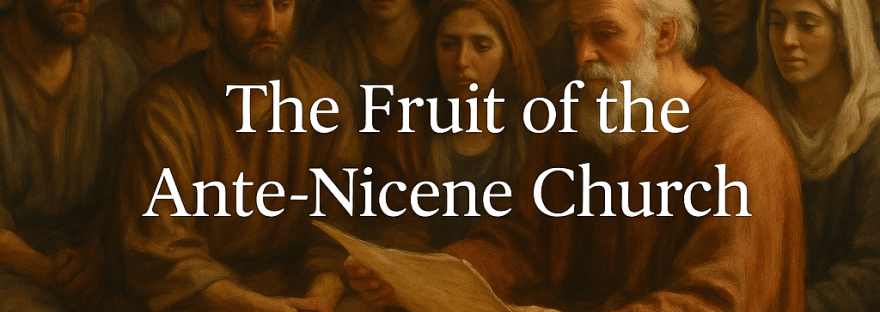
The Ante-Nicene Christians—those who lived between AD 33 and 325—weren’t superhuman saints. They were men and women like us. What made them distinct wasn’t special status or superior knowledge, but their radical faith, sacrificial love, and unwavering loyalty to the teachings of Christ. These were the disciples of the disciples, and their witness shook empires.
Who Were the Ante-Nicene Christians?
The term Ante-Nicene refers to the Christians who lived before the Council of Nicaea in AD 325. Their faith flourished not in freedom or comfort but in the midst of intense persecution. They didn’t rely on seminaries or institutionalized church systems. They followed the written Word of God, the oral teaching passed down from the Apostles, and the living guidance of the Holy Spirit (John 14:26; 1 John 2:27).
They were:
- Disciples of disciples — directly trained by those who had been taught by the Apostles.
- Anchored in Scripture — believing it to be complete and sufficient. They sought the Holy Spirit for understanding, not evolving human traditions.
- Fluent in context — They lived in the same Greco-Roman world, understood the Koine Greek language, and read Scripture without needing to “bridge” historical gaps.
- Unified and scattered — They met in homes, not cathedrals, yet they were deeply united in faith across continents because they trusted the Word and the Spirit—not centralized authority or councils.
By the early 4th century, Christianity had spread through nearly every province of the Roman Empire—and beyond. Eusebius, the early church historian, recorded that the message of Christ had reached “all the nations” even before Constantine’s reign (Eusebius, Ecclesiastical History, 3.1).
What Were They Known For?
Perhaps the most compelling testimony doesn’t come from Christians themselves, but from their Roman persecutors.
Tertullian, writing around AD 197, defended Christians against Roman accusations in his work Apologeticus. In chapter 39, he says:
“It is mainly the deeds of a love so noble that lead many to put a brand upon us. ‘See,’ they say, ‘how they love one another!’”
This wasn’t Tertullian boasting—it was his account of what the pagans were saying about Christians. Their persecutors were bewildered. These people didn’t just love their friends—they loved their enemies. They didn’t cling to life—they gave it away. They took in orphans, buried the poor, and rescued unwanted infants from death (Justin Martyr, First Apology, 67; Aristides, Apology).
Roman Emperor Julian the Apostate, a later critic of Christianity, begrudgingly admitted in the 4th century:
“It is disgraceful that the impious Galileans support not only their own poor but ours as well; all men see that our people lack aid from us.”
— Letter to Arsacius, c. AD 362
Even when slandered or martyred, the early Church was unmistakably marked by this Kingdom love—poured out from a heart changed by the Spirit.
What Set Them Apart?
These early believers didn’t call themselves “theologians.” They didn’t take titles. They didn’t isolate into monasteries or create layers of leadership. Their lives were marked by humility, holiness, and servanthood.
They saw themselves as:
- Slaves of Christ (Romans 6:22),
- Aliens and strangers in this world (1 Peter 2:11),
- Ambassadors of a Kingdom not of this earth (2 Corinthians 5:20).
They refused to kill, even in war or self-defense. They refused to worship Caesar or offer a pinch of incense, even if it cost them their life. Why? Because they believed what Jesus said in Matthew 5–7 was not just a poetic sermon—but the Constitution of Heaven.
Why This Matters Today
Today, the modern Church—especially in the West—has lost much of its saltiness. The world often can’t tell the difference between a false Christian and a real one. Even faithful churches struggle to impact the world the way the early church did. Why?
Because we’ve traded in Kingdom living for cultural acceptance. We’ve treated the Sermon on the Mount like a suggestion instead of the standard.
But if we are truly Christ’s—if we are His slaves and sons—we must return to that radical, holy, love-filled walk that marked the early believers. Not with pride in them, but with worship toward the same God who empowered them to persevere.
“They overcame him because of the blood of the Lamb and because of the word of their testimony, and they did not love their life even when faced with death.”
— Revelation 12:11 (NASB 1995)
I don’t glorify these early Christians—God already has. He called them “those of whom the world was not worthy” (Hebrews 11:38). They didn’t just die for Jesus—they lived completely for Him.
What’s Ahead
In the coming weeks, I’ll explore their writings, their testimonies, and most importantly, the Scriptures that shaped them. We’ll test everything—past and present—by the Word of God, seeking the interpretation of the Holy Spirit, not men.
Let’s walk this journey together, rooted in Scripture and raised in Christ.
📚 Sources & References
· Scripture:
- John 14:26
- 1 John 2:27
- Jude 3
- Hebrews 11:38–40
- Revelation 12:11
- Romans 6:22
- 1 Peter 2:11
- 2 Corinthians 5:20
- Matthew 5–7
· Historical & Early Church Writings:
- Tertullian, Apology, ch. 39 (c. AD 197)
- Eusebius, Ecclesiastical History, 3.1
- Justin Martyr, First Apology, ch. 67
- Aristides, Apology
- Emperor Julian, Letter to Arsacius (c. AD 362)
- Rodney Stark, The Rise of Christianity, HarperOne, 1996
4–5 minutes

 Solo Spiritu Sancto — By the Holy Spirit Alone


Leave a comment