
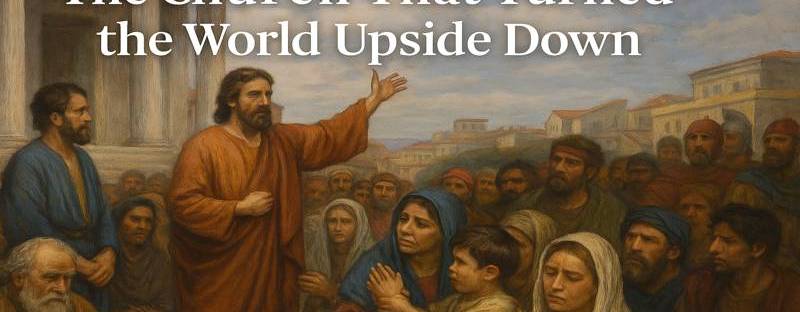
When the gospel began spreading across the Roman Empire, it didn’t come with military might, political clout, or institutional support. It came through fishermen, slaves, mothers, merchants, and martyrs—ordinary people who lived with such conviction that the world couldn’t ignore them.
In Acts 17:6, the accusation was made:
“These men who have turned the world upside down have come here also…”
This was not an exaggeration. The Kingdom of God was turning everything upside down—starting with the hearts of those who refused to live by the world’s values. And nowhere was this more evident than in the early Church.
They Preached Without Platforms
The first Christians had no church buildings, no mass communication, no social media, and no celebrity pastors. Yet the gospel spread like fire. Why? Because every believer saw themselves as a vessel of the Kingdom.
Evangelism wasn’t a program—it was a way of life. Wherever they went, they preached Christ—not only with words, but with love, generosity, and forgiveness.
“They are attacked by Jews as aliens and are persecuted by Greeks, yet those who hate them are unable to give any reason for their hatred.”
— Epistle to Diognetus, ch. 5
They Loved Without Limits
The Church’s growth wasn’t driven by theological arguments—it was fueled by radical love.
- They cared for abandoned babies left to die.
- They served the sick when others fled during plagues.
- They welcomed strangers, enemies, and the poor.
- They forgave their persecutors and prayed for their executioners.
Their love had no worldly explanation, and that’s exactly what made it powerful.
“See how they love one another… and how they are ready to die for each other.”
— Tertullian, Apology 39
They Refused to Compromise
The early Christians didn’t adapt the gospel to gain favor with the world. They didn’t soften Jesus’ commands to make converts. They lived holy lives—separate from the systems of the world—and embraced the cost of faithfulness.
Whether it meant losing jobs, status, property, or life—they counted it joy to suffer for Christ. Their courage wasn’t rooted in pride but in eternal hope.
“You joyfully accepted the plundering of your property, since you knew that you yourselves had a better possession and an abiding one.”
— Hebrews 10:34
They Made Disciples, Not Just Converts
The goal wasn’t just to win arguments or gain numbers—it was to raise up citizens of the Kingdom who would live and die for Christ.
Discipleship happened in homes, in prison cells, and at gravesides. It was personal. It was sacrificial. And it changed the world.
What About Today?
If we want to turn the world upside down again, we must stop trying to fit in and start living like we truly belong to another Kingdom. Programs won’t change the world—but holy, Spirit-filled lives will.
We don’t need more influence—we need more obedience. We don’t need louder voices—we need brighter light.
What We Can Learn
- The early Church didn’t have power—they had presence.
- Love, holiness, and sacrifice still change hearts.
- We must stop conforming and start transforming.
- Ordinary believers with extraordinary obedience can shake nations.
Sources:
- The Holy Bible — Acts 17:6; Hebrews 10:34; Matthew 5:14–16
- Epistle to Diognetus, ch. 5
- Tertullian, Apology 39
- Eusebius, Church History
Discover more from Rooted & Raised
Subscribe to get the latest posts sent to your email.


Leave a Reply