
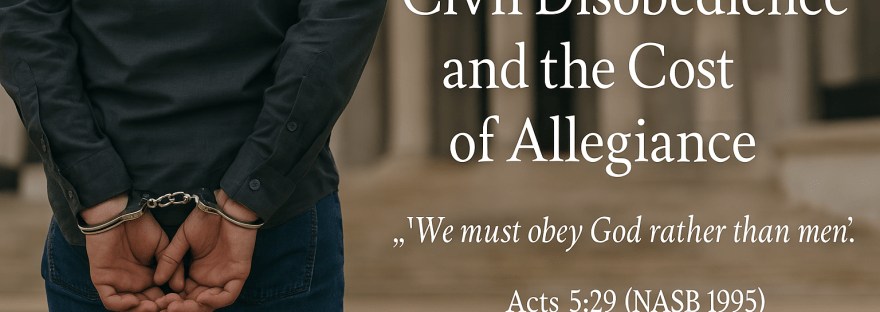
To the early Christians, allegiance to Jesus wasn’t just verbal—it was visible. It shaped every action, every relationship, and every response to authority. While they obeyed laws, paid taxes, and prayed for leaders, they also understood there were limits to civil obedience. When human commands contradicted divine truth, they chose Christ over Caesar—no matter the cost.
“We must obey God rather than men.”
— Acts 5:29
This wasn’t rebellion for the sake of rebellion. It was faithful resistance, grounded in humility, guided by Scripture, and empowered by the Spirit.
Civil Obedience with Heavenly Boundaries
The early Christians were not revolutionaries in the worldly sense. They sought peace, respected government, and lived quiet lives (1 Thessalonians 4:11–12). But they drew a line where obedience to earthly rulers would require disobedience to God.
When commanded to worship the emperor, offer incense to idols, or renounce Christ, they refused—even if it meant death.
“We are ready to serve you, but we cannot worship your gods or call the emperor ‘Lord.’ Christ is our only King.”
— Apology of Athenagoras, c. AD 177
They Were Arrested for Faithfulness, Not Lawlessness
These believers weren’t jailed for rioting or plotting rebellion—they were arrested for refusing to bow to anything or anyone but Jesus. Their defiance came in the form of silence before magistrates, refusal to sacrifice, hymns sung in prison, and joyful submission to execution.
They didn’t curse the state. They didn’t demand their rights. They simply stood firm in holy allegiance—and accepted the consequences.
Civil Disobedience Was Normalized in Their Discipleship
Early church leaders didn’t encourage blind compliance. They taught believers that following Christ might lead to breaking laws that broke God’s law, and that suffering was not failure—but faithfulness.
“We who fear God do not suppose that the empire is to be hated; we pray for it… but we refuse to call Caesar ‘God.’”
— Tertullian, To Scapula 2
Obeying God over men wasn’t an act of civil unrest—it was a mark of spiritual integrity.
Faithfulness Was Costly
Choosing Christ over culture meant:
- Loss of business and income
- Disqualification from public office
- Social exclusion
- Arrest, torture, and martyrdom
But they counted it a privilege to suffer for the Name.
“They left the council, rejoicing that they were counted worthy to suffer dishonor for the Name.”
— Acts 5:41
They did not seek suffering, but they did not fear it. Their eyes were on a better Kingdom, a righteous Judge, and an eternal reward.
What We Can Learn Today
- Civil disobedience is a biblical, necessary practice when human authority contradicts God’s Word.
- Faithfulness to Christ will cost us something—it always has.
- Our stand must be marked by humility, courage, and peace.
- We are not rebels—we are citizens of a higher Kingdom.
Sources:
- The Holy Bible — Acts 5:29, 41; 1 Thessalonians 4:11–12
- Tertullian, To Scapula
- Athenagoras, Apology
- Martyrdom of Polycarp, c. AD 155
- Eusebius, Church History
Discover more from Rooted & Raised
Subscribe to get the latest posts sent to your email.


Leave a Reply