
From the Series: The Biblical Jesus and His Bride
Scripture quotations are from the New King James Version®.
Copyright © 1982 by Thomas Nelson. Used by permission. All rights reserved.
We have established that Jesus is the eternal Son, the crucified and risen Lord, Redeemer, and Bridegroom. He saves not only individuals, but a people, the Church, whom He loves, betroths, and claims as His own. Therefore, who is the Church in the present age, not merely in glory or at the Marriage of the Lamb, but during the period between Christ’s ascension and return? Scripture offers clear answers.
Understanding the Church’s identity is not just an abstract belief; it shapes how we live and serve today. Realizing we belong to Christ’s beloved people gives meaning to our worship, unity, and calling. It motivates us to love one another, serve sacrificially, and witness to God’s grace as members of His living body. This truth speaks to our daily Christian walk as much as to the Church’s eternal destiny.
Christ did not redeem only to withdraw. Although He has ascended, He has not abandoned His Church. From heaven, He reigns and yet remains near. The Church is not merely a waiting room; she is the living Body of Christ. “And He is the head of the body, the church.” (Colossians 1:18, NKJV)
This language is not simply symbolic; it expresses a profound reality. The Church lives because her Head lives: she is animated, directed, sustained, and governed by Him. If the Head reigns, the Body is not lifeless. If He intercedes, the Body is not forgotten. This truth transforms our understanding of the Church. She is not primarily an organization, denomination, or authority structure, but a living organism joined to her Lord and sustained by the Holy Spirit. Even though the visible Church is marked by denominational differences and historical divisions, the essential unity of the Body of Christ is upheld by the Spirit. These distinctions do not erase the Church’s deeper spiritual oneness in Christ. Believers from various traditions, though dispersed, remain members of one Body, sharing in the same life and hope.
Now we continue seamlessly:
When Jesus prepared His disciples for departure, He didn’t tell them to build in His absence, but promised Another—His presence by the Spirit, not a substitute. “If I depart, I will send Him to you.” (John 16:7, NKJV)
The Holy Spirit is not an accessory to the Church, but the divine Person through whom Christ indwells His people. Without the Spirit, the Church is reduced to memory and ritual. With the Spirit, she is truly alive. Paul makes this point unmistakably clear:
“Do you not know that you are the temple of God and that the Spirit of God dwells in you?” (1 Corinthians 3:16, NKJV)
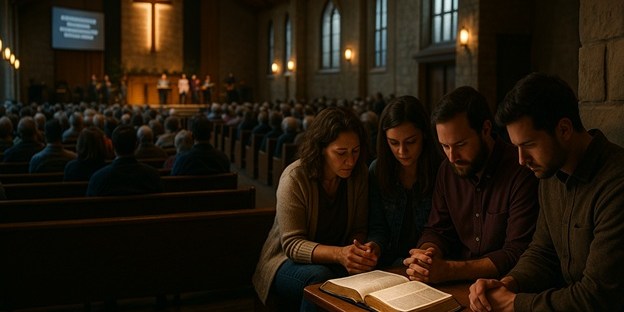
For this reason, the Church cannot be reduced to a building. The true temple is not constructed of stone, but consists of people. God’s dwelling place is not architectural; it is covenantal. The Spirit does not merely influence believers externally; He unites them from within. “For by one Spirit we were all baptized into one body.” (1 Corinthians 12:13, NKJV)
Therefore, the unity of the Church is not subject to human negotiation or manufacture; it is established by the Spirit Himself. From this unity arise gifts, leadership, holiness, and perseverance—not as isolated topics, but as organic expressions of Christ actively governing His Bride in the present age. In the following sections, we will explore how the Holy Spirit bestows spiritual gifts, calls and equips leaders, and works through the sacraments to build up the Church. By examining these themes in greater depth, we will see how each contributes to the life and mission of the Church and how, together, they express Christ’s ongoing presence among His people.
Discover more from Rooted & Raised
Subscribe to get the latest posts sent to your email.

