
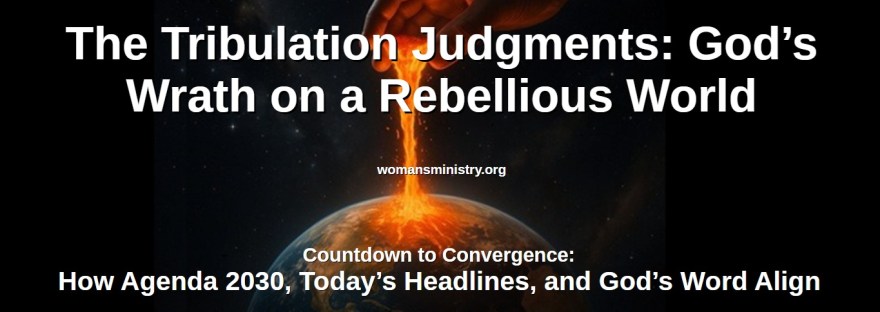
The convergence of politics, economy, and religion reaches its peak in the Antichrist’s system. But this is not the end of the story. When mankind unites in rebellion against God, the Lord Himself responds with direct judgment.
The Bible describes this period as the Tribulation — a time when God’s wrath is poured out on a rebellious world. It is marked by escalating judgments that shake every part of creation and expose the futility of human power.
Headlines like “Global Catastrophes Intensify” and “Unprecedented Disasters Shake the World” already foreshadow what Scripture says will come on a global scale.
Agenda 2030: Man’s Futile Solutions
Agenda 2030 emphasizes climate action and sustainable development:
- Goal 13: Climate action — humanity’s attempt to “save the planet.”
- Goal 11: Sustainable cities — visions of resilience and safety.
Yet the Bible declares that no global agreement or human plan will stop what God has decreed. Cities will fall (Revelation 16:19), and the earth itself will reel under judgment.
Current Events in Motion
- Natural disasters intensifying — earthquakes, floods, fires, and storms.
- Climate initiatives framed as humanity’s chance to control the earth’s future.
- Global cooperation on crises foreshadowing the collective response during the Tribulation.
- Echoes of Revelation’s plagues already appearing in smaller form: pandemics, famine, and economic disruption.
What we see now are birth pains. The fullness will come when God’s judgments are released.
Prophecy Foretold This
Revelation describes a sequence of escalating judgments:
- The Seal Judgments (Revelation 6, c. AD 95): conquest, war, famine, death, martyrs, and cosmic disturbances.
- The Trumpet Judgments (Revelation 8–9, c. AD 95): vegetation burned, seas turned to blood, waters poisoned, darkness, locusts unleashed, demonic armies released.
- The Bowl Judgments (Revelation 16, c. AD 95): painful sores, seas and rivers turned to blood, scorching heat, darkness, Euphrates dried up, and the gathering of Armageddon.
Other prophets echoed these truths:
- “Behold, the Lord makes the earth empty and makes it waste, distorts its surface and scatters abroad its inhabitants… The earth is also defiled under its inhabitants… Therefore the curse has devoured the earth.” (Isaiah 24:1–6, c. 700 BC, NKJV)
- “And I will show wonders in the heavens and in the earth: Blood and fire and pillars of smoke. The sun shall be turned into darkness, and the moon into blood, before the coming of the great and awesome day of the Lord.” (Joel 2:30–31, c. 835 BC, NKJV)
- “For then there will be great tribulation, such as has not been since the beginning of the world until this time, no, nor ever shall be.” (Matthew 24:21, c. AD 60, NKJV).
These judgments are global, devastating, and undeniable.
Why This Matters
- God’s sovereignty overrules man’s control. No agenda, treaty, or policy can stop His decrees.
- His wrath is purposeful. It brings justice, exposes rebellion, and prepares for Christ’s kingdom.
- Urgency is required. The time to repent and believe in Christ is now, before these events unfold.
God’s Pattern of Judgment and Deliverance
God has always distinguished between the rebellious and His own:
- Egypt (Exodus 7–12, c. 1445 BC): Plagues fell on Egypt but Israel was preserved.
- Sodom (Genesis 19, c. 2000 BC): God judged the city but delivered Lot.
- The Flood (Genesis 6–9, c. 2300 BC): God judged the world but preserved Noah and his family.
So it will be again: God will judge the world but preserve His covenant promises and bring His kingdom.
A Call to Watchfulness
- For unbelievers: these warnings are mercy — flee to Christ while there is time.
- For believers: comfort in the Blessed Hope — “For God did not appoint us to wrath, but to obtain salvation through our Lord Jesus Christ.” (1 Thessalonians 5:9, NKJV).
- For all: know that no global agenda can stop God’s plan, but His mercy is available now through Jesus Christ.
Sources & References
Scripture
- Genesis 6–9, c. 2300 BC
- Genesis 19, c. 2000 BC
- Exodus 7–12, c. 1445 BC
- Isaiah 24:1–6, c. 700 BC
- Joel 2:30–31, c. 835 BC
- Matthew 24:21, c. AD 60
- 1 Thessalonians 5:9, c. AD 51
- Revelation 6; 8–9; 16, c. AD 95
Agenda 2030
- Goal 11: Sustainable cities
- Goal 13: Climate action
- Transforming Our World: The 2030 Agenda for Sustainable Development (United Nations, 2015)
Current Events
Rising Disasters
- Global Assessment Report (GAR) 2025: Resilience Pays: Financing and Investing for our Future (UNDRR, May 27, 2025) Annual disaster costs now surpass $2.3 trillion globally when including cascading and ecosystem impacts; emphasizes rising economic burden and un-insurability, with interactive maps projecting GDP losses from hazards like floods and storms up to 2100.
- Natural disasters have caused more than $131 billion in losses so far in 2025 (CBS News, Aug 2, 2025) First-half global losses hit $131 billion (up from prior years), with $80 billion insured—the second-highest on record; driven by LA wildfires ($53 billion) and Myanmar earthquake ($12 billion); climate change cited as amplifying frequency.
- Wildfires around Los Angeles, severe thunderstorms: US natural catastrophes dominate global losses in the first half of 2025 (Munich Re, Jul 2025) Global losses: $131 billion (weather events 88%); insured losses $80 billion (second-highest H1 ever); LA wildfires alone $53 billion; temperatures 1.4°C above pre-industrial levels fuel more frequent severe storms and fires.
- Global Insured Losses From Natural Disasters Could Top $150B in 2025: Swiss Re Report (Insurance Journal, Aug 6, 2025) Insured losses trending to $145-150 billion for 2025 (5-7% annual growth); H1 economic losses $135 billion (59% insured); warns of higher Q4 activity from hurricanes; protection gap remains $181 billion globally.
- Are Natural Disasters Increasing? (Emergency Assistance Foundation, Jun 23, 2025) 2025 on pace for record billion-dollar events; global emergencies include DR Congo floods, Myanmar earthquake, and Mozambique cyclone; rising moisture and wind shifts from warming exacerbate trends.
- US Sees 14 Billion-Dollar Disasters in First Half of 2025 (Earth.org, Oct 22, 2025)US alone: 14 events costing $101 billion (wildfires, storms); global pattern shows increasing frequency; Climate Central data highlights unprecedented levels post-2024 records.
- Natural Disaster Statistics in 2025 (The Zebra, May 2, 2025) Global disasters affected 93.1 million in 2023 (upward trend into 2025); 60,000 annual deaths; floods/storms dominate, with 80-90% of recent events tied to climate extremes; only 18% of Americans prepared financially.
- World Risk Report 2025 (Bündnis Entwicklung Hilft / Ruhr University Bochum, 2025) Ranks 193 countries; Philippines, India, Indonesia highest risk; flood risks surging due to climate/land use changes; exposure/vulnerability data shows rising threats to 2.5 billion people.
- CO2 levels hit highest ever recorded, WMO says, warning of more extreme weather (Reuters, Oct 15, 2025) CO2 up 3.5 ppm (largest since 1957), turbo-charging extremes; WMO forecasts 70% chance of 1.5°C average warming in 2025-2029, driving more heatwaves, floods, and droughts.
- The top 10 crises the world can’t ignore in 2025 [International Rescue Committee (IRC), Dec 11, 2024 (updated 2025)] Sudan, Syria, Myanmar top list; climate shocks (floods, cyclones) exacerbate conflicts, displacing millions; Horn of Africa among most affected by rising disasters.
- Natural Disasters in China Rack Up $7.6bn in Losses in H1 2025 (Earth.org, Aug 20, 2025) China: 23 million affected, $7.6 billion losses, 307 deaths; floods 90% of damage; 28.7% more homes destroyed than 2024, signaling broader Asian trends.
- Climate disasters in first half of 2025 costliest ever on record, research shows (The Guardian, Oct 22, 2025) US: 14 billion-dollar events ($101 billion); global costs up due to storms/cyclones/wildfires; 2014-2024 decade saw 3x increase over 1985-1995.
Climate/Global Cooperation Efforts
- COP30 Begins With U.S. Allies and Rivals Alike Calling for Action (The New York Times, November 7, 2025) Summit opens amid record heat; allies push economic benefits of slowing warming, countering Trump’s skepticism; highlights cooperation on energy security despite trade wars and disasters like recent hurricanes in Mexico and Haiti.
- What to Expect in Climate Change in 2025: Opportunities Amid Challenges
(Global Center on Adaptation, January 13, 2025) Pivotal year for justice, finance, and cooperation; calls for scaling adaptation in vulnerable nations, with decisions shaping decades of action. - State of Climate Action 2025 (World Resources Institute, October 2025) Comprehensive roadmap for Paris goals; assesses sectors like power and forests; notes private finance surge to $1.3T but warns 75% of indicators need 2-4x acceleration by 2030.
- 5 Ways COP30 Can Deliver on Countries’ Climate Plans (World Resources Institute, November 6, 2025) Urges NDC renewals for 1.5°C; emphasizes integrating coalitions into COP Action Agenda for energy, forests, and finance; stresses multi-level collaboration.
- Goal 13: Climate Change (United Nations Sustainable Development, Updated 2025) COP29 finance goal of $300B/year by 2035 tripled; emissions must halve by 2030; highlights tech sharing and resilience for vulnerable regions.
- The State of Climate Action in 2025: 10 Key Findings (World Resources Institute
October 2025) 10th Paris anniversary; decarbonization in cement promising but overall efforts off-track; calls for faster removals and sector targets. - International Climate Action (World Resources Institute, Ongoing 2025) ACT2025 consortium elevates vulnerable voices; pushes multilateral banks for finance and bilateral ties for zero-carbon economy.
wri.org - COP30: Council sets EU position for the climate conference in Belém (European Council, October 21, 2025) EU reaffirms 1.5°C limit; prioritizes tripling renewables, phasing fossils, and $1.3T finance; aims to lead on mitigation/adaptation.
- Economic and Environmental Benefits from International Cooperation on Climate Policies [International Monetary Fund, March 16, 2022 (updated 2025)] Analyzes carbon price floors and climate clubs; post-COP26 gap requires scaling policies for <2°C; differentiates by development level.
- International Cooperation: Key to Combating the Climate Crisis (Greenly
2025) Paris Agreement’s NDCs and finance/tech sharing essential; aids adaptation in low-emission Africa; unified response for resilience.
greenly.earth
Discover more from Rooted & Raised
Subscribe to get the latest posts sent to your email.

