
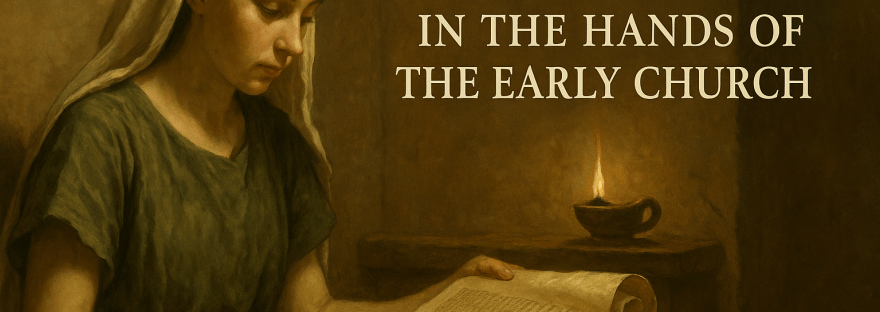
“You search the Scriptures because you think that in them you have eternal life; it is these that testify about Me.”
— John 5:39 (NASB1995)
How the Early Church Handled the Word
Before councils and confessions, before systematic theologies and seminaries, there were scrolls in homes, Scripture quoted in letters, and truth defended in blood.
The Ante-Nicene Church didn’t possess theological freedom to play with interpretations. They held to what was handed down. The Scriptures were not open to speculation. They were read, believed, memorized, and lived.
“Let us, then, not only call Him Lord, for that will not save us. For He says, ‘Not everyone who says to Me, Lord, Lord, will be saved, but he that does what is right.’ Let us, then, be His disciples, and obey His commands… by loving one another, by not committing adultery, by not speaking evil of one another.”
— Second Epistle of Clement, c. AD 140
This was Sola Scriptura in action: not merely affirming that the Bible is true, but that it is binding, transforming, and meant to be obeyed.
Their View: Scripture as Final and Unified
While false teachers—like the Gnostics—claimed secret knowledge, the early Church clung to the clear, public, and preserved Word.
“These men draw nothing from the Scriptures which are properly called divine, but they boast that they possess more Gospels than there really are. But in reality, they are full of blasphemy.”
— Irenaeus, Against Heresies, Book 3
They did not divide Old Testament from New. They saw one unified message:
- The prophets foretold Christ.
- The Gospels revealed Him.
- The apostles explained Him.
- The Church obeyed Him.
Scripture as the Standard for Doctrine
When disputes arose, they didn’t appeal to personal revelation or mystical interpretation. They returned to what was written.
“For if they would really make use of the Scriptures, they would see clearly that the heresies must be rejected… for the faith has been transmitted from the apostles to the Church through the Scriptures.”
— Tertullian, Prescription Against Heretics, c. AD 200
They didn’t add to the Word with theological scaffolding. They didn’t twist the Word with philosophical grids. They received the Word as it was delivered and allowed the Spirit to teach them.
And this led to deep unity.
Scripture for the Ordinary Believer
The early Church was decentralized. There was no singular hierarchy dictating doctrine for all. The people had the Word—and many were literate enough to read or hear it.
Even uneducated believers were saturated in Scripture. They didn’t rely on spiritual elites to tell them what it meant. They were taught by the Holy Spirit, discipled in small gatherings, and held one another accountable to live it.
“Brethren, we ought to think of Jesus Christ as God, as the judge of the living and the dead, and we ought not to belittle our salvation. Let us then do His will, and not our own, obeying His commandments.”
— Letter of Ignatius to the Magnesians, c. AD 110
This wasn’t Bible knowledge as trivia. It was Scripture as a way of life.
What We’ve Lost—and Must Recover
Much of today’s Church has traded:
- Scripture for secondhand theology
- Spirit-taught truth for institutionalized interpretations
- Obedience for theological correctness
The early Church didn’t claim Sola Scriptura.
They lived it.
They believed that Scripture was:
- Clear to the humble
- Powerful to the obedient
- Taught by the Spirit
- Sufficient for salvation and godliness
And that hasn’t changed.
Kingdom Discipleship Reflection
- Do I handle the Word as the early Church did—with reverence, humility, and obedience?
- Have I unintentionally elevated teachings about Scripture over Scripture itself?
- Am I living what I read, or merely affirming it as true?
This week, choose a New Testament command from Christ or His apostles. Write it out. Memorize it. Obey it.
Walk it out—not to earn salvation, but to walk as one who has been transformed by the truth.
“But prove yourselves doers of the word, and not merely hearers who delude themselves.”
— James 1:22 (NASB1995)
Discover more from Rooted & Raised
Subscribe to get the latest posts sent to your email.


Leave a comment