
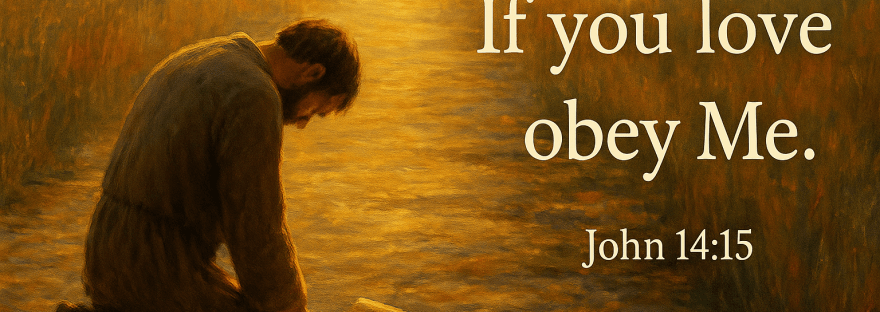
From the series “The Commands of Christ — Love in Action”
The love of God is not a feeling we carry. It is a life we surrender.
It does not ask for admiration. It calls for obedience.
Love that does not obey is not love at all.
“If you love Me, you will keep My commandments.”
— John 14:15, NASB 1995
Jesus didn’t say this to burden His disciples.
He said it to anchor them.
Because love for Christ is not measured in passion, eloquence, or emotion—but in faithfulness.
To follow Jesus is not to admire His teachings.
It is to obey His voice.
There is a kind of faith that applauds Christ from a distance.
There is a kind of love that sings on Sunday and wanders on Monday.
But the love that saves—the love born of the Spirit—is a love that listens, follows, repents, and obeys.
“Why do you call Me, ‘Lord, Lord,’ and do not do what I say?”
— Luke 6:46
This is the question that echoes through every age of the Church.
Not, “Do you feel love for Me?”
But, “Will you do what I say?”
Jesus’ commands are not suggestions. They are not optional for the mature or the zealous. They are for every disciple who has been born of the Spirit and adopted into the family of God.
“For this is the love of God, that we keep His commandments; and His commandments are not burdensome.”
— 1 John 5:3
True love doesn’t argue with the Word.
It doesn’t try to explain away obedience with theology.
It bows. It follows. It trusts.
The early Church understood this well. Their love was visible, not because they claimed it, but because they lived it.
The Didache (c. AD 50–100):
“There are two ways: one of life, one of death. This is the way of life: First, you shall love God who made you; second, your neighbor as yourself. And whatsoever you would not have done to you, do not do to another… walk according to the commandments.”
— Didache, Ch. 1–2
Irenaeus (c. 180 AD):
“Those who love Him walk in His commandments. For love does not destroy the Law, but fulfills it through obedience.”
— Against Heresies, Book IV
These early believers did not separate doctrine from practice.
They didn’t ask how little they could obey and still be saved.
They asked how deeply they could obey to show their love.
So what does this mean for us?
It means love cannot remain vague.
It must be expressed in action—in forgiving, in speaking truth, in denying self, in remaining faithful, in keeping His words even when it costs us everything.
It means discipleship isn’t just about knowing what Jesus said—it’s about doing it.
“But the one who has listened and has not acted accordingly is like a man who built a house on the ground without a foundation…”
— Luke 6:49
And it means this: the clearest evidence that the love of God abides in us… is that we obey.
📚 Sources & References
If You Love Me, Obey Me
Scripture (NASB 1995):
- John 14:15 – “If you love Me, you will keep My commandments.”
- 1 John 5:3 – “This is the love of God, that we keep His commandments…”
- Luke 6:46–49 – “Why do you call Me, ‘Lord, Lord’ and do not do what I say?”
Ante-Nicene Sources:
- The Didache, Chapters 1–2.
“There are two ways… walk according to the commandments.”
[Available at: EarlyChristianWritings.com] - Irenaeus, Against Heresies, Book IV.
“Love does not destroy the Law, but fulfills it through obedience.”
[Available at: NewAdvent.org]
Discover more from Rooted & Raised
Subscribe to get the latest posts sent to your email.


Leave a comment