
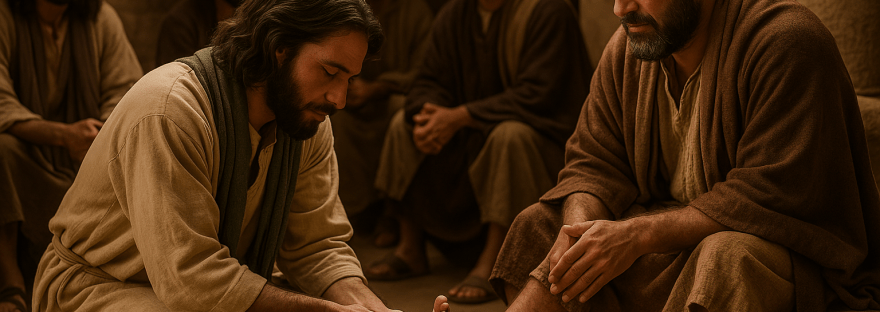
In today’s church culture, titles, leadership platforms, and structured hierarchies are often assumed to be part of faithful church practice. But the early Christians—those who lived between AD 33 and AD 325—embraced a radically different model of leadership. Their lives were marked not by authority over others, but by servanthood under Christ.
Leadership, to them, meant dying to self, living in humility, and shepherding others through example—not position.
They Followed the Example of Christ and the Apostles
Jesus said:
“The greatest among you shall be your servant. Whoever exalts himself will be humbled, and whoever humbles himself will be exalted.”
— Matthew 23:11–12
This wasn’t a metaphor to them—it was a way of life. The early church imitated this model. Leaders weren’t elevated above the body but walked among them, sharing meals, burdens, prayers, and persecution. Titles like “Reverend,” “Most Holy,” or even “Bishop” in the later sense were foreign to the earliest believers.
Paul referred to himself as a slave of Christ (Romans 1:1), not a spiritual elite. Peter called himself a fellow elder (1 Peter 5:1), not a ruling overseer.
Elders and Deacons, Not Religious Offices
The early church recognized elders and deacons, but these were functions, not formal offices. Elders were to shepherd the flock by example (1 Peter 5:2–3), teach faithfully, and guard the body from false teaching. Deacons served the practical needs of the church (Acts 6:1–6).
They did not wear robes, sit on thrones, or live apart from the people. They labored with their hands, often poor and persecuted alongside the rest of the church.
“We do not speak great things—we live them.”
— Cyprian, c. AD 250
They Rejected the Pursuit of Status
As the church began to gain influence, especially after Constantine, some leaders accepted state favor, wealth, and power. But before this shift, the Ante-Nicene leaders refused to chase status.
Many actively rejected positions of authority or fled from recognition. Leadership was not sought after but reluctantly accepted, and only by those proven faithful in character.
“Let no one exalt himself… let the honor be given by others, not seized for oneself.”
— Didache, ch. 15
They were deeply aware of their weaknesses, and they didn’t want anything that would distract from serving Christ or His people.
Simplicity in Life and Worship
These believers lived simply. They gathered in homes. Their worship wasn’t performance-driven but Spirit-led. There were no stages, lighting, or platforms—only Scripture, prayer, mutual edification, and the breaking of bread (Acts 2:42).
This simplicity wasn’t poverty—it was freedom. Free from systems. Free from religious show. Free to focus on Christ and one another.
Why This Matters Today
The Church has often drifted from the humility of its beginnings. Leadership has become professionalized. Buildings have replaced homes. Titles have overtaken relationships. And the result? A weakened witness to the world.
But the example of the early church calls us back—not to romanticize the past, but to recover a posture of servanthood, simplicity, and spiritual power.
What We Can Learn
- True leadership is service.
- Simplicity fosters authenticity.
- The body of Christ thrives when every member is honored.
- We must guard against the temptation to elevate systems over Spirit-led relationships.
Sources:
- The Holy Bible — Matthew 23:11–12; Romans 1:1; 1 Peter 5:1–3; Acts 2:42; Acts 6:1–6
- Cyprian, Epistles, c. AD 250
- Didache, ch. 15
Discover more from Rooted & Raised
Subscribe to get the latest posts sent to your email.


Leave a comment