
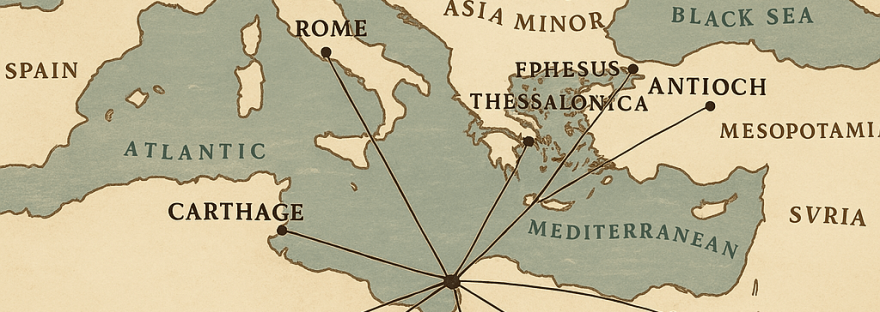
How did the gospel go from a small band of disciples in Jerusalem to a global movement spanning empires—all without political power, printing presses, or large buildings? Before the Council of Nicaea in AD 325, Christianity had already spread like wildfire across the known world. But it didn’t spread the way religions do today—it spread through persecution, love, and uncompromising obedience to Christ.
From Jerusalem to the Ends of the Earth
Jesus’ final command was clear:
“You will be my witnesses in Jerusalem, and in all Judea and Samaria, and to the ends of the earth.”
— Acts 1:8
By the end of the book of Acts, the gospel had already reached Rome. But that was only the beginning. The first three centuries of Christianity were marked by relentless expansion—not through organized missions boards or campaigns, but through ordinary believers living out their faith in the marketplaces, fields, prisons, and homes of the Roman Empire.
Evangelism Through Persecution
Persecution was fierce and constant in many regions during this period. Yet this didn’t slow the gospel—it accelerated it.
“The blood of the martyrs is the seed of the church.”
— Tertullian, Apology 50
Rather than scare believers into silence, persecution emboldened them. Their courage, joy, and refusal to recant made the world take notice. Many came to faith after watching Christians face lions, fire, and swords with peace on their faces and forgiveness on their lips.
House to House, Village to Village
The church grew underground, yet it wasn’t hidden. Christians met in homes (Romans 16:5), shared meals, and welcomed strangers. As they traveled for work or trade, they carried the gospel with them. No church buildings. No budgets. Just transformed lives and the Word of God.
Eusebius writes that churches could be found in nearly every city and village of the empire by the early 300s:
“The word of salvation was zealously preached… churches were multiplied and grew from small beginnings.”
— Eusebius, Church History 8.1
Geographical Reach by the 3rd Century
Here’s a glimpse of how widespread the Church became by AD 300:
- Italy & Rome – thriving despite intense persecution
- North Africa – home to Tertullian, Cyprian, and others
- Egypt & Alexandria – a major center of early Christian teaching
- Asia Minor – vibrant churches from Paul’s time, many still active
- Gaul (modern France) – early martyrdoms like those in Lyon
- Germany & Britain – evidence of Christian communities by late 2nd to 3rd centuries
- Persia, Armenia, and beyond – reaching into the East before Rome ever recognized Christianity
The gospel was already global before it was ever legal.
Carried by the Faithful, Not the Famous
The Church’s expansion wasn’t led by celebrity pastors or state-sponsored missionaries. It was carried on the backs of slaves, merchants, mothers, soldiers, and widows—men and women who understood they were part of something eternal.
“Christians are not distinguished from the rest of mankind by country, language, or customs… yet they display to us a wonderful and confessedly striking method of life.”
— Letter to Diognetus, c. AD 130–200
They preached by their actions. They discipled by example. And they evangelized by love.
What We Learn Today
- You don’t need a platform to spread the gospel. You need obedience.
- The Spirit leads the willing. Many early Christians didn’t plan to evangelize—they simply refused to hide Christ.
- The gospel is not bound by borders. Even in places where persecution raged, the church thrived.
- We must recover the simplicity and power of everyday witness. Before there were systems, there were saints who walked with Christ and changed the world.
Sources:
- The Holy Bible — Acts 1:8; Romans 16:5
- Tertullian, Apology 50
- Eusebius of Caesarea, Church History, Book 8
- Letter to Diognetus, c. AD 130–200
- Stark, R. (1996). The Rise of Christianity. HarperOne
Discover more from Rooted & Raised
Subscribe to get the latest posts sent to your email.


Leave a comment