Feast of Tabernacles, Holy Days

Feast of Tabernacles — God With Us

Scripture Focus: Leviticus 23:33–43; Zechariah 14:16–19; John 1:14; John 7:2–39; Revelation 21:3–4


The Feast of Tabernacles—Sukkot—begins at sundown on October 6, 2025, and lasts for seven days, followed by a sacred assembly on the eighth day. It is the grand finale of the appointed times, a joyous celebration of God’s provision, presence, and promise. Israel was commanded to dwell in booths (sukkot) to remember their wilderness journey and to rejoice in the Lord.

But this was no mere camping trip. It was a prophetic rehearsal of something far greater: the coming of Emmanuel—God with us.

Dwelling in Booths: A Temporary Reminder

“You shall dwell in booths for seven days… so that your generations may know that I had the sons of Israel live in booths when I brought them out from the land of Egypt” (Leviticus 23:42–43).

During Sukkot, the people lived in makeshift shelters to recall how God sustained them in the wilderness. It was a time of rejoicing and remembering: God led them, fed them, and dwelled among them in the pillar of cloud and fire.

Jesus at the Feast

In John 7, we find Jesus attending the Feast of Tabernacles. On the last and greatest day of the feast, He stood and cried out:

“If anyone is thirsty, let him come to Me and drink. He who believes in Me, as the Scripture said, ‘From his innermost being will flow rivers of living water.’” (John 7:37–38)

This declaration occurred during the water-drawing ceremony, when priests would pour water at the altar in anticipation of rain and the Spirit. Jesus proclaimed He is the source of that living water. He is the presence of God among us.

And John had already declared:

“And the Word became flesh, and dwelt [tabernacled] among us…” (John 1:14).

The Future Fulfillment: Dwelling Forever

The Feast of Tabernacles looks not only backward and inward—but forward:

“Behold, the tabernacle of God is among men, and He will dwell among them, and they shall be His people…” (Revelation 21:3)

In the age to come, God will dwell permanently with His people. There will be no more need for temporary shelters. No more tears. No more separation. Just God with us, forever.

Devotional Reflection: Joy in His Presence

Read Together: Leviticus 23:33–43; John 7:2–39; Revelation 21:1–4

Discuss:

  • Why did God command Israel to rejoice during this feast?
  • How does Jesus fulfill the symbols of Sukkot?
  • What does it mean to experience His presence now, even before the final fulfillment?
  • How can we cultivate joy as we await His dwelling among us?

Reflect: Build a small booth or tent as a family, or sit outside under the stars. Remember how God has sustained you. Rejoice in His faithfulness. Let your heart long for the day when the dwelling of God will be fully with us.

Pray: Lord, You are our shelter, our provision, our joy. Thank You for coming to dwell among us through Christ. Help us rejoice in Your presence now, and long for the day when we will see You face to face. Amen.

The booth is temporary. His presence is eternal. Rejoice, for God will dwell with us forever.

2–3 minutes

Leave a comment

Feast of Trumpets, Holy Days

Feast of Trumpets — The King Is Coming

Scripture Focus: Leviticus 23:23–25; Numbers 10:1–10; Matthew 24:29–31; 1 Thessalonians 4:16–17; Revelation 11:15


The Feast of Trumpets, known in Hebrew as Yom Teruah, means “Day of Blowing.” It begins at sundown on September 22, 2025. This day was unique among the appointed times of the Lord. It was a memorial day marked by the blast of trumpets and a sacred assembly. No specific reason was given in the Torah—only that Israel was to rest, gather, and listen for the sound.

But Scripture interprets Scripture. And when the trumpet sounds in the Word of God, it announces something critical: the arrival of a king, a call to assembly, or a declaration of war.

A Day of Blowing and Awakening

“Speak to the sons of Israel, saying, ‘In the seventh month on the first of the month you shall have a rest, a reminder by blowing of trumpets, a holy convocation’” (Leviticus 23:24).

In Numbers 10, trumpets were used to:

  • Call the congregation together (v. 2)
  • Signal the movement of the camp (v. 5)
  • Sound the alarm for war (v. 9)
  • Celebrate joyous occasions and offerings (v. 10)

In this way, the Feast of Trumpets prepares the people—a wake-up call for the coming High Holy Days.

The Prophetic Picture: The Return of the King

Jesus spoke of His return in unmistakable terms:

“And He will send forth His angels with a great trumpet and they will gather together His elect from the four winds…” (Matthew 24:31).

Paul says:

“For the Lord Himself will descend from heaven with a shout, with the voice of the archangel and with the trumpet of God, and the dead in Christ will rise first” (1 Thessalonians 4:16).

The trumpet will announce the coming of the true King—Jesus, returning to judge, to redeem, and to reign.

In Revelation 11:15, at the sounding of the seventh trumpet, loud voices in heaven declare:

“The kingdom of the world has become the kingdom of our Lord and of His Christ; and He will reign forever and ever.”

A Call to Readiness

Yom Teruah calls us to pause, reflect, and prepare. It comes without warning, as the new moon was not visible until it was observed and confirmed. This is why Jesus said:

“Of that day and hour no one knows… but the Father alone” (Matthew 24:36).

Just as the feast was dependent on watchfulness, so is our readiness for Christ’s return. Are we listening for the trumpet?

Devotional Reflection: Awake, Watch, Prepare

Read Together: Leviticus 23:23–25; 1 Thessalonians 4:16–17; Matthew 24:29–31

Discuss:

  • What did the trumpet signify in ancient Israel?
  • How does the sound of the trumpet relate to the second coming of Christ?
  • What does it mean to live in a state of spiritual readiness?
  • Are there areas of your life that need to come under the Lordship of the returning King?

Reflect: The Feast of Trumpets is both a warning and a promise. It reminds us that this world is not the end. Our King is coming, and He will not be late. Let the trumpet stir your heart toward repentance, worship, and joyful anticipation.

Pray: Lord, awaken us to the sound of Your trumpet. Shake us from spiritual slumber. Help us to live holy and alert, with lamps burning and hearts ready. We long for Your appearing. Come quickly, Lord Jesus. Amen.

The trumpet will sound. The King will return. Are we ready?

2–3 minutes

Leave a comment

Feast of Weeks, Holy Days

Pentecost (Shavuot)— The Spirit and the Harvest

Scripture Focus: Leviticus 23:15–22; Acts 1:4–8; Acts 2:1–41; John 14:16–17; Joel 2:28–32


Fifty days after the waving of the Firstfruits offering, the Feast of Weeks—known in Greek as Pentecost—was celebrated. It marked the end of the barley harvest and the beginning of the wheat harvest, a time of joyful gathering and thanksgiving. Yet in the fullness of time, God used this appointed day not only to gather grain, but to gather souls into His Kingdom.

The Count Leads to Completion

Leviticus 23 commands Israel to count seven complete Sabbaths from the day of Firstfruits, totaling fifty days (vv. 15–16). Then a new offering was to be presented to the LORD:

“You shall bring in from your dwelling places two loaves of bread for a wave offering… they shall be of fine flour, baked with leaven as first fruits to the Lord” (v. 17).

Unlike the earlier grain offerings, these two loaves were baked with leaven, symbolizing the full harvest of both Jew and Gentile—people from every nation, still imperfect, yet accepted in Christ.

The Fulfillment: The Holy Spirit Poured Out

In Acts 2, the early disciples were gathered in one place, as instructed by Jesus. Then suddenly:

“There came from heaven a noise like a violent rushing wind, and it filled the whole house… And they were all filled with the Holy Spirit” (Acts 2:2,4).

This was the fulfillment of what Jesus had promised: the Baptism of the Holy Spirit, the empowerment for witness (Acts 1:8), and the beginning of the Church’s public ministry.

It was also the fulfillment of Joel’s prophecy:

“It shall come about after this that I will pour out My Spirit on all mankind… And it will come about that whoever calls on the name of the Lord will be delivered” (Joel 2:28,32).

The result? Three thousand souls were added to the Church that day (Acts 2:41). The true harvest had begun.

The Role of the Spirit in the Believer’s Life

Pentecost is not just a historical event—it is a present reality. The same Spirit who descended at Pentecost dwells in every believer today:

  • He teaches and reminds us of Christ’s words (John 14:26)
  • He empowers us to witness (Acts 1:8)
  • He produces fruit in us (Galatians 5:22–23)
  • He convicts the world of sin and testifies of Christ (John 16:8,14)

The indwelling of the Spirit is both the seal of our salvation and the source of our sanctification. Through Him, we are transformed into the image of Christ (2 Corinthians 3:18).

Devotional Reflection: From Grain to Glory

Read Together: Leviticus 23:15–22; Acts 2:1–41; Joel 2:28–32

Discuss:

  • Why do you think God chose to pour out the Spirit on the day of Pentecost?
  • What do the two leavened loaves symbolize?
  • How does the Spirit equip you for witness and transformation?
  • What does it mean to live in daily dependence on the Spirit?

Reflect: Take time to thank God for the gift of the Holy Spirit. As the early Church was empowered to declare the mighty works of God, ask the Lord to fill your life with the same boldness, holiness, and harvest. We are no longer counting the days—we are living in the fulfillment.

Pray: Holy Spirit, we welcome You. As You filled the disciples at Pentecost, fill us anew. Empower us to speak truth, live boldly, and walk in step with Your leading. May our lives be a living offering to the Lord of the harvest. In Jesus’ name, Amen.

The fire has fallen. The harvest has begun.

2–4 minutes

Leave a comment

Holy Days, Summary

Appointed by God, Fulfilled in Christ

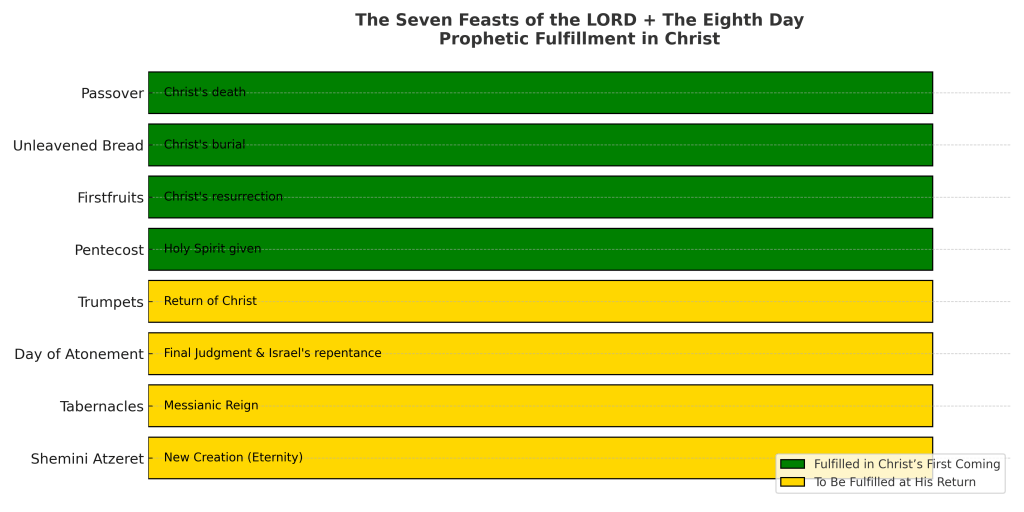
According to Leviticus 23, God established seven appointed feasts (moedim), and these were given in order as prophetic markers—each one fulfilled in Christ, either in His first coming or still to be fulfilled at His second coming.

Here’s a complete list:


🌿 SPRING FEASTS – Fulfilled in Christ’s First Coming

  1. Passover (Pesach)Christ’s crucifixion “Christ our Passover also has been sacrificed” (1 Cor. 5:7)
    • Fulfilled: Jesus died on Passover as the Lamb of God (John 1:29)
  2. Unleavened BreadChrist’s burial and sinlessness
    • Fulfilled: Jesus was buried, His body without sin or corruption (Acts 2:27)
  3. FirstfruitsChrist’s resurrection “Christ has been raised… the firstfruits of those who are asleep” (1 Cor. 15:20)
    • Fulfilled: Jesus rose on the day of Firstfruits, the “first of the harvest”
  4. Pentecost (Shavuot / Feast of Weeks)Giving of the Spirit “You will receive power when the Holy Spirit has come upon you…” (Acts 1:8)
    • Fulfilled: 50 days after Firstfruits, the Spirit was poured out (Acts 2)

🍂 FALL FEASTS – To Be Fulfilled at Christ’s Return

  1. Feast of Trumpets (Yom Teruah)Return of the King “…at the last trumpet… the dead will be raised” (1 Cor. 15:52; Matt. 24:31)
    • Awaiting Fulfillment: This feast foreshadows the resurrection, rapture, and announcement of the King’s return
  2. Day of Atonement (Yom Kippur)Final Judgment and National Repentance “They will look on Me whom they have pierced” (Zech. 12:10; Rom. 11:26–27)
    • Awaiting Fulfillment: A picture of Israel’s future repentance and the full revelation of Christ as High Priest and Judge
  3. Feast of Tabernacles (Sukkot)Millennial Kingdom, God dwelling with man “The tabernacle of God is among men…” (Rev. 21:3)
    • Awaiting Fulfillment: Points to the Messianic Kingdom and God’s permanent dwelling among His people

BONUS: Shemini Atzeret – The Eighth Day of Completion

Not a separate feast but a concluding assembly—a prophetic picture of eternity and the new creation. It follows Tabernacles and looks beyond the millennial reign into the eternal state where God dwells with His people forever (Revelation 21–22).


There are no additional holy days listed in Leviticus 23 beyond these seven feasts + the 8th Day. These encompass the entire redemptive timeline of Christ’s work—from the cross to the crown.

1–2 minutes

Leave a comment