
Featured & Foundational, Featured Article

CENTRALIZED POWER, DECEPTIVE UNITY, AND GLOBAL DOMINION

One World Government: “And the ten horns which you saw are ten kings who have received no kingdom as yet, but they receive authority for one hour as kings with the beast. These are of one mind, and they will give their power and authority to the beast.” (Revelation 17:12–13) — This speaks of a future global confederation of kings (or regions) who unite under the authority of the Antichrist. This is a centralized world government, short-lived and driven by satanic influence (Rev. 13:2), ultimately giving rise to the final Beast system described in Daniel and Revelation.

One World Religion: “So he carried me away in the Spirit into the wilderness. And I saw a woman sitting on a scarlet beast… And on her forehead a name was written: MYSTERY, BABYLON THE GREAT, THE MOTHER OF HARLOTS AND OF THE ABOMINATIONS OF THE EARTH.” (Revelation 17:3–5) — Revelation 17 describes Mystery Babylon, a global false religious system that fornicates with kings and seduces the world into spiritual adultery. This woman rides the Beast, meaning the Antichrist initially uses religion to gain global control, but later destroys her (Rev. 17:16–17). This fits the image’s implication of interfaith ecumenicalism paving the way for universal worship ,  eventually pointing to the worship of the Beast himself (Rev. 13:8).

One Leader: “And he shall confirm a covenant with many for one week; but in the middle of the week he shall bring an end to sacrifice and offering. And on the wing of abominations shall be one who makes desolate…” — Daniel 9:27 (NKJV); “Let no one deceive you by any means; for that Day will not come unless the falling away comes first, and the man of sin is revealed, the son of perdition.” (2 Thessalonians 2:3 (NKJV) — This leader is the Antichrist, described as the Little Horn (Dan. 7:8), the Beast from the sea (Rev. 13:1), and the man of sin (2 Thess. 2:3). He rises in a time of chaos, offering peace and order, but ultimately demands worship and blasphemes God.

One Purpose: “It was granted to him to make war with the saints and to overcome them. And authority was given him over every tribe, tongue, and nation.” (Revelation 13:7); “All who dwell on the earth will worship him, whose names have not been written in the Book of Life…” (Revelation 13:8) — The “one purpose” of Satan is to unite mankind in rebellion against God, to exalt himself above all that is called God (2 Thess. 2:4), and to enslave the world in spiritual darkness.

“And in the Darkness Bind Them”: “He causes all, both small and great, rich and poor, free and slave, to receive a mark… and that no one may buy or sell except one who has the mark or the name of the beast…” (Revelation 13:16–17) — This is bondage in darkness, not merely economic control, but spiritual enslavement,  sealing allegiance to the Beast and eternal separation from God for those who take the mark (Rev. 14:9–11). The world is not heading toward unity, peace, and progress, it is heading toward consolidated rebellion under Satan’s final push. But Jesus Christ, the true King, will return and shatter this false unity with the sword of His mouth (Revelation 19:15).

“And the kingdom and dominion… shall be given to the people, the saints of the Most High.” — Daniel 7:27 (NKJV)
Featured & Foundational, Featured Article

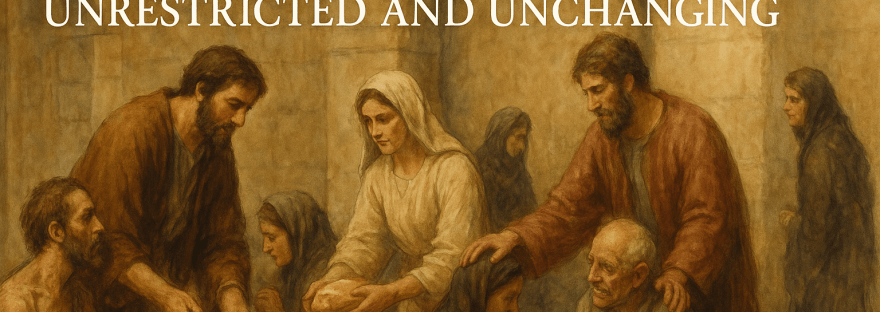
God’s Love: Unrestricted and Unchanging

There is a teaching, often repeated with great confidence, that God does not love anyone who is not “in Christ.” It sounds weighty, reverent, and even logical—until it is tested by the very Word of God.

The Scriptures do not describe God’s love as something hidden or conditional. They describe it as demonstrated, revealed, and poured out. It is not withheld until one believes; it is why one is drawn to believe.

Romans 5:8 tells us, “But God demonstrates His own love toward us, in that while we were yet sinners, Christ died for us.” This declaration is not veiled in mystery. It plainly states that God loved us before we were justified, reconciled, or sanctified. It is not union with Christ that produced His love; rather, it was His love that initiated the very mission of redemption.

When the Lord Jesus said, “Love your enemies… that you may be sons of your Father in heaven,” He grounded the command in God’s own nature: “for He causes His sun to rise on the evil and the good, and sends rain on the righteous and the unrighteous” (Matthew 5:44–45). If God’s love were only extended to those already in Christ, then His kindness toward the wicked would be hypocrisy. But Jesus makes clear: our Father loves even His enemies—and we are called to reflect that very love.

This love is not mere sentiment—it is action. The Father sent the Son not because we were worthy, but because we were lost. The mission of Christ was not the beginning of God’s love—it was the manifestation of what had always been in His heart. “For God so loved the world, that He gave His only begotten Son…” (John 3:16). Not the believing world. Not the elect world. The world.

The early Church understood this deeply. They did not preach a love confined to a theological category. They preached a Gospel that was for all men. They were ridiculed, slandered, and hunted—yet they loved their persecutors. They healed the sick, fed the poor, and offered hope to prisoners. Their writings and their lives bore witness that God’s love extended even to the enemies of the cross.

Justin Martyr wrote that Christ became man “for the sake of the human race,” and that the Father sent the Son “for the good of all men.” The Epistle to Diognetus describes God as sending His Son not to those who were already righteous, but to those who were corrupt and unworthy. The Church believed that God’s love was universal in offer and particular in reception—not because His love was limited, but because not all would receive it.

They lived what they believed. In Roman arenas, they forgave their killers. In plague-ridden cities, they stayed to care for the dying. In households and prisons, they offered the Gospel to every soul without distinction. Their theology was not an abstract system—it was the fragrance of Christ, poured out for the world.

This rich testimony stands in stark contrast to later teachings influenced by Stoic and Neoplatonic thought. These philosophies shaped views of God that emphasized impassibility—teaching that the divine could not experience change or passion. Within such a framework, God’s love became a selective extension of will, rather than the unchanging essence of His nature.

As these ideas entered Christian thought through certain teachers, the concept of divine love shifted. God’s affections were no longer seen as genuine or universally extended, but as fixed upon a predetermined few. The dynamic, pursuing love revealed in Scripture gave way to a colder logic—one where love became synonymous with election, and wrath with everyone else.

But the God of Scripture is not like the impassive gods of Greek philosophy. He is the God who weeps over Jerusalem, who is patient toward the wicked, who takes no pleasure in the death of the sinner, who rejoices over the lost sheep. He is not moved by merit, but by mercy. He is not controlled by our response, but He responds in faithful, pursuing love—so that we might turn and live.

If we are to return to the faith once for all delivered to the saints, we must recover this truth: God is love. Not selectively. Not reactively. Not philosophically. He is love by nature, and He has demonstrated that love by giving His Son—so that whoever believes in Him should not perish, but have everlasting life.

May we, like the early Church, live as those who have known this love—and extend it freely to all. For we are not loved because we are in Christ. We are in Christ because we were loved.

3–5 minutes

Leave a comment

Featured & Foundational, Featured Article

God Is Love: The Everlasting Compassion of Our Father

In a world full of brokenness, confusion, and unanswered questions, one truth remains unshaken: God is love. This declaration is not a passing sentiment or poetic phrase—it is the very nature of the One who created us. Scripture reveals this truth plainly, consistently, and powerfully from Genesis to Revelation. Yet, some theological perspectives have raised the question: Does God only love those who are already His?

Let us answer that not with human reasoning, but with the full counsel of God’s Word.

“The one who does not love does not know God, for God is love.”
— 1 John 4:8

The statement “God is love” does not mean that God merely shows love, but that love is the essence of His being. He cannot be anything other than who He is. His justice, His mercy, His holiness—all flow out of His perfect love. This love is not conditional upon our worthiness or position. It is who He has always been, even when we were still far off.

“But God demonstrates His own love toward us, in that while we were yet sinners, Christ died for us.”
— Romans 5:8

God’s love is not triggered by our faith—it is revealed in His initiative. He sent His Son to die while we were still sinners. That means God’s love was extended to us even when we were lost, rebellious, and unbelieving. It is because of that love that we even had the opportunity to repent and believe.

“For God so loved the world, that He gave His only begotten Son, that whoever believes in Him shall not perish, but have eternal life.”
— John 3:16

The word “world” speaks of humanity as a whole—fallen, undeserving, and estranged. And yet, God so loved this world that He gave what was most precious to Him. This was not selective love for a few, but a sacrificial love offered to all. The passage does not say God loved “the righteous,” or “the believing,” but the world.

“When He approached Jerusalem, He saw the city and wept over it…”
— Luke 19:41

Jesus, the visible image of the invisible God, wept over those who rejected Him. He lamented their unwillingness to receive the peace He came to bring. Does God grieve over those He does not love? No. His tears were the overflow of divine compassion, even for the lost.

“But I say to you, love your enemies and pray for those who persecute you, so that you may be sons of your Father who is in heaven; for He causes His sun to rise on the evil and the good, and sends rain on the righteous and the unrighteous.”
— Matthew 5:44–45

Jesus commands us to love our enemies because our Father in heaven does. He pours out kindness on both the righteous and the unrighteous. He is not distant or detached from the hurting, the stubborn, or the rebellious—He is actively showing them patience, kindness, and love, even as they resist Him.

“The Lord is not slow about His promise… but is patient toward you, not wishing for any to perish but for all to come to repentance.”
— 2 Peter 3:9

If God did not love those outside of Christ, there would be no reason for Him to be patient. But His patience flows from His loving desire that all would come to repentance. He tarries, not out of indifference, but out of longing.

“What man among you, if he has a hundred sheep and has lost one of them, does not leave the ninety-nine… and go after the one which is lost until he finds it?”
— Luke 15:4

The parable of the lost sheep paints a vivid picture of a Shepherd who seeks—not because the sheep earned it, but because they are His and He loves them. God does not wait for the lost to find Him. He seeks, rescues, and rejoices over the one who is found.

It is because God loved us in our sin that we now walk in grace. It is because He extended mercy to us when we were blind that we now see. And it is because His love is faithful and true that we can proclaim His name to every tribe, tongue, and nation—offering the same love to all, without partiality.

“We love, because He first loved us.”
— 1 John 4:19

The love of God is not only something we receive—it is something we are called to reflect. The more we understand that God loved us while we were enemies, the more we are compelled to love others in the same way. This is not a suggestion. It is the way of the Kingdom.

When Jesus said to love our enemies, He wasn’t offering a lofty idea for a peaceful society. He was describing the culture of Heaven. To love our enemies is to act like our Father. It is to see people not as threats or failures, but as souls for whom Christ died.

On the cross, in agony, Jesus prayed, “Father, forgive them; for they do not know what they are doing” (Luke 23:34). He loved not only His disciples, but those who mocked Him, beat Him, and drove nails through His hands. He did not wait for their repentance—He extended love while they were still enemies.

Stephen, the first martyr, followed the same example. As he was being stoned, he cried out, “Lord, do not hold this sin against them!” (Acts 7:60). Paul later wrote, “Bless those who persecute you; bless and do not curse” (Romans 12:14). This was not mere moral advice. It was the manifestation of a heart transformed by God’s love.

The early Church understood this well. From the time of Pentecost to the rise of imperial Christianity, they lived under persecution. Yet they were known—even by their enemies—as a people marked by love. Tertullian recorded that outsiders marveled, saying, “See how they love one another!” They prayed for their captors, forgave their executioners, and blessed their persecutors. Their love, even for enemies, testified to the power of the Gospel and turned the world upside down.

The Church today must recover this radical, Spirit-filled love. Not a love that approves of sin, but a love that lays down its life in truth, compassion, and mercy—even for those who hate us. To love as He loves is not weakness. It is warfare against the spirit of darkness. It is how the Kingdom advances—not by sword, but by sacrifice.

“Beloved, if God so loved us, we also ought to love one another.”
— 1 John 4:11

Let us be known—not for our arguments, strategies, or strength—but for our love. Not a love defined by the world, but by the cross. A love that prays for enemies, endures persecution, and reflects the character of our Father. The kind of love that can only be born of the Spirit.

This is the love that overcomes the world.

5–7 minutes

Leave a comment

Featured Article

When the Fire Refines: A Testimony of Christ in the Midst of Trial


“That the proof of your faith, being more precious than gold which perishes though tested by fire, may be found to result in praise, glory, and honor at the revelation of Jesus Christ.”
— 1 Peter 1:7, NASB1995


I didn’t plan for this season. I didn’t ask for the quiet ache that lingers in the heart when you’re thousands of miles away from a dying loved one. I didn’t ask for the weight of rising expenses, broken appliances, and unchanging income. I didn’t ask for the tears shed in silence after a long workday, or the sense of frustration when physical weariness overwhelms my efforts to steward my body and life well.

But I know this much: God wastes nothing.

Each of these trials—some quiet, some crushing—have become invitations. Invitations not to despair, but to deeper trust. Not to self-reliance, but to surrender. Not to perfection, but to the presence of Christ.

Sometimes I respond with faith. Other times, I forget to bring my cares to Him at all. And yet, He remains faithful.

I’m learning—not always gracefully, not always quickly—that the Christian life is not about ease, but refinement. That following Christ doesn’t remove trials—it reveals their purpose. He uses them to peel away false security, shallow obedience, and performance-driven faith. He uses them to form in me the heart of a true disciple.

And though I’ve failed many times to change habits or respond rightly, He continues to draw me into His Word. There, through the Spirit’s gentle conviction, I see where I’m being shaped—not just in theology, but in character, trust, and eternal hope.

Like those early believers in the Ante-Nicene Church, who loved not their lives even unto death, I am learning that faithfulness doesn’t require applause or ease—it requires endurance. And endurance doesn’t come from strength—it comes from Christ.

So this is not a story of how I overcame. This is the story of how Christ is sustaining me, in the middle of what still feels unfinished. I don’t know how every prayer will be answered, or how every need will be met. But I know who holds the answer. And I know He is good.

If you’re walking through something similar, take heart. We are not alone. Not even in the fire. And the same Jesus who walked with Shadrach, Meshach, and Abednego still walks with us today.


Lord, in every unknown, every burden, and every trial—teach me to cling to You. Not for relief alone, but for transformation. Let my life testify to Your faithfulness, even when the way is hard. Make me a living sacrifice that reflects the beauty of Christ. Amen.

2–3 minutes

Leave a comment

Featured & Foundational, Featured Article

Rooted, Raised… and Ready to Die for Christ

This blog began with a simple but serious question:
What does it mean to truly follow Jesus—according to His Word, not the traditions of men?

My journey started with prayer, conviction, and the Sermon on the Mount—Jesus’ Kingdom Constitution in Matthew 5–7. These weren’t suggestions. They were commands—radical, countercultural, Spirit-empowered commands. And I realized I wasn’t living them.

When I looked around modern Christianity, I saw a reflection of myself: well-meaning, but comfortable, distracted, and far from the sacrificial love and obedience Jesus described. We were not the kind of people our enemies could point to and say, “Look how they love one another.” We were not ready to lose our lives for Christ—or even our comforts. But in going back through church history, I found a people who were. The Ante-Nicene Christians—those who lived from AD 33 to 325—were no strangers to trials. And though they had faults, their lives were radically different from ours. They faced betrayal, injustice, persecution, poverty, and death… and still lived boldly, faithfully, and visibly for Christ. Their doctrine was Scripture. Their teacher was the Holy Spirit. Their gatherings were house to house, and their love for one another—legendary. Even their enemies took notice.

“See how they love one another… and how they are ready to die for each other.”
Tertullian, Apology 39.7 (quoting pagan observers)

That kind of Christianity is not extinct. It’s just been buried. Buried under comfort. Under compromise. Under culture. And I knew I had to dig it up again—for myself, my family, and anyone else who would listen.


This Is My “Why”

I’m not looking to go backward for nostalgia. I’m looking to move forward in truth. I need the fellowship of believers who are willing to lose everything to follow Jesus. I need iron to sharpen iron.

Because what Jesus said still stands:

“Whoever does not carry his own cross and come after Me cannot be My disciple.”
Luke 14:27 (NASB 1995)

These are not words to decorate a coffee cup. They’re words that pierce, and they should. They call us to surrender family, land, comfort, and even our lives for Christ and His Kingdom.


My Hope for You

This journey isn’t for the casual Christian. It’s for the remnant. Those who want to walk the narrow path. Those who don’t want to just read about faith—they want to live it, even when it costs.

I won’t pretend it’s easy. But in the power of the Holy Spirit, with the armor of God in place, and eyes fixed on Christ, I press on—whether to persecution or glory, so long as He is with me. Because I only have one life to live—and I want to get it right.

If this resonates with you, welcome. Let’s walk this road together—rooted in Scripture, raised in Christ.

2–3 minutes

Leave a comment